Passive Reporting Structures
Core PathWay
1 Moving Beyond Basic Passives: Reporting Structures
You’ve already studied simple and continuous passive forms in present, perfect and past tenses. Now it’s time to explore a more advanced use of the passive: reporting structures.
When we read news articles, business reports, or history books, we often see special passive forms that report what people say, think, or believe. These structures are useful because they sound formal and professional. They also help us share information without saying exactly who said it. For example, instead of writing ‘People say that the economy is improving’, we can write ‘It is said that the economy is improving’. This sounds more objective and formal.
These reporting verbs include say, report, believe, think, announce, and claim. We use them in passive structures to create distance between the writer and the information. This is especially important in journalism and business communication, where we need to sound neutral and professional.
Here’s a short news report that shows these structures in action:
Local Tech Company Faces Challenges
It is reported that DataCore Solutions is experiencing financial difficulties. The company, which employs over 200 people, has been struggling since last year. It was believed that the problems started when a major client cancelled their contract. However, it has now been announced that the CEO will step down next month. Industry experts say the company needs fresh leadership. It is thought that several investors are interested in buying the business. Employees are worried about their jobs, but it is said that no redundancies are planned at this stage. The board will meet next week to discuss the future.
Key Terms
2 Grammar Overview: ‘It’ Clause Reporting Structures
The most common passive reporting structure uses ‘it’ as an empty subject. This means ‘it’ doesn’t refer to anything specific – it’s just a grammatical placeholder. The structure follows this pattern: it + passive reporting verb + that + clause. This structure works in present, perfect, and past tenses, and we can use different reporting verbs to create slightly different meanings.
Focus
- Use ‘it’ as an empty subject (it doesn’t refer to anything)
- Follow with a passive reporting verb (is said, was believed, has been reported)
- Add ‘that’ before the clause containing the actual information
- The tense of the reporting verb can be present, perfect, or past
Rules
- Present: it + is/are + past participle + that + clause → It is said that prices will rise
- Past: it + was/were + past participle + that + clause → It was believed that he left the country
- Present Perfect: it + has/have been + past participle + that + clause → It has been reported that sales increased
Examples
- It is thought that the negotiations will continue next week.
- It was announced that the new bridge would open in September.
- It has been reported that three companies are interested in the contract.
Common mistake
3 Business Report: Infrastructure Development Update
Regional Infrastructure Programme: Quarterly Update
It has been announced that the regional infrastructure programme is ahead of schedule. The £450 million project aims to improve transport links and utilities across the county.
It is reported that the new bypass around Milltown will be completed by June, three months earlier than planned. This road will reduce traffic congestion in the town centre by approximately 40%. Local businesses have welcomed the news. It was believed that construction delays would push the opening date into autumn, but improved weather conditions have helped the project team.
Meanwhile, it has been confirmed that work on the water treatment plant will begin next month. This facility will serve 80,000 homes and is essential for future housing development in the area. It is thought that the plant will be operational by next spring.
However, it is said that the rail link extension faces challenges. Funding issues have emerged, and it was reported last week that costs have increased by 15%. It is believed that the transport authority will need to find an additional £20 million. Despite this, it has been stated that the project remains a priority.
It is expected that the full programme will deliver significant economic benefits to the region.
Key Terms
4 Grammar Overview: Infinitive Reporting Structures
Another important passive reporting structure uses the infinitive or perfect infinitive instead of a ‘that’ clause. This structure puts the subject at the beginning of the sentence. We use the infinitive (to be, to have) when the action happens at the same time as the reporting, and the perfect infinitive (to have been, to have left) when the action happened before the reporting. This creates a more concise and formal style.
Focus
- Put the subject (person or thing being reported about) at the start of the sentence
- Use a passive reporting verb after the subject
- Follow with ‘to + infinitive’ for present/future actions
- Use ‘to have + past participle’ for past actions
Rules
- Present infinitive: subject + passive verb + to + infinitive → The CEO is said to be very experienced
- Perfect infinitive: subject + passive verb + to have + past participle → The man is thought to have left the country
- Past tense: subject + was/were + past participle + to + infinitive → The company was believed to be in trouble
Examples
- The minister is reported to be considering his position.
- The suspect is thought to have fled abroad last Tuesday.
- The merger was announced to be worth $2 billion.
Common mistake
5 News Report: Corporate Merger Negotiations
ACME Corp and Beta Corp: Merger Talks Continue
Senior executives from ACME Corp and Beta Corp are reported to be holding crucial merger talks this week. The two companies, both leaders in the technology sector, have been in negotiations for over six months.
ACME’s CEO, Sarah Chen, is said to be pushing for a deal that would create one of the largest tech firms in Europe. Industry analysts believe the combined company would be worth approximately €8 billion. Ms Chen is thought to have the support of ACME’s board, though some shareholders are believed to have concerns about the valuation.
Beta Corp’s chief financial officer, James Walsh, was reported to have met with investment banks last month to discuss financing options. It is understood that Beta is seeking a more equal partnership rather than a traditional takeover. The company’s founder, Dr Michael Foster, is said to be reluctant to give up control.
It has been confirmed that due diligence is now complete. Both companies are thought to have shared detailed financial information. However, it was announced yesterday that talks have been extended by two weeks. Sources close to the negotiations say that disagreements over management structure remain.
The merger is expected to be finalized by the end of next quarter, though some observers believe the deal could still collapse. Regulatory approval will also be required before any agreement can proceed.
Key Terms
6 Recap: Passive Reporting Structures
You’ve now learned two important passive reporting structures that make your English sound more formal and professional.
The first structure uses ‘it’ as an empty subject: it + passive verb + that + clause. You can use this in present (it is said that), past (it was believed that), or perfect (it has been reported that) tenses. This structure is perfect for news reports and business writing because it sounds neutral and objective.
The second structure puts the subject at the beginning: subject + passive verb + infinitive. Use the simple infinitive (to be, to have) for present or future actions, and the perfect infinitive (to have been, to have left) for past actions. This structure is more concise and is common in journalism.
Both structures use reporting verbs like say, report, believe, think, announce, and claim. They help you share information without saying exactly who the source is. This is essential in formal writing, especially in business reports, news articles, and academic texts. Practice using these structures to develop a more professional writing style.
🎮 Practice Section: There are 3 practice sub-sections
🎮 Main Practice 1 – Tracked Vocabulary Acquisition System (Unlock, Match, Recall)
Member-Exclusive Vocabulary Review & Acquisition System
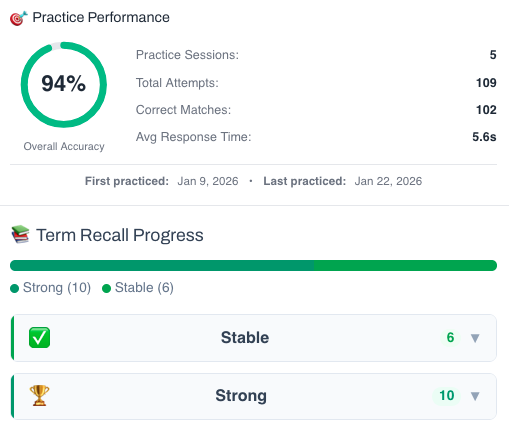
This isn’t a simple quiz — it’s a fully tracked learning system. You build knowledge through recognition, then recall, and your progress feeds directly into the Integrated Practice Bar (Writing tasks, AI Chat, and more).
- Practice sessions, accuracy, and response-time tracking
- Term strength levels (Learning → Stable → Strong)
- Personal progress history for each unit
This feature is available to YSP members.
Explore Membership Benefits🎮 Main Practice 2 – Vocabulary & Grammar Practice
Member-Exclusive Practice Bar
Access a wide range of integrated practice for this unit — from Vocabulary and Grammar activities to AI-curated Writing tasks and Thematic Chat practice.
This feature is available to YSP members.
Explore Membership Benefits🎮 Extra Practice Games
Section 1 – Fill in the Gaps
Passive Reporting Forms – Vocabulary Practice 1
Member-Exclusive Cloze Test
Fill in the gaps to complete authentic passages and reinforce your vocabulary in context.
This feature is available to YSP members.
Explore Membership BenefitsSection 2 – Fill in the Gaps
Passive Reporting Forms – Vocabulary Practice 2
Member-Exclusive Cloze Test
Fill in the gaps to complete authentic passages and reinforce your vocabulary in context.
This feature is available to YSP members.
Explore Membership BenefitsSentence Scrambler
Passive 101 – Sentence Scramble
Member-Exclusive Sentence Builder
Reconstruct scrambled sentences to practice word order and develop your grammar intuition.
This feature is available to YSP members.
Explore Membership Benefits