Procedures at Work: Language, Rules, and Compliance
Core PathWay
1 Section 1. What Is a Procedure — and Why Does It Matter?
Every workplace has rules. Some are written down. Some are very strict. All of them exist for a reason.
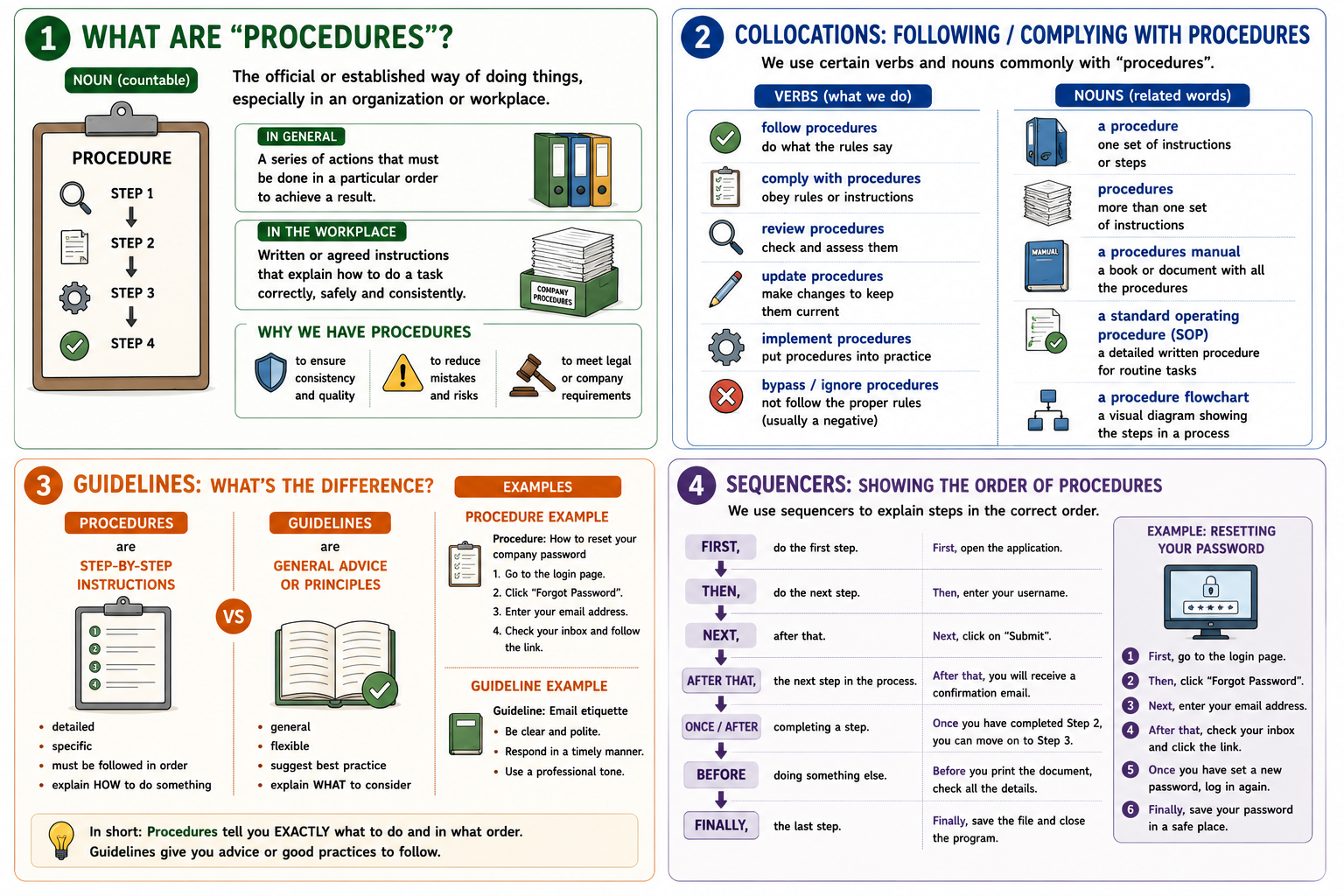
A procedure is the official or standard way to do something. It tells you what to do and how to do it. A process is bigger — it is the full series of stages from beginning to end. Think of the process as the journey, and the procedure as the map for one part of that journey.
Some procedures are so important that they become a formal written document. We call this an SOP — a Standard Operating Procedure. In technical, medical, or safety contexts, you may also hear the word protocol. A protocol is stricter than a procedure. It leaves no room for personal judgment.
Not all rules are this strict. Guidelines are advice or recommended practice. They are less strict than a procedure — you should follow them, but there is sometimes some flexibility. Behind all of these sits the policy: the general rule or principle that explains why the procedure exists.
💬 Here is a short conversation between two colleagues. Alex works in Airport Safety. Sam works in Procurement and Tenders.
—
Alex: “We had an audit last week. The inspector wanted to see that we follow the safety protocol for every single check — no shortcuts.”
Sam: “I understand that completely. In procurement, we have a strict SOP for evaluating tenders. If we don’t follow it, the whole process can be challenged.”
Alex: “Exactly. The policy is clear: safety first. The procedure is how we make that policy real.”
Sam: “And if someone doesn’t follow the guidelines, it can create serious problems — even legal ones.”
Alex: “Right. A procedure isn’t just bureaucracy. It protects everyone.”
—
🗣️ Discussion starter: Do you follow a procedure or SOP in your work? What happens if someone doesn’t follow it?
2 Section 2. Grammar Focus: Present Simple and Imperative for Procedures
When we write or talk about procedures, we use two grammar forms more than any others. These are the present simple and the imperative. Let’s look at both — and at the words we use to show the order of steps.
Focus
- Present Simple: used to describe what a procedure does or requires
- Imperative: used to give instructions — telling someone what to do
- Simple sequencing words: first, then, next, finally
- Advanced sequencing: before + -ing, after + -ing
Rules
- PRESENT SIMPLE: Use subject + base verb (+ -s for he/she/it). This form describes facts, rules, and regular actions. We use it to explain what a procedure involves or what a policy requires. Example pattern: ‘The SOP requires staff to sign the form.’
- IMPERATIVE: Use the base verb with NO subject. This form gives direct instructions. We use it in written procedures, SOPs, and step-by-step guides. Example pattern: ‘Sign the form. Submit the report. Check the records.’
- SIMPLE SEQUENCING: Use ‘first’, ‘then’, ‘next’, and ‘finally’ to show the order of steps. These words come at the start of a sentence or clause. Example: ‘First, review the documentation. Then, inspect the records.’
- ADVANCED SEQUENCING with before/after + -ing: Use ‘before’ or ‘after’ followed by a verb in the -ing form to connect two actions. This is more compact and sounds more professional. Example: ‘Before submitting the report, cross-check the information.’ / ‘After validating the data, update the record.’
Examples
- Present Simple: ‘The workflow requires every team member to track progress at each stage.’ | Imperative: ‘Track progress at each stage.’
- Simple sequencing: ‘First, review the documentation. Next, inspect the records. Then, flag any issues. Finally, submit your report.’
- Advanced sequencing: ‘Before escalating an issue, document it clearly.’ / ‘After correcting an error, update the record immediately.’
Common mistake
3 Section 3. The Right Order Matters
Jordan and Chris both work at a large international airport. Jordan is a Safety Compliance Officer. Chris is a new member of the team. Today, Chris is learning the correct sequence for handling a safety report.
“The order is everything,” Jordan said. “If you get the steps wrong, you can breach a procedure — and that creates serious problems.”
Chris nodded. “OK, so where do we start?”
“First, review the documentation. Make sure you have all the relevant forms. Then inspect the records from the previous shift. You need to cross-check the information before you do anything else.”
“And if I find something wrong?”
“If you identify an error, you correct an error immediately and update the record. If you identify a gap — something missing — you need to document the issue and flag an issue to your supervisor.”
“What about delays?”
“If you identify a delay in the process, you report an issue straight away. Don’t wait. If the problem is serious, you may need to escalate an issue to senior management.”
Chris looked at the checklist. “And all of this helps us meet compliance standards?”
“Exactly,” Jordan said. “We need to maintain an audit trail — a clear record of every action we take. That way, we can provide evidence that we followed the correct steps. If we fail to comply with the protocol, we are responsible. The records protect us.”
“So the sequence isn’t just procedure,” Chris said. “It’s protection.”
Jordan smiled. “Now you understand.”
4 Section 4. Grammar Focus: Must and Have To
When we talk about rules and procedures, we often use must and have to. They can look similar, but they are not the same. Understanding the difference will help you sound natural and professional.
Focus
- Must: a modal verb — formal, often used in written rules and official documents
- Have to: more conversational — common in spoken English and questions
- You must / You have to: both mean there is a rule and there is no choice
- Modal verb grammar rules for must: no -s, no past form, no ‘to’ after it
Rules
- MUST is a modal verb. It follows modal verb grammar: (1) No -s in the third person — ‘She must follow the SOP’ NOT ‘She musts follow’. (2) No past form — use ‘had to’ for past meaning. (3) Always follow with a base verb (no ‘to’) — ‘You must validate the data’ NOT ‘You must to validate’.
- HAVE TO is NOT a modal verb. It behaves like a regular verb: (1) Third person -s: ‘He has to report the issue.’ (2) Past form: ‘They had to escalate the issue yesterday.’ (3) Questions use DO/DOES: ‘Do we have to follow this protocol?’ This is the natural, conversational form for questions.
- WHY NOT ‘Must we…?’ in questions: In modern English, question forms with ‘must’ sound very formal or old-fashioned. In everyday professional speech, we prefer ‘Do we have to…?’ or ‘Does she have to…?’
- YOU MUST vs YOU HAVE TO: When the subject is ‘you’, both forms are roughly equivalent. Both mean: there is a rule, and you do not have a choice. Example: ‘You must maintain an audit trail.’ = ‘You have to maintain an audit trail.’ — same meaning, slightly different register.
- ALSO USEFUL — TO BE REQUIRED TO: This is a more formal, passive-style structure often seen in official documents. Example: ‘All staff are required to ensure compliance.’ This is common in written SOPs and policies.
Examples
- Must (formal/written): ‘All operators must validate the data before submitting the report.’ | Have to (spoken/conversational): ‘Do we have to cross-check the information every time?’
- ‘You must document the issue.’ (formal rule, written procedure) = ‘You have to document the issue.’ (conversational, same meaning) — both are correct, choose based on context.
- Past form: NOT ‘She must report it yesterday’ — CORRECT: ‘She had to report it yesterday.’ | Required to: ‘Staff are required to maintain an audit trail at all times.’
Common mistake
5 Section 5. Writing Task: An Email About a Procedure
Now practise the vocabulary and grammar from this page. Write a short professional email about a procedure you followed — or one you need to explain to a colleague.
6 Section 6. Page Recap: What You Have Covered
Well done — you have covered a lot of essential ground on this page.
You now know the key words in the procedures family: procedure, process, step, workflow, SOP, protocol, guidelines, and policy. Each word has a slightly different meaning, and choosing the right one shows professional precision.
You have also seen the grammar we use to talk about procedures. The present simple describes what a procedure requires. The imperative gives direct instructions. Sequencing words — first, then, next, finally, before + -ing, after + -ing — help you show the correct order of steps.
The situational story showed you the vocabulary of compliance in action: how to flag an issue, report an issue, escalate an issue, correct an error, validate the data, and maintain an audit trail.
Finally, you reviewed must and have to — two forms that look similar but behave differently. Remember: for questions, use Do you have to…? not Must you…?
This is page 1 of 5. The next pages will go deeper into this vocabulary and give you more opportunities to practise in context. Keep going!
Member-Exclusive Practice Bar
Access a wide range of integrated practice for this unit — from Vocabulary and Grammar activities to AI-curated Writing tasks and Thematic Chat practice.
This feature is available to YSP members.
Explore Membership BenefitsMember-Exclusive Vocabulary Review & Acquisition System
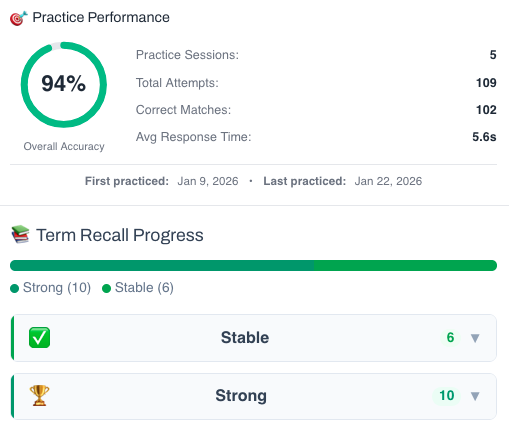
This isn’t a simple quiz — it’s a fully tracked learning system. You build knowledge through recognition, then recall, and your progress feeds directly into the Integrated Practice Bar (Writing tasks, AI Chat, and more).
- Practice sessions, accuracy, and response-time tracking
- Term strength levels (Learning → Stable → Strong)
- Personal progress history for each unit
This feature is available to YSP members.
Explore Membership Benefits🎮 Practice Games
Sentence Scrambler
Procedures [1] – B1 – Sentence Scramble
Member-Exclusive Sentence Builder
Reconstruct scrambled sentences to practice word order and develop your grammar intuition.
This feature is available to YSP members.
Explore Membership Benefits