Present Perfect Continuous: Seeing the Evidence
Core PathWay1 Section 1. Reading the Evidence Around You
You already know how to handle sentences like ‘I’ve been working since 9am’ or ‘I’ve been playing tennis a lot recently.’ That’s the Present Perfect Continuous doing what it does best — connecting an ongoing action to the present moment. Now we’re going to unlock a second, equally important use: the ‘I can SEE or GUESS what has been happening’ use.
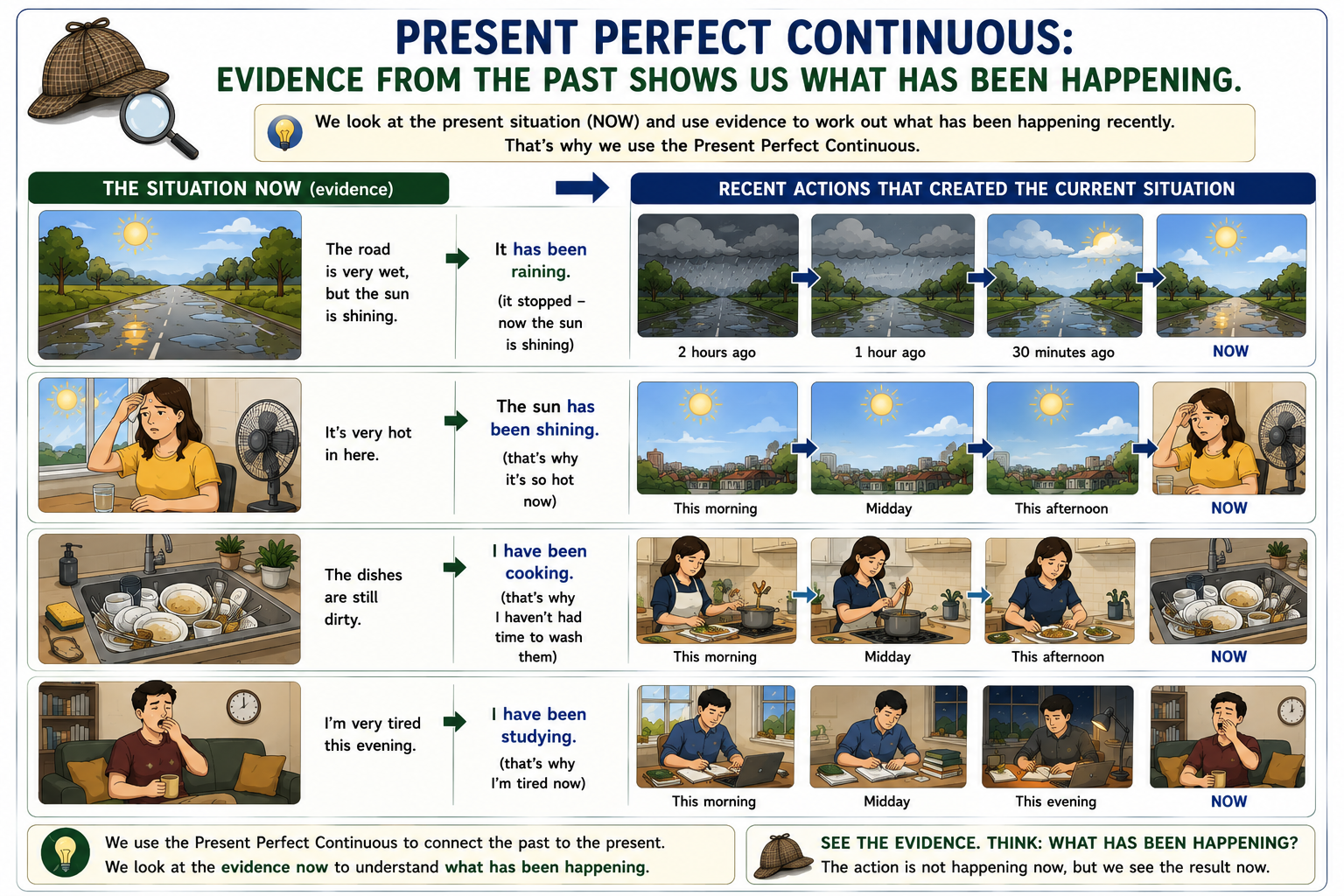
Imagine this. You wake up on a summer morning and look out of the window. The sky is completely blue — not a cloud in sight. But the road below is soaking wet. There are puddles on the pavement. The parked cars are dripping. Something happened while you were asleep. What do you say?
You can’t simply say ‘It rained’ — past simple describes a single, completed event at a known point in time, and you don’t know when it happened. You could try ‘It was raining an hour ago’ — but that’s impossible, because you were asleep an hour ago and you have no direct evidence for that specific time. What about ‘It has rained’? That’s closer, but present perfect simple gives us one flat, finished action — and the sheer volume of water on the road suggests something more sustained than a single shower.
So what do native speakers instinctively reach for? It has been raining. The action — the rain — may well have stopped. But its effects are everywhere. The wetness IS the evidence. The present perfect continuous is the form English uses when you can see or reasonably deduce the result of a recent, sustained activity.
Here’s a second example. You go to the kitchen in the morning. The milk bottle that was completely full when you went to bed is now almost empty. You didn’t drink it. So what happened? Your family has been drinking milk — before you woke up, while you were asleep. You didn’t witness the action directly, but the visible evidence makes the conclusion entirely reasonable. Milk doesn’t evaporate in fridges. It doesn’t drink itself. The empty bottle tells the whole story.
2 Section 2. The Grammar at a Glance
This use of the Present Perfect Continuous has one key idea at its heart: the action may be finished, but its effects are still visible right now. You are not reporting a past event — you are explaining the present situation by pointing to what has been happening. Think of it as detective grammar: you see the result, and the Present Perfect Continuous names the cause.
Focus
- Use the Present Perfect Continuous when you can SEE or REASONABLY DEDUCE the result of a recent activity.
- The action itself may have finished — but its effects are present and visible NOW.
- This form is common in spoken English for making observations and deductions.
- It often answers the question: ‘Why does this situation look the way it does?’
Rules
- Form: subject + have/has + been + verb-ing
- Use this form when present evidence points to a recent, sustained or repeated activity.
- You do not need to know exactly when the activity happened — only that its effects are visible now.
- Questions in this form often begin with ‘Have you been…?’ when you notice something about a person’s appearance or state.
Examples
- The road is completely wet — it has been raining.
- You look exhausted. Have you been sleeping properly?
- The kitchen smells amazing. Has someone been baking?
Common mistake
2 Section 2. Ten More Examples to Notice
Here are ten natural examples of this use. In every case, there is present evidence — something you can see, smell, hear, or logically deduce — that points to a recent, sustained activity.
1. ‘You look really tanned! Have you been sunbathing?‘
2. ‘The grass is soaking. It has been raining heavily.’
3. ‘Your eyes are red. Have you been crying?‘
4. ‘The dog is exhausted and muddy. Someone has been walking her for hours.’
5. ‘There are empty coffee cups everywhere. They have been working through the night.’
6. ‘You’re out of breath! Have you been running?‘
7. ‘The fridge is nearly empty. The kids have been eating everything again.’
8. ‘The office smells of paint. The maintenance team has been decorating.’
9. ‘Your hands are covered in flour. Have you been baking?‘
10. ‘The road is blocked and there are police everywhere. There has been an accident — and judging by the traffic, it has been causing delays for hours.’
Notice the pattern every time: you see the present result first, and the Present Perfect Continuous names the recent cause. The action may be completely finished — the rain has stopped, the baking is done — but the effects are still here, right in front of you.
3 Section 3. Writing Task: Reading Between the Lines
Now it’s your turn to put this into practice. Use the Present Perfect Continuous to describe what you can see — and deduce what has been happening.
Use ALL of the following observations as the basis for your deductions:
• Sam looked very fit and toned
• Sam had a deep tan
• Sam seemed tired but happy
• Sam’s hands were rough and calloused
• Sam mentioned feeling much calmer and less stressed
Start your email with: ‘You’ll never guess who I ran into yesterday…’
For each observation, use the Present Perfect Continuous to explain what you think Sam has been doing. For example: ‘He looked really fit — I think he has been working out a lot.’ Make sure you use the form ‘has/have been + verb-ing’ at least four times.
4 Recap: The Evidence is Right in Front of You
Here is the core idea from this page, stated as simply as possible: when you can SEE or REASONABLY DEDUCE the result of a recent activity, the Present Perfect Continuous is the natural form to use. The action itself may have stopped — the rain, the baking, the workout — but its effects are still present. That connection between a past activity and its visible present result is exactly what this form expresses.
Remember the two key tests before you use it: Is there visible evidence in the present? And does that evidence point to a sustained or repeated activity in the recent past? If the answer to both is yes, the Present Perfect Continuous is almost certainly the right choice. In the next page, we will look at further uses that build on this foundation.
Member-Exclusive Practice Bar
Access a wide range of integrated practice for this unit — from Vocabulary and Grammar activities to AI-curated Writing tasks and Thematic Chat practice.
This feature is available to YSP members.
Explore Membership BenefitsMember-Exclusive Vocabulary Review & Acquisition System
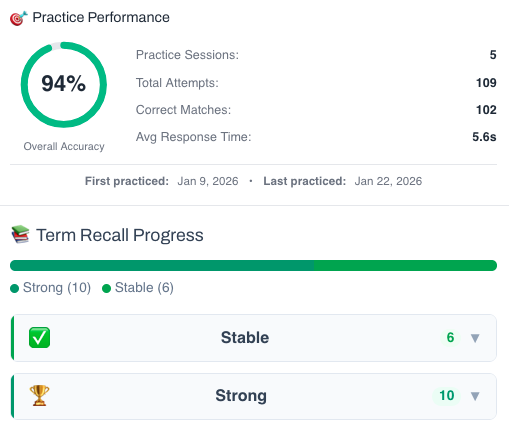
This isn’t a simple quiz — it’s a fully tracked learning system. You build knowledge through recognition, then recall, and your progress feeds directly into the Integrated Practice Bar (Writing tasks, AI Chat, and more).
- Practice sessions, accuracy, and response-time tracking
- Term strength levels (Learning → Stable → Strong)
- Personal progress history for each unit
This feature is available to YSP members.
Explore Membership Benefits