Stating & Supporting Your Opinions: Advanced Expression
Core PathWay
1 🌐 Introduction
When you express opinions in English, using the same basic phrases repeatedly can make your speech sound repetitive and less convincing. Native speakers use a rich variety of expressions to introduce opinions, support them with different types of evidence, and soften statements when appropriate. Understanding this semantic field – the network of words and phrases related to opinion-giving – is essential for fluency. By exploring how these expressions work together, you’ll develop the ability to sound more natural, persuasive, and sophisticated in discussions. This lesson takes you beyond simple patterns like ‘I think’ and ‘because’ into the diverse language that makes opinion discourse engaging and credible.
💬 Dialogue 1: Discussing Weekend Plans
Two friends, Sophie and Marco, are chatting over coffee on Thursday evening, trying to decide what to do on Saturday. They’re looking at their phones and checking the weather forecast.
2 📋 Lexical Categories
Category 1: Advanced Opinion Phrases (Informal Register)
the way I see it – how something appears to you; your view of a situation
The way I see it, we need to start the project sooner rather than later.
if you ask me – used to introduce your personal opinion, often when you want to be direct
If you ask me, that restaurant is overpriced for the quality they offer.
as far as I’m concerned – from your point of view; what matters to you
As far as I’m concerned, the most important thing is customer satisfaction.
to my mind – in your opinion; how you think about something
To my mind, the original version of the film was better than the remake.
it seems to me that – something appears to be true based on what you observe
It seems to me that more people are working from home these days.
I’d say that – you would express this as your opinion
I’d say that learning a language takes at least two years of regular practice.
I reckon – informal way to say you think something (common in British English)
I reckon we’ll finish the work by Friday if everyone helps.
I’m convinced that – you strongly believe something is true
I’m convinced that regular exercise improves mental health as well as physical health.
I’m of the opinion that – slightly formal way to state your view
I’m of the opinion that schools should teach financial literacy to all students.
I’d argue that – you would make this point in a debate or discussion
I’d argue that social media has changed communication more than any other technology.
I tend to think that – this is usually your opinion; your general view
I tend to think that people work better when they have flexible schedules.
I’m inclined to believe – you feel pulled toward thinking something is true
I’m inclined to believe that climate change is the biggest challenge we face.
Category 2: Supporting Your Opinion – Evidence & Reasoning
based on – using something as the reason or foundation for your opinion
Based on the sales figures, I think we should expand into new markets.
given that – taking into account this fact; considering this information
Given that most customers prefer online shopping, we need a better website.
considering that – when you think about this fact
Considering that she only started learning last year, her English is excellent.
the evidence suggests – information and facts point to this conclusion
The evidence suggests that eating less sugar improves overall health.
research shows that – studies and investigations have found this to be true
Research shows that children learn languages faster than adults.
according to – based on what someone or something says
According to the weather forecast, it’s going to rain all weekend.
studies indicate that – research points toward this conclusion
Studies indicate that people who read regularly have better memory skills.
in my experience – based on things that have happened to you personally
In my experience, the best way to learn vocabulary is through reading.
from what I’ve seen – based on things you have observed yourself
From what I’ve seen, most successful businesses focus on customer service.
to give you an example – you will now provide a specific case to illustrate your point
To give you an example, my friend lost 10 kilos just by walking every day.
take [something] for instance – consider this particular case as an example
Take Sweden for instance – they have excellent public transport systems.
this is supported by – evidence or facts back up this claim
This is supported by recent data from the health department.
you can see this in – this example shows what I’m talking about
You can see this in countries where education is free – literacy rates are higher.
it’s worth noting that – this is an important point to mention
It’s worth noting that not everyone has access to the internet.
Category 3: Hedging – Softening Your Opinion
I suppose – you think something is probably true, but you’re not completely certain
I suppose you’re right about needing to save more money.
I guess – informal way to say you think something, showing you’re not totally sure
I guess we could try the new restaurant, though I’ve heard mixed reviews.
sort of – to some degree; partly but not completely
I sort of agree with you, but I see some problems with that approach.
kind of – similar to ‘sort of’; somewhat or in some ways
It’s kind of expensive, but the quality is really good.
to some extent – partly true; true in some ways but not completely
To some extent, I understand why people prefer online shopping.
in a way – looking at it from one perspective; partly true
In a way, working from home is more productive, but I miss seeing colleagues.
more or less – approximately; almost but not exactly
I more or less agree with the proposal, though I’d change a few details.
arguably – it can be argued; some people would say this is true
This is arguably the best restaurant in the city.
I could be wrong but – you might not be correct; you’re not completely certain
I could be wrong, but I think the meeting was scheduled for Tuesday.
I might be mistaken but – perhaps you don’t have the right information
I might be mistaken, but didn’t you say you were vegetarian?
it’s possible that – this could be true; there’s a chance
It’s possible that prices will increase next year.
it could be argued that – someone could make this point; this view has some validity
*It could be argued that technology makes us less social.*
some people might say – this is one view that exists (often before disagreeing)
Some people might say that grammar isn’t important, but I disagree.
there’s a case for – there are good reasons to support this view
There’s a case for starting work later in the morning.
Category 4: Conversation Management & Honesty Markers
to be fair – being honest and balanced; acknowledging another side
To be fair, the service was slow, but the food was delicious.
to put it another way – saying the same thing using different words
To put it another way, we need to increase income or reduce costs.
if I’m being honest – when you want to tell the truth, even if it’s difficult
If I’m being honest, I didn’t enjoy the film as much as I expected.
to be honest with you – introducing a frank or direct opinion
To be honest with you, I think you should look for a different job.
frankly speaking – speaking in an open and honest way
Frankly speaking, the project has serious problems that we need to address.
to be perfectly frank – being completely honest and direct
To be perfectly frank, I don’t think this plan will work.
💬 Dialogue 2: Work Meeting Discussion
Alex and Jordan are product managers at a tech company, sitting in a meeting room discussing the launch timeline for their new mobile app. They have different views on when to release it to customers.
3 🔗 Common Collocations & Idioms
see eye to eye – to agree completely with someone about something
My manager and I don’t always see eye to eye on the best approach to customer complaints.
agree to disagree – to accept that you have different opinions and stop arguing
We talked for an hour but couldn’t reach agreement, so we decided to agree to disagree.
take something with a pinch of salt – to not completely believe something; to be skeptical
He tends to exaggerate his stories, so I take what he says with a pinch of salt.
play devil’s advocate – to argue against an idea to test it, even if you don’t really disagree
I actually support your proposal, but let me play devil’s advocate for a moment – what if customers don’t like the changes?
on the fence – unable to decide; not having a clear opinion yet
I’m still on the fence about whether to accept the job offer or stay in my current position.
💬 Dialogue 3: Debating a Social Issue
Sam and Chris are university friends having coffee in the student café. They’re discussing an article they both read about social media’s impact on mental health. They have different perspectives but want to understand each other’s views.
4 👀 Grammar Spotlight
When expressing opinions, several grammar structures help you sound natural and sophisticated. That-clauses follow many opinion verbs and phrases: I believe that technology improves education or It seems to me that prices are rising. Notice that in informal speech, ‘that’ is often dropped. Gerunds and infinitives appear after certain opinion phrases: I’m inclined to believe the report (infinitive) versus I think taxing smokers is a good idea (gerund after I think). For hedging, conditional structures soften statements: It could be argued that social media has negative effects. The passive voice makes opinions sound more objective: It’s worth noting that this view is supported by several studies. Finally, the present perfect connects past experience to present opinions: From what I’ve seen, this approach works well or In my experience, customers have preferred the original design.
5 😊 Expressive Range
Mastering this rich vocabulary transforms how you participate in discussions and debates. Instead of repeating ‘I think’ constantly, you can choose from a variety of opinion phrases that match your level of certainty and the formality of the situation. When supporting your views, you’ll sound more convincing by citing evidence, sharing personal experience, or referring to research rather than simply saying ‘because.’ Hedging language helps you sound thoughtful rather than aggressive, making others more receptive to your ideas. The fixed expressions and idioms add natural color to your speech. Together, these elements give you the flexibility to express nuanced opinions, acknowledge complexity, and engage in sophisticated discussions where you sound confident yet open-minded – exactly how effective communicators operate in English.
🎮 Practice
Use the VAS to build solid recognition and recall of the terms below.
✔ Every correct Match = +1 point
✔ Every correct Recall = +2 points
🎓 Reach 5 points with good accuracy and the term is automatically promoted to your Personal Dictionary.
Incorrect answers lower accuracy, meaning more correct Matches or Recalls may be needed to reach promotion.
Member-Exclusive Vocabulary Review & Acquisition System
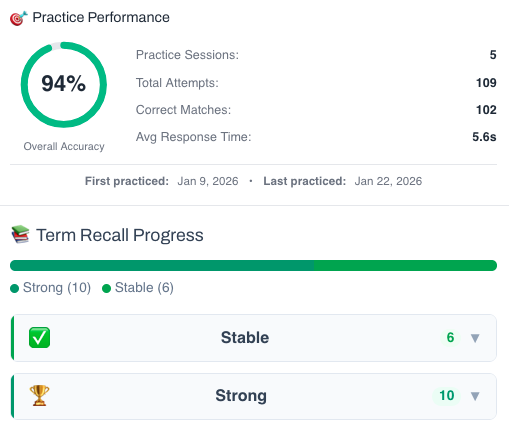
This isn’t a simple quiz — it’s a fully tracked learning system. You build knowledge through recognition, then recall, and your progress feeds directly into the Integrated Practice Bar (Writing tasks, AI Chat, and more).
- Practice sessions, accuracy, and response-time tracking
- Term strength levels (Learning → Stable → Strong)
- Personal progress history for each unit
This feature is available to YSP members.
Explore Membership BenefitsMember-Exclusive Practice Bar
Access a wide range of integrated practice for this unit — from Vocabulary and Grammar activities to AI-curated Writing tasks and Thematic Chat practice.
This feature is available to YSP members.
Explore Membership BenefitsMember-Exclusive Sentence Builder
Reconstruct scrambled sentences to practice word order and develop your grammar intuition.
This feature is available to YSP members.
Explore Membership Benefits