Mustn't vs Don't Have To: Two Very Different Things
Core PathWay
1 Section 1. From 'Have To' to 'Don't Have To' — and Where 'Mustn't' Fits In
On the last page, we looked at have to. Remember: ‘have to’ means an external rule or situation forces you to do something. You don’t have a choice — your free will is removed.
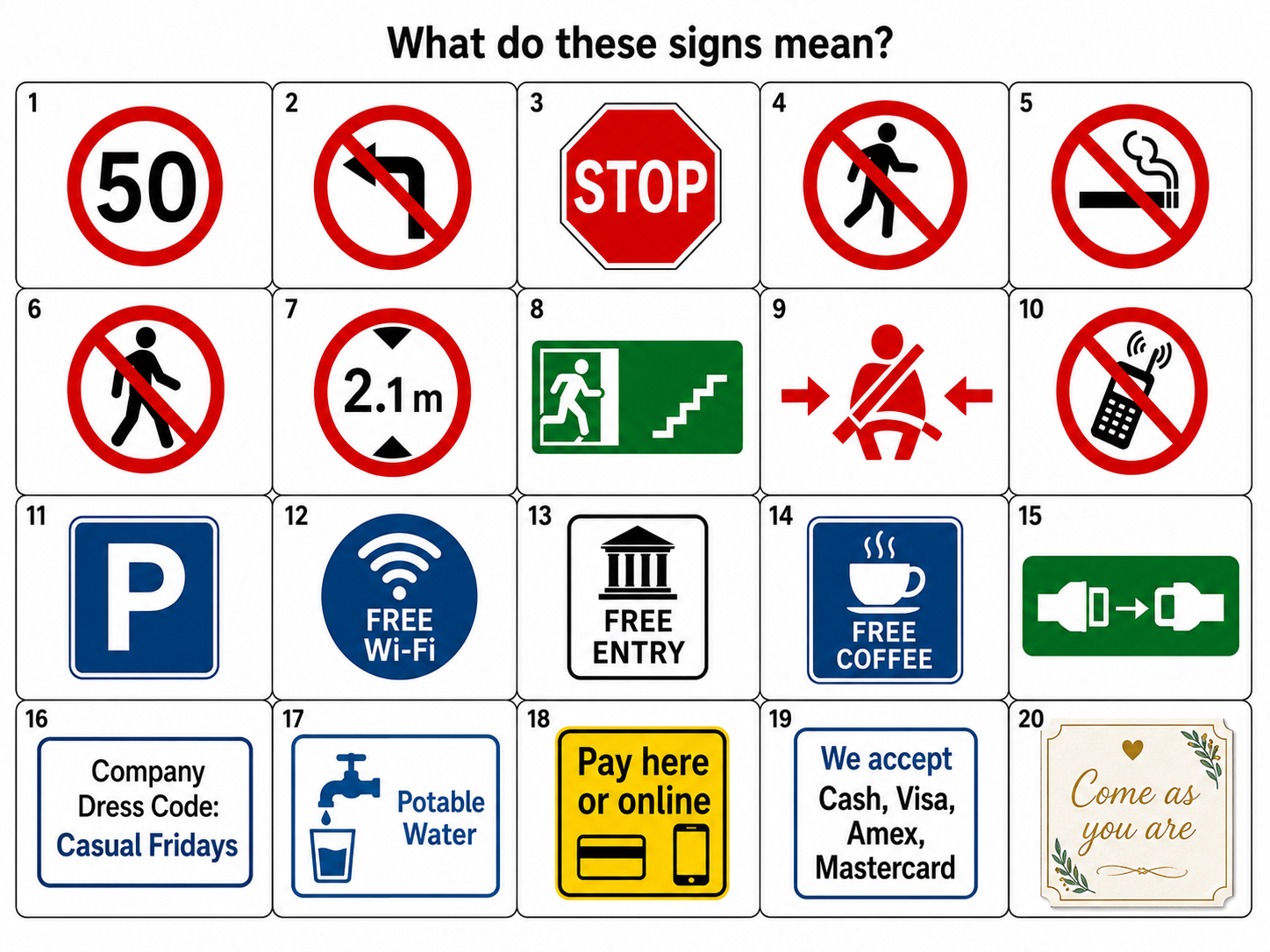
Think about an airplane. When the seatbelt sign is on, you have to fasten your seatbelt. The rule is clear. You have no choice. Or think about a company dress code — if the policy says ‘wear formal clothes’, you have to follow it, whether you like it or not.
Now here is the key point for this page: ‘don’t have to’ is the exact opposite. It means there is NO external rule or situation forcing you. When the seatbelt sign goes off, you don’t have to keep your seatbelt fastened — but you can if you want. The choice is yours. Your free will is restored.
But what about mustn’t? This is where many learners make a mistake. ‘Mustn’t’ is NOT the opposite of ‘must’. It has two specific meanings. First, it can mean something is prohibited — a rule, law, or regulation says you cannot do it. For example: ‘You mustn’t use your phone while driving.’ Second, it can mean something is strongly inadvisable — there is no law against it, but the consequences are serious. For example: ‘You mustn’t pour water into a laptop.’ No law stops you, but the result will be very bad. So ‘mustn’t’ is about danger or rules — not about choice.
2 Section 2. Deep Dive — Don't Have To
Let’s look closely at don’t have to. This expression means there is no external necessity. Nobody is forcing you. You have a choice. It is the direct opposite of ‘have to’.
Here is something very useful to know. ‘Have to’ is a semi-modal verb. This means it comes from the verb ‘have’, not from a pure modal verb like ‘must’. Because of this, ‘have to’ — and ‘don’t have to’ — can be used in any tense or form. This is very different from ‘must’, which only works in the present. You can say ‘I didn’t have to go’ or ‘She won’t have to wait’ — but you cannot do this with ‘must’. This flexibility makes ‘have to’ extremely useful.
You can also use not having to as a noun phrase (a gerund) at the start of a sentence. For example: ‘Not having to start at 9am is one of the benefits of my job.’ This sounds very natural in spoken and written English.
‘Don’t need to‘ is a very close parallel. In most everyday situations, ‘don’t have to’ and ‘don’t need to’ mean the same thing — there is no obligation. For example, ‘You don’t have to book in advance’ and ‘You don’t need to book in advance’ carry the same message. The difference is very small: ‘don’t need to’ can sometimes focus more on practical necessity, while ‘don’t have to’ focuses more on the absence of a rule or obligation. For most learners at B1 level, the two are interchangeable in everyday use.
don't have to
- I like not having to wear a uniform — it's one of the best things about my job.
- Not having to commute every day saves me two hours.
don't need to
- You don't need to book a table — the restaurant is never full on weekdays.
- She didn't need to stay late because the project was already finished.
3 Section 3. Deep Dive — Mustn't
Now let’s look carefully at mustn’t. This word has two clear meanings, and it is important to know both of them.
The first meaning is prohibition — something is not allowed. A rule, law, or regulation makes it forbidden. The second meaning is strong inadvisability — there is no official rule, but the action will almost certainly cause serious harm or a very bad result. Notice that ‘mustn’t’ is stronger than ‘shouldn’t‘. If something is merely inadvisable — a bit unwise but not dangerous — we use ‘shouldn’t’. If the consequences are serious or certain, we use ‘mustn’t’. Think of it as a scale: ‘shouldn’t’ = not a great idea; ‘mustn’t’ = really do not do this.
mustn't (prohibition)
- You mustn't use your phone in the examination room — it is strictly forbidden.
- Passengers mustn't leave their bags unattended in the airport.
mustn't (strongly inadvisable)
- You mustn't pour water into a laptop — there is no law against it, but you will destroy the machine.
- You mustn't ignore chest pain — it could be a sign of something serious.
4 Section 4. The New Job — A Conversation Between Two Colleagues
Alex had just started a new job at a busy marketing agency. On her first morning, her colleague Sam offered to show her around and explain how things worked.
‘So,’ said Sam, ‘the first thing to know is that you mustn’t share any client information outside the office. It’s in the contract — it’s strictly forbidden. We work with some very big brands, and confidentiality is everything here.’
‘Understood,’ said Alex. ‘What about the dress code? My last company had a strict uniform policy.’
Sam smiled. ‘You don’t have to wear formal clothes here. Most people wear whatever they feel comfortable in. It’s completely your choice.’
‘That’s a relief,’ said Alex. ‘I like not having to think about that every morning.’
‘There’s one more thing,’ Sam added. ‘You mustn’t leave your laptop unlocked when you step away from your desk — even for a minute. It’s not a written rule exactly, but the IT team will be very unhappy if client data is exposed. Trust me, you really don’t want that.’
Alex nodded. ‘And meetings? Do I have to attend all of them?’
‘No,’ said Sam. ‘You don’t have to go to the weekly strategy meeting unless your project is on the agenda. It’s optional for most of the team. Not having to sit through a two-hour meeting every Monday is honestly one of the best things about this department.’
Alex laughed. She was starting to feel much better about her new job.
5 Section 5. Your Turn — Write a Workplace Email
Now it’s your turn to use what you have learned. Write a short email to a new colleague about your workplace. Use mustn’t and don’t have to to explain the rules and the freedoms in your job.
6 Section 6. Recap — What You Have Learned
Let’s bring everything together. Here are the three key ideas from this page.
First: ‘don’t have to’ is the direct opposite of ‘have to’. ‘Have to’ removes your choice — an external rule or situation forces you. ‘Don’t have to’ gives your choice back. There is no rule. You decide.
Second: ‘mustn’t’ is NOT the opposite of ‘must’. It has two meanings: something is prohibited (a rule or law forbids it), or something is strongly inadvisable (no law, but serious consequences). Both meanings carry a strong warning. Note that ‘can’t’ is also used for prohibition in everyday speech — ‘you can’t do that here’ and ‘you mustn’t do that here’ often mean the same thing.
Third: watch the difference between ‘mustn’t’ and ‘shouldn’t’. ‘Shouldn’t’ means something is merely inadvisable — not a great idea. ‘Mustn’t’ means the consequences are serious or certain — really, do not do this.
And remember: because ‘have to’ is a semi-modal, you can use ‘don’t have to’ in any tense — past, future, or as a gerund. ‘Not having to commute every day is a real benefit.’ You can’t do that with ‘must’ — and that’s what makes ‘have to’ so flexible and so useful.
Member-Exclusive Practice Bar
Access a wide range of integrated practice for this unit — from Vocabulary and Grammar activities to AI-curated Writing tasks and Thematic Chat practice.
This feature is available to YSP members.
Explore Membership BenefitsMember-Exclusive Vocabulary Review & Acquisition System
This isn’t a simple quiz — it’s a fully tracked learning system. You build knowledge through recognition, then recall, and your progress feeds directly into the Integrated Practice Bar (Writing tasks, AI Chat, and more).
- Practice sessions, accuracy, and response-time tracking
- Term strength levels (Learning → Stable → Strong)
- Personal progress history for each unit
This feature is available to YSP members.
Explore Membership Benefits🎮 Practice Games
Sentence Scrambler
Don’t have to | Mustn’t – Sentence Scramble
Member-Exclusive Sentence Builder
Reconstruct scrambled sentences to practice word order and develop your grammar intuition.
This feature is available to YSP members.
Explore Membership BenefitsSpeaking Practice in Class with your Trainer