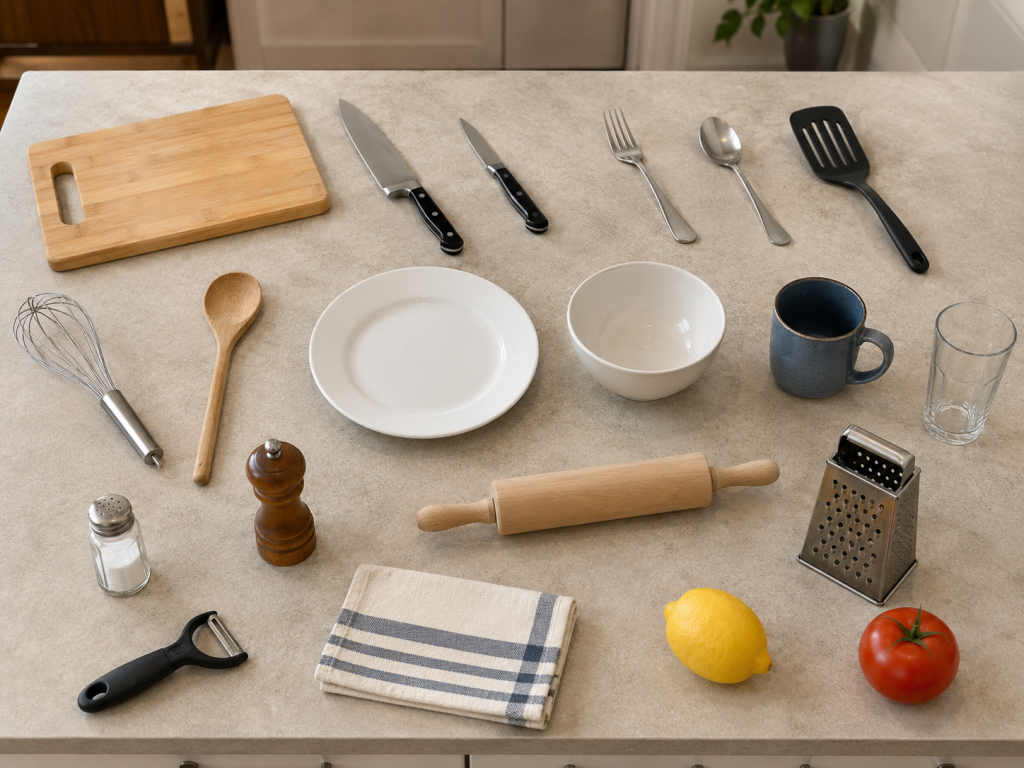
This image teaches kitchen vocabulary — the names, uses, and descriptions of common kitchen tools, utensils, and tableware at A2 level.
Learning objectives:
• Name common kitchen tools and utensils in English
• Describe objects using adjectives for colour, size, and material
• Use prepositions of place to say where objects are
• Use 'there is' and 'there are' to describe a scene
• Use 'might' and 'could' to speculate about purpose and use
← Previous
Page 3 of 1
Next (Coming Soon)
What Can You See?
Look at the photograph. You will see many kitchen tools. First, study the key words below. Then listen to the description and do the tasks.
📚 Key Vocabulary
Before you listen, study these words. You will hear them in the description.
worksurface — the flat area where you prepare foodcutting board — a flat board for cutting food onchef's knife — a big, wide knife for cookingparing knife — a small knife for peeling or cuttingwhisk — a wire tool for mixing eggs or creamspatula — a flat tool for lifting or turning foodrolling pin — a round stick for flattening doughbox grater — a metal tool with holes for grating foodpepper mill — a small device that grinds peppersalt shaker — a small container that holds saltvegetable peeler — a tool for removing skin from vegetableskitchen towel — a cloth used to dry hands or dishes
🎧 Listen
Before: Look at the photograph for 30 seconds and notice the different tools you can see.
While listening: Listen for the key words and notice where each item is on the worksurface.
After: Read the text on screen and find each key word in the description.
📖 1 · Short description 🎧
A light grey stone-effect kitchen worksurface holds a large number of individual kitchen objects. The objects include cutting tools, cooking utensils, tableware, and two food items. Everything is placed separately and spread across the surface. No food preparation is happening. In the background, white kitchen cabinets and a green potted plant are partly visible. The image is taken from above, so all objects are easy to see.
📖 2 · Full description 🎧
A light grey stone-effect kitchen worksurface holds a large number of individual kitchen objects. The objects include cutting tools, cooking utensils, tableware, and two food items. Everything is placed separately and spread across the surface. No food preparation is happening. In the background, white kitchen cabinets and a green potted plant are partly visible. The image is taken from above, so all objects are easy to see.
📖 3 · The story behind the picture 🎧
Someone is probably getting ready to cook. They put all their tools on the worksurface before they started. The lemon and tomato suggest a simple recipe — maybe a salad or a pasta dish. After cooking, they will use the kitchen towel to dry their hands and the plate and bowl to serve the food.
📝 Short description
A light grey stone-effect kitchen worksurface holds a large number of individual kitchen objects. The objects include cutting tools, cooking utensils, tableware, and two food items. Everything is placed separately and spread across the surface. No food preparation is happening. In the background, white kitchen cabinets and a green potted plant are partly visible. The image is taken from above, so all objects are easy to see.
📖 Full description
A light grey stone-effect kitchen worksurface holds a large number of individual kitchen objects. The objects include cutting tools, cooking utensils, tableware, and two food items. Everything is placed separately and spread across the surface. No food preparation is happening. In the background, white kitchen cabinets and a green potted plant are partly visible. The image is taken from above, so all objects are easy to see.
💬 The story behind the picture
Someone is probably getting ready to cook. They put all their tools on the worksurface before they started. The lemon and tomato suggest a simple recipe — maybe a salad or a pasta dish. After cooking, they will use the kitchen towel to dry their hands and the plate and bowl to serve the food.
Now it's your turn
You listened to the description and you studied the key words. Now use what you learned to complete the writing tasks below.
🖼️Task 1 · Materials and ColoursVocabulary
Choose five objects from the image and write a precise description of each one. For every object, describe its colour, material, and one other visual feature — for example, its shape, size, or finish. Use accurate adjective + noun collocations and avoid repeating the same adjectives. Write your descriptions as a short connected paragraph of around 80–100 words.
Language focus: adjective + noun collocations; colour and material vocabulary
0 words / ~90 target
~500 tokens
💡 Coaching Hints
Looking at the picture and your answer…
🔍 After you have written: compare
One possible answer:
The smooth bamboo cutting board has a warm honey-brown tone and a handled rectangular shape. Beside it, the light wooden rolling pin is cylindrical and has a natural, unfinished finish. The stainless steel box grater is four-sided and stands upright, its silver surface catching the light. In contrast, the dark wooden pepper mill is a deep brown and has the same cylindrical form. Finally, the checked cotton kitchen towel is folded flat and features a classic cream and blue pattern.
Things you could mention:
The cutting board is described as rectangular and made of bamboo.
The rolling pin is described as wooden, cylindrical, and light-coloured.
The box grater is described as stainless steel, four-sided, and standing upright.
The pepper mill is described as dark brown, wooden, and cylindrical.
The kitchen towel is described as cream and blue, checked, and made of cotton.
The wooden spoon is described as light brown, long-handled, and unfinished.
The mug is described as dark blue (navy), ceramic, and glazed.
🖼️Task 2 · Tools and Their FunctionsVocabulary
Write a connected paragraph of around 100–120 words explaining the purpose of at least five cutting, mixing, or preparing tools visible in the image. Use precise verb collocations — for example, verbs such as grate, whisk, roll out, peel, chop, or blend — and avoid repeating the same verb or sentence structure. Do not simply list the tools; explain how and why each one is used.
Language focus: function language with precise verb collocations: grate, whisk, roll out, peel, chop
0 words / ~110 target
~500 tokens
💡 Coaching Hints
Looking at the picture and your answer…
🔍 After you have written: compare
One possible answer:
Several of the tools in the image serve distinct preparation purposes. The wire whisk is designed to beat eggs or whip cream quickly and efficiently. The wooden rolling pin is used to roll out pastry or dough to a uniform thickness before baking. When it comes to harder ingredients, the stainless steel box grater allows the cook to grate cheese or firm vegetables with ease. The Y-shaped vegetable peeler is ideal for peeling the skin from fruit or root vegetables, while the large chef's knife is best suited to chopping and slicing bulkier ingredients. The smaller paring knife, by contrast, is used to trim or cut smaller, more delicate items with precision.
Things you could mention:
The whisk is used to beat or combine liquid ingredients such as eggs or cream.
The rolling pin is used to roll out dough to an even thickness.
The box grater is used to grate hard ingredients such as cheese or vegetables.
The vegetable peeler is used to peel the skin from vegetables or fruit.
The chef's knife is used to chop or slice larger ingredients.
The paring knife is used to trim or cut smaller items such as fruit.
The spatula is used to flip or lift food during cooking.
🖼️Task 3 · How Things Are Made and DisplayedGrammar
Write a paragraph of around 100–130 words describing at least six objects in the image. Focus on what each object is made of, how it is finished or decorated, and where it is positioned on the worksurface. You must use the present simple passive throughout — for example: 'is made of', 'is finished in', 'is placed', 'is displayed'. Vary the passive structures you use and try to include at least one preposition of place in each sentence.
Language focus: present simple passive with material and location phrases
0 words / ~115 target
~500 tokens
💡 Coaching Hints
Looking at the picture and your answer…
🔍 After you have written: compare
One possible answer:
The bamboo cutting board is made of a smooth, light-coloured natural material and is placed in the upper left corner of the worksurface. Nearby, the checked kitchen towel is made of cotton and is folded flat beneath the wooden rolling pin in the lower centre. The glazed ceramic mug is finished in a deep navy blue and is positioned to the right of the mixing bowl. The salt shaker is made of glass with a silver metal top and is displayed to the left of the dark wooden pepper mill. Finally, the stainless steel box grater is made of metal and is displayed upright on the lower right side of the worksurface.
Things you could mention:
The cutting board is made of bamboo and is positioned in the upper left of the worksurface.
The kitchen towel is made of cotton, is checked in cream and blue, and is folded flat beneath the rolling pin.
The mug is made of ceramic, is glazed in dark blue, and is placed to the right of the mixing bowl.
The salt shaker is made of glass with a silver metal top and is positioned to the left of the pepper mill.
The worksurface is finished in a light grey stone-effect material.
The rolling pin is made of wood and is placed horizontally in the lower centre of the worksurface.
The box grater is made of stainless steel and is displayed upright on the right side of the worksurface.
🖼️Task 4 · What Happens Next?Grammar
Look at the tools, ingredients, and arrangement visible in the image. Write a paragraph of around 120–150 words speculating about what the person is likely to cook and how they might use the objects around them. Support each speculation with a reason based on what you can see. You must use a range of future speculation structures — including 'might', 'could', 'is likely to', and 'will probably' — and vary the structures you use. Do not simply list objects; develop your ideas into a coherent argument.
Language focus: future speculation with modal verbs: might, could, is likely to, will probably
0 words / ~135 target
~500 tokens
💡 Coaching Hints
Looking at the picture and your answer…
🔍 After you have written: compare
One possible answer:
Based on the objects visible in the image, the person is likely to prepare a simple but varied meal. The lemon and tomato suggest they might make a fresh salad or a light pasta dish, using the chef's knife to chop the tomato and the vegetable peeler to prepare other ingredients. However, the rolling pin is a strong clue that they could also be planning to make pastry or a pizza base. The box grater suggests they will probably grate cheese at some point, while the wire whisk indicates they might need to beat eggs or blend a sauce. The mixing bowl is likely to be used for combining ingredients before cooking. Overall, the range of tools suggests a cook who is well prepared for several different tasks.
Things you could mention:
The lemon and tomato suggest a simple recipe such as a salad or pasta dish.
The rolling pin suggests the person might be planning to make pastry or dough.
The box grater suggests the person could be planning to grate cheese or a vegetable.
The whisk suggests the person might need to beat eggs or a sauce.
The chef's knife and paring knife together suggest the person will probably need to chop and trim ingredients.
The mixing bowl suggests ingredients will likely be combined at some stage.
The vegetable peeler suggests the person is likely to peel one of the fresh ingredients.
💬 Discussion
• Do you have a cutting board or a rolling pin in your kitchen?
• Which tool in the photo do you use most often when you cook?
• Is your kitchen worksurface similar to this one, or is it different?
← Previous
Page 3 of 1
Next (Coming Soon) →
Manage your privacy
We use technologies like cookies to store and/or access device information. We do this to improve browsing experience and to show (non-) personalized ads. Consenting to these technologies will allow us to process data such as browsing behavior or unique IDs on this site. Not consenting or withdrawing consent, may adversely affect certain features and functions.
Functional
Always active
The technical storage or access is strictly necessary for the legitimate purpose of enabling the use of a specific service explicitly requested by the subscriber or user, or for the sole purpose of carrying out the transmission of a communication over an electronic communications network.
Preferences
The technical storage or access is necessary for the legitimate purpose of storing preferences that are not requested by the subscriber or user.
Statistics
The technical storage or access that is used exclusively for statistical purposes.The technical storage or access that is used exclusively for anonymous statistical purposes. Without a subpoena, voluntary compliance on the part of your Internet Service Provider, or additional records from a third party, information stored or retrieved for this purpose alone cannot usually be used to identify you.
Marketing
The technical storage or access is required to create user profiles to send advertising, or to track the user on a website or across several websites for similar marketing purposes.