Linking Words for Contrast: Connecting Opposing Ideas
Core PathWay
Grammar Overview
When we communicate, we often need to connect two ideas that seem opposite or surprising when placed together. Contrast linkers help us do exactly this – they show that two facts exist at the same time, even when one fact seems to contradict the other. For example, ‘The weather was terrible’ and ‘We enjoyed our holiday’ can be connected: ‘Although the weather was terrible, we enjoyed our holiday.’ English offers many ways to express contrast, from simple conjunctions to more formal expressions, and choosing the right one depends on the structure of your sentence and how formal you want to sound.
Structure Analysis
Structure: Contrast Conjunctions (Clause + Clause)
Form: though/although/even though/whilst + subject + verb, main clause OR main clause + though/although/even though/whilst + subject + verb
Function: Connects two complete clauses where one fact contrasts with or surprises us given the other fact
Usage Context: Used in both speaking and writing when you want to admit one fact while asserting another that seems opposite or unexpected
Key Uses: To show that two opposing facts are both true, To make your argument stronger by admitting a counter-point first, To express surprise that one fact exists given another fact
- “Although I studied hard, I didn’t pass the exam.”
- “She went to work even though she felt ill.”
- “The restaurant was busy, though the food wasn’t very good.”
- “Whilst I understand your concern, I still think we should proceed.”
Structure: Contrast Prepositions (Preposition + Noun Phrase)
Form: despite/in spite of/notwithstanding + noun/pronoun/gerund (-ing form)
Function: Shows contrast between two ideas, but the contrast idea is expressed as a noun phrase, not a complete clause
Usage Context: More common in formal writing and professional contexts; creates more concise sentences than using conjunctions
Key Uses: To create shorter, more formal-sounding sentences, When the contrasting idea can be expressed as a noun or gerund, To vary sentence structure and avoid repetition of ‘although/though’
- “Despite the rain, we enjoyed the picnic.”
- “In spite of her injury, she finished the race.”
- “They succeeded notwithstanding the difficulties.”
- “Despite feeling tired, I went to the gym.”
Structure: Contrast Adverbs (Sentence Connectors)
Form: Sentence 1. However/Nevertheless/Nonetheless, sentence 2. OR Sentence 1; however/nevertheless/nonetheless, sentence 2.
Function: Connects two separate sentences to show that the second sentence contrasts with or surprises us given the first sentence
Usage Context: Used to connect ideas between sentences rather than within a single sentence; common in both formal writing and structured speaking
Key Uses: To show contrast between two independent ideas, To introduce an unexpected result or opposite viewpoint, To create clear paragraph structure by signaling a shift in direction
- “The project was difficult. However, we completed it on time.”
- “I sent three emails. Nevertheless, I received no response.”
- “The evidence seemed clear. Nonetheless, the jury found him innocent.”
- “She had little experience; however, she performed excellently.”
1 Why Contrast Matters: Making Your English More Natural
Imagine you’re telling someone about your day: ‘The meeting was long. I found it interesting.’ These two sentences are fine, but they sound a bit choppy and disconnected. Now compare this: ‘Although the meeting was long, I found it interesting.’ Suddenly, your English sounds more sophisticated and natural.
Contrast linkers help you show relationships between ideas, especially when those ideas seem to pull in opposite directions. They’re essential because real life is full of contrasts: the weather is bad but you’re happy, you’re tired but you keep working, something is expensive but worth it.
At B1 level, mastering contrast linkers helps you:
English offers you many tools for expressing contrast. Some are simple conjunctions you use inside sentences. Others are prepositions that create shorter, more formal phrases. And some are adverbs that connect separate sentences together. Learning when and how to use each type will make your English much more flexible and natural.
💬 Dialogue 1: Planning a Weekend Trip
Two friends are discussing their plans for a weekend trip. They need to make decisions despite various challenges and constraints.
2 Group 1: Conjunctions That Join Clauses (Though, Although, Even Though, Whilst)
These four words are conjunctions – they join two clauses (groups of words with a subject and verb) together. They all express contrast, but with slightly different strengths and styles.
THOUGH and ALTHOUGH are the most common and can be used interchangeably in most situations. They mean ‘despite the fact that’ or ‘even when considering that’. You can put them at the start of a sentence or in the middle:
• Although I’m not a big fan of horror films, I enjoyed that one.
• I enjoyed that film, though I’m not usually a fan of horror.
Notice that though feels slightly more informal and is especially common at the end of sentences in spoken English: ‘It was expensive, though.’ This end position doesn’t work with although.
EVEN THOUGH is stronger – it emphasizes that the contrast is particularly surprising or extreme:
• Even though it was pouring with rain, she walked to work. (This emphasizes how surprising or extreme her decision was)
• Compare: Although it was raining, she walked to work. (Less emphasis on the surprise)
WHILST means exactly the same as ‘although’ but is more formal and more common in British English. Americans rarely use it:
• Whilst I appreciate your offer, I must decline.
• Whilst the results are promising, more research is needed.
Key Terms
💬 Dialogue 2: Discussing a Job Offer
A person is talking to their partner about a job offer they received. The offer has both advantages and disadvantages that need to be weighed carefully.
3 Group 2: Prepositions That Create Phrases (Despite, In Spite Of, Notwithstanding)
These three expressions are prepositions – they must be followed by a noun phrase, not a clause with subject and verb. This creates shorter, often more formal-sounding sentences.
DESPITE and IN SPITE OF mean exactly the same thing and are completely interchangeable. They mean ‘even when considering’ or ‘without being prevented by’:
• Despite the terrible weather, we had a great time.
• In spite of her lack of experience, she got the job.
• We arrived on time despite the heavy traffic.
Notice what follows these words: ‘the terrible weather’ (noun phrase), ‘her lack of experience’ (noun phrase), ‘the heavy traffic’ (noun phrase). You can also use an -ing form (gerund):
• Despite feeling exhausted, I couldn’t sleep.
• In spite of trying hard, he failed the test.
NOTWITHSTANDING is very formal and mostly used in legal, academic, or official writing. It means the same as ‘despite’ but sounds much more serious and formal:
• Notwithstanding the difficulties, the project was completed on schedule.
• The contract remains valid notwithstanding any previous agreements.
You’ll rarely hear notwithstanding in everyday conversation – it would sound strange and overly formal.
Key Terms
4 Group 3: Adverbs That Connect Sentences (However, Nevertheless, Nonetheless)
These three words are adverbs that work as sentence connectors. Unlike conjunctions, they don’t join clauses within a single sentence – instead, they show the relationship between two separate sentences.
HOWEVER is the most common and versatile. It introduces an idea that contrasts with or seems to contradict what came before:
• The restaurant had excellent reviews. However, we were disappointed with the food.
• I sent the email yesterday. However, I haven’t received a reply yet.
You can also put however in the middle of the second sentence for a slightly different rhythm:
• The restaurant had excellent reviews. We were, however, disappointed with the food.
NEVERTHELESS and NONETHELESS are more formal and mean ‘despite what was just said’ or ‘even so’. They’re nearly identical in meaning, with nonetheless being slightly more emphatic:
• The task was extremely difficult. Nevertheless, the team completed it successfully.
• The evidence was weak. Nonetheless, the jury reached a guilty verdict.
These three words are particularly useful in formal writing, presentations, and structured arguments where you want to acknowledge a point and then introduce a contrasting perspective.
5 Transformations: Saying the Same Thing Different Ways
One of the most useful skills with contrast linkers is being able to transform sentences – to say the same basic idea using different structures. This helps you vary your language and choose the most appropriate form for your context.
From Conjunction to Preposition:
When you have a clause (subject + verb) after although/though/even though, you can often transform it into a noun phrase with despite/in spite of:
• Although the weather was bad, we enjoyed the trip.
• Even though she has little experience, she’s very capable.
Notice how the verb disappears and we use just the noun phrase.
From Conjunction to Adverb:
You can split a sentence with although/though into two sentences connected by however/nevertheless/nonetheless:
• Although the film was long, it was engaging.
• Though I studied hard, I didn’t pass.
From Preposition to Conjunction:
When you have despite/in spite of + noun, you can expand it into a full clause with although/though:
• Despite his age, he’s very active.
• In spite of the noise, I managed to sleep.
Key Terms
6 Sentence Building: Creating Complex Sentences with Contrast
Now let’s practice building sentences from scratch using contrast linkers. The key is to identify two facts that seem to pull in opposite directions, then choose the right linker to connect them.
Building with Conjunctions (although/though/even though/whilst):
Start with two simple sentences:
• Fact 1: The hotel was expensive.
• Fact 2: The rooms were small.
Combine them:
• Although the hotel was expensive, the rooms were small.
• The hotel was expensive, though the rooms were small.
• Even though we paid a lot, the rooms were small. (stronger emphasis)
Building with Prepositions (despite/in spite of):
Identify the contrasting fact and turn it into a noun phrase:
• Fact 1: There was heavy traffic.
• Fact 2: We arrived on time.
Combine them:
• Despite the heavy traffic, we arrived on time.
• We arrived on time in spite of the heavy traffic.
With -ing forms:
• Despite leaving late, we arrived on time.
• In spite of driving slowly, we arrived on time.
Building with Adverbs (however/nevertheless/nonetheless):
Present two contrasting facts as separate sentences:
• Fact 1: The instructions were clear.
• Fact 2: Many people made mistakes.
Combine them:
• The instructions were clear. However, many people made mistakes.
• The instructions were clear. Nevertheless, many people still made mistakes.
7 Sentence Combination: Joining Ideas Smoothly
In real communication, you often have multiple pieces of information that need connecting. Contrast linkers help you combine these smoothly instead of presenting them as disconnected facts.
Example 1: Basic Combination
Separate ideas:
• The weather forecast predicted rain.
• We decided to have the party outside.
Combined options:
• Although the weather forecast predicted rain, we decided to have the party outside.
• We decided to have the party outside despite the rain forecast.
• The weather forecast predicted rain. However, we decided to have the party outside.
Example 2: Multiple Contrasts
Separate ideas:
• The course was challenging.
• The teacher was demanding.
• I learned a lot.
Combined options:
• Although the course was challenging and the teacher was demanding, I learned a lot.
• Despite the challenging course and demanding teacher, I learned a lot.
• The course was challenging and the teacher was demanding. Nevertheless, I learned a lot.
Example 3: Adding Nuance
Separate ideas:
• She had very little training.
• She performed the task perfectly.
Combined options:
• Even though she had very little training, she performed the task perfectly. (emphasizes the surprise)
• Despite having very little training, she performed the task perfectly. (more concise and formal)
• She had very little training. Nonetheless, she performed the task perfectly. (emphasizes the achievement)
8 Emma’s Commute: A Story Using All the Contrast Linkers
Emma works in the city center, about fifteen kilometers from her home. Every morning, she faces the same difficult choice about how to get to work.
Although the train is faster than driving, the station is a twenty-minute walk from her house. Despite this inconvenience, she usually chooses the train because parking in the city is extremely expensive. Even though she has to leave home early to catch the 7:30 train, she prefers it to sitting in traffic.
Last Tuesday, though, everything went wrong. The train was cancelled due to technical problems. Emma had to drive instead. Despite leaving immediately, she knew she would be late. The traffic was terrible. Notwithstanding her best efforts to find a quicker route, she spent over an hour in her car.
She finally arrived at the office at 9:45. Her manager wasn’t happy. However, Emma explained the situation and showed him the train company’s cancellation notice on her phone. Whilst he understood the circumstances, he reminded her about the important client meeting at 9:00 that she’d missed.
Emma felt frustrated. She had tried her best. Nevertheless, she had let her team down. That evening, she researched alternative routes to work. The bus took longer than the train. Nonetheless, it ran more frequently, so if one bus was cancelled, another would come soon.
In spite of the stress of that terrible Tuesday, Emma learned something valuable. Although the train was her preferred option, she needed a backup plan. From that day forward, she always checked the train status before leaving home. Despite occasional delays, her new strategy worked well. She was never seriously late again.
Even though her commute remained challenging, Emma felt more in control. The city traffic was still awful. However, she now had several options and could adapt to problems. Notwithstanding the daily difficulties of getting to work, she actually started to enjoy her job more – perhaps because the journey no longer caused her so much anxiety.
9 Common Mistakes to Avoid
Even advanced learners make mistakes with contrast linkers. Here are the most common errors and how to avoid them:
Mistake 1: Using ‘although’ with ‘but’
❌ Although it was raining, but we went out.
Remember: Choose although OR but, never both in the same sentence.
Mistake 2: Using a clause after ‘despite’
❌ Despite it was cold, we walked to the park.
Remember: Despite/in spite of must be followed by a noun or -ing form, not subject + verb.
Mistake 3: Saying ‘despite of’
❌ Despite of the rain, we enjoyed ourselves.
Remember: It’s just ‘despite‘ (one word) or ‘in spite of‘ (three words).
Mistake 4: Using only a comma before ‘however’
❌ The weather was bad, however we went out.
Remember: However/nevertheless/nonetheless connect separate sentences, not clauses within one sentence.
Mistake 5: Forgetting the comma after sentence-initial adverbs
❌ However we decided to continue.
Remember: Always use a comma after however/nevertheless/nonetheless at the start of a sentence.
10 Choosing the Right Linker: Register and Context
With so many contrast linkers available, how do you choose which one to use? The answer depends on three factors: formality, emphasis, and sentence structure.
Formality Scale (Informal → Formal):
Informal/Spoken: though (especially at the end)
↓
Neutral: although, despite, however
↓
Formal: whilst, nevertheless, nonetheless
↓
Very Formal: notwithstanding
For everyday conversation and informal emails, stick with though, although, and despite. For business writing, presentations, or academic work, whilst, nevertheless, and nonetheless are appropriate. Use notwithstanding only in very formal or legal contexts.
Emphasis Scale (Neutral → Strong):
although/though = neutral contrast
even though = stronger, more surprising contrast
nevertheless/nonetheless = strong persistence despite obstacles
If you want to emphasize how surprising or extreme the contrast is, choose even though or nonetheless.
Structure Considerations:
If you have two complete clauses (subject + verb in both parts):
If you want a more concise phrase without a full clause:
If you want to separate two contrasting ideas into distinct sentences:
Use the VAS to build solid recognition and recall of the terms below.
✔ Every correct Match = +1 point
✔ Every correct Recall = +2 points
🎓 Reach 5 points with good accuracy and the term is automatically promoted to your Personal Dictionary.
Incorrect answers lower accuracy, meaning more correct Matches or Recalls may be needed to reach promotion.
Member-Exclusive Vocabulary Review & Acquisition System
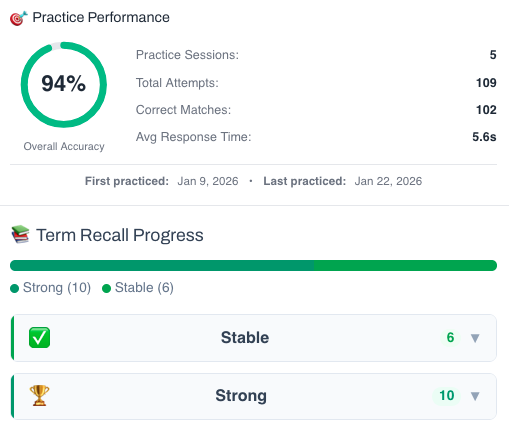
This isn’t a simple quiz — it’s a fully tracked learning system. You build knowledge through recognition, then recall, and your progress feeds directly into the Integrated Practice Bar (Writing tasks, AI Chat, and more).
- Practice sessions, accuracy, and response-time tracking
- Term strength levels (Learning → Stable → Strong)
- Personal progress history for each unit
This feature is available to YSP members.
Explore Membership BenefitsMember-Exclusive Practice Bar
Access a wide range of integrated practice for this unit — from Vocabulary and Grammar activities to AI-curated Writing tasks and Thematic Chat practice.
This feature is available to YSP members.
Explore Membership BenefitsMember-Exclusive Sentence Builder
Reconstruct scrambled sentences to practice word order and develop your grammar intuition.
This feature is available to YSP members.
Explore Membership Benefits