Counting Completed Actions with Present Perfect
Core PathWay
1 Introduction: Why Do We Count Actions?
When we talk about our lives, we often want to be specific about what we’ve done. We don’t just say ‘I’ve travelled’ – we might say ‘I’ve visited 15 countries’ or ‘I’ve been to Paris three times’. This is counting completed actions.
The Present Perfect Simple is perfect for this job because it connects the past to now. When you say ‘I’ve written five reports this week‘, you’re counting something that happened in a present time frame – a period of time that includes now and isn’t finished yet.
Here are some common present time frames we use for counting:
– today (the day isn’t finished)
– this week (the week continues)
– this month (we’re still in this month)
– this year (the year hasn’t ended)
– so far (up until now)
Let’s look at a real example:
‘I’ve drunk three coffees today, and it’s only 11 a.m.!’
This sentence counts a specific number (three coffees) in a present time frame (today). The speaker is probably surprised or worried about drinking so much coffee while the day is still happening.
💬 Dialogue 1: Busy Week at the Office
Two colleagues, Sarah and Mark, are talking during their lunch break on Friday afternoon about their busy work week
2 Counting vs Quantity: What’s the Difference?
Here’s where it gets interesting. Present Perfect Simple can express two different ideas, and it’s important to understand both.
USE 1: COUNTING (with specific numbers)
When we can count the action or the object, we use a number:
– I’ve written five emails this morning.
– She’s visited ten countries in her life.
– We’ve had three meetings today.
– He’s drunk four glasses of water so far.
USE 2: QUANTITY (without specific numbers)
When we can’t count, we describe the amount generally:
– I’ve written a lot this morning. (We can’t count ‘writing’ itself)
– She’s travelled a lot in her life. (We can’t count ‘travelling’)
– We’ve talked a lot today. (We can’t count ‘talking’)
– He’s drunk too much coffee. (Coffee is uncountable)
Let’s see both in conversation:
Sarah: How’s your day going?
Mark: Busy! I’ve answered 20 phone calls this morning. (COUNTING)
Sarah: Wow! I’ve worked a lot too, but I haven’t made any calls. (QUANTITY)
Both sentences use Present Perfect Simple, but Mark counts a specific number while Sarah describes quantity generally.
Key Terms
💬 Dialogue 2: Gym Progress Check
Two friends, Emma and Tom, meet at a café on Sunday morning and talk about their fitness progress this month
3 Present Perfect Simple vs Continuous: Counting vs Repeating
Now let’s add another layer. Sometimes we use Present Perfect Continuous to talk about repeated actions, and this can look similar to counting – but it’s different!
PRESENT PERFECT SIMPLE – COUNTING:
I’ve eaten five cakes this week.
(This counts exactly how many cakes – it’s a specific number)
PRESENT PERFECT CONTINUOUS – REPEATED QUANTITIES:
I’ve been eating a lot this week.
(This means eating happened on more than one occasion – repeatedly – but we don’t count how many times)
Let’s see more examples:
COUNTING (Simple):
– She’s been to the gym three times this week.
– We’ve watched two films this month.
– He’s made six phone calls today.
REPEATED QUANTITIES (Continuous):
– She’s been going to the gym a lot recently. (many occasions, but we don’t count)
– We’ve been watching a lot of films lately. (repeated activity)
– He’s been making lots of phone calls all day. (continuous repeated action)
Emma: Have you been working out?
Tom: Yes! I’ve been to the gym four times this week. (COUNTING – Simple)
Emma: That’s great! I’ve been exercising a lot too. (REPEATED – Continuous)
Tom: What have you been doing?
Emma: I’ve been running every morning. (REPEATED – Continuous)
Tom: How far have you run in total?
Emma: I’ve run about 20 kilometres this week. (COUNTING – Simple)
Notice how Tom and Emma switch between counting specific numbers (four times, 20 kilometres) using Simple, and describing repeated activity (a lot, every morning) using Continuous.
Key Terms
4 Never = Not Even Once (Counting Zero)
Here’s a clever use of Present Perfect counting that might surprise you: when we say ‘never’, we’re actually counting ZERO times!
Think about it:
– I’ve never been to Japan. = I’ve been to Japan zero times.
– She’s never tried sushi. = She’s tried sushi zero times.
– We’ve never met before. = We’ve met zero times before.
This is why ‘never’ fits perfectly with the Present Perfect counting use. It’s giving a specific number – the number is just zero!
Compare these:
– I’ve been to Paris once. (counting: 1 time)
– I’ve been to Paris three times. (counting: 3 times)
– I’ve never been to Paris. (counting: 0 times)
All three sentences are counting! They’re all answering the question ‘How many times?’
Let’s see it in context:
Sarah: Have you ever eaten snails?
Mark: No, I’ve never tried them. How about you?
Sarah: I’ve eaten them twice – once in France and once here.
Mark: Did you like them?
Sarah: The first time, no. But I’ve never been to a bad French restaurant, so I tried again!
Notice how ‘never’, ‘twice’, and ‘never’ again are all counting experiences – including the zero experiences!
Key Terms
5 Transformations: Practice Counting Actions
Now let’s practice transforming sentences to use Present Perfect counting. This will help you master the structure.
TRANSFORMATION TYPE 1: Add a specific number
Change general statements to counting statements:
General: I’ve travelled a lot this year.
Counting: I’ve visited six countries this year.
General: She’s worked hard this week.
Counting: She’s completed ten projects this week.
TRANSFORMATION TYPE 2: Change Continuous to Simple (repeated to counting)
Change repeated activity to specific counting:
Repeated: I’ve been going to the cinema a lot.
Counting: I’ve been to the cinema five times this month.
Repeated: He’s been calling me all day.
Counting: He’s called me eight times today.
TRANSFORMATION TYPE 3: Expand with time frames
Add a present time frame to make the counting clear:
Basic: I’ve written three reports.
With time frame: I’ve written three reports this week.
Basic: She’s drunk four coffees.
With time frame: She’s drunk four coffees today.
TRANSFORMATION TYPE 4: Never to a number
Change ‘never’ statements to show the counting:
Never: I’ve never been there.
Counting: I’ve been there zero times / not even once.
Never: He’s never tried it.
Counting: He’s tried it zero times in his life.
1. Change: ‘I’ve been studying a lot’ → Add a specific number
2. Change: ‘She’s never visited’ → Show it’s counting zero
3. Change: ‘We’ve had meetings’ → Add a time frame and number
Key Terms
6 Sentence Building: Create Your Own Counting Sentences
Let’s build sentences step by step to practice Present Perfect counting.
BUILDING BLOCK 1: Subject + have/has + past participle
Start with the basic structure:
– I have written
– She has visited
– They have completed
– He has drunk
BUILDING BLOCK 2: Add a countable object with a number
Now add what you’re counting:
– I have written five emails
– She has visited three museums
– They have completed ten tasks
– He has drunk two coffees
BUILDING BLOCK 3: Add a present time frame
Finally, add when (remember: it must be a time period that’s still continuing):
– I have written five emails this morning
– She has visited three museums this week
– They have completed ten tasks today
– He has drunk two coffees so far
BUILDING BLOCK 4: Add context or reaction
Make it more natural by adding why it matters:
– I have written five emails this morning, and I’m exhausted!
– She has visited three museums this week, so she’s learned a lot
– They have completed ten tasks today, which is a record
– He has drunk two coffees so far, and it’s only 9 a.m.
1. Choose a subject (I, you, he, she, we, they)
2. Add have/has + past participle
3. Add a number + countable object
4. Add a present time frame
5. Add a reaction or context
Example template:
[Subject] + have/has + [past participle] + [number] + [countable object] + [time frame] + [reaction]
Practice combinations:
– read / books / this year
– make / mistakes / today
– send / messages / this morning
– attend / meetings / this week
Key Terms
7 Sentence Combinations: Counting and Quantity Together
In real conversations, we often combine counting and quantity in the same discussion. Let’s practice this natural combination.
PATTERN 1: Counting + Quantity contrast
Combine a specific count with a general quantity:
I’ve sent three important emails this morning, but I’ve written a lot in total.
(counting specific emails + general quantity)
She’s visited five countries this year, and she’s travelled a lot by plane.
(counting countries + general quantity of travel)
PATTERN 2: Simple counting + Continuous repeated
Combine a count with a description of repeated activity:
I’ve been to the gym four times this week, and I’ve been feeling much better.
(counting visits + repeated feeling)
He’s made six calls today because he’s been trying to contact the manager.
(counting calls + repeated attempt)
PATTERN 3: Never (zero) + positive counting
Contrast never doing something with counting something else:
I’ve never been to Asia, but I’ve visited ten European countries.
(zero times in Asia + counting in Europe)
She’s never tried Indian food, although she’s eaten at 20 different restaurants this year.
(zero Indian experiences + counting other restaurants)
PATTERN 4: Building longer sequences
Combine multiple counting statements:
This week has been crazy! I’ve attended five meetings, written three reports, and made about 30 phone calls. I’ve been working really hard, and I’ve drunk too much coffee!
– Three counting statements (five meetings, three reports, 30 calls)
– One continuous repeated (been working)
– One quantity statement (too much coffee)
Your turn – Complete these combinations:
1. I’ve read ___ books this month, and I’ve been reading ___.
2. She’s never ___, but she’s ___ three times.
3. We’ve completed ___ today, so we’ve been ___.
Key Terms
Use the VAS to build solid recognition and recall of the terms below.
✔ Every correct Match = +1 point
✔ Every correct Recall = +2 points
🎓 Reach 5 points with good accuracy and the term is automatically promoted to your Personal Dictionary.
Incorrect answers lower accuracy, meaning more correct Matches or Recalls may be needed to reach promotion.
Member-Exclusive Vocabulary Review & Acquisition System
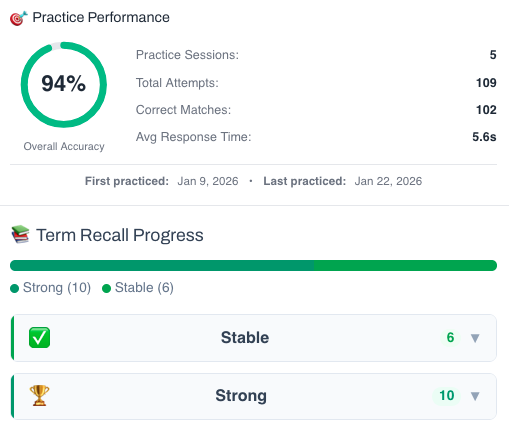
This isn’t a simple quiz — it’s a fully tracked learning system. You build knowledge through recognition, then recall, and your progress feeds directly into the Integrated Practice Bar (Writing tasks, AI Chat, and more).
- Practice sessions, accuracy, and response-time tracking
- Term strength levels (Learning → Stable → Strong)
- Personal progress history for each unit
This feature is available to YSP members.
Explore Membership BenefitsMember-Exclusive Practice Bar
Access a wide range of integrated practice for this unit — from Vocabulary and Grammar activities to AI-curated Writing tasks and Thematic Chat practice.
This feature is available to YSP members.
Explore Membership BenefitsMember-Exclusive Sentence Builder
Reconstruct scrambled sentences to practice word order and develop your grammar intuition.
This feature is available to YSP members.
Explore Membership Benefits