Mastering Gerunds: Understanding -ING Forms in English Communication
Core PathWay
1 Understanding Gerunds: The -ING Form as a Noun
Have you ever wondered why we say ‘I enjoy swimming’ but ‘I want to swim’? The answer lies in understanding gerunds and infinitives. On this page we are looking at gerunds
A gerund is the -ING form of a verb that acts like a noun. This means it can be the subject or object of a sentence, just like any other noun. For example, ‘Swimming is fun’ uses ‘swimming’ as the subject. When you say ‘I enjoy swimming’, the word ‘swimming’ is the object of the verb ‘enjoy’ and is a gerund. We can also call this form a verbal noun because it comes from a verb but behaves like a noun.
The -ING form has two main jobs in English. Sometimes it creates the continuous form of a verb, like ‘I am swimming’ (present continuous). However, in this lesson we focus on when -ING acts as a gerund after another verb. This is where learners often feel confused because different verbs have different preferences.
The key question is: does a verb take a gerund (‘enjoy swimming’), an infinitive (‘want to swim’), or both? The answer depends on verb patterns, which are the rules about what can follow each verb. Some verbs always take gerunds, some always take infinitives, and some can take both forms. Understanding these patterns will help you speak more naturally and make fewer mistakes.
Key Terms
2 Grammar Overview: Verb Patterns with Gerunds
Understanding complementation is essential for mastering gerunds. Complementation means ‘what comes after a verb to complete its meaning’. Some verbs need a gerund to complete their meaning, while others need an infinitive. This isn’t random – there are patterns you can learn.
The good news is that you don’t need to memorize every verb individually. Many verbs fall into logical categories based on their meaning. Verbs about enjoying or disliking activities usually take gerunds. Verbs about intentions, plans, or desires usually take infinitives. When you understand these meaning groups, choosing the right form becomes much easier.
Focus
- Complementation determines what form follows a verb
- Certain verb categories consistently take gerunds
- Some verbs can take both gerunds and infinitives with different meanings
- Understanding meaning groups helps you predict the correct pattern
Rules
- Verbs of liking/disliking take gerunds: enjoy, dislike, mind, can’t stand + gerund
- Verbs of starting/stopping take gerunds: finish, stop, avoid, keep, give up + gerund
- Verbs of suggestion/recommendation take gerunds: suggest, recommend, consider + gerund
- Verbs of intention/desire take infinitives: want, hope, plan, decide, need + infinitive
- Some verbs change meaning: ‘stop doing’ (quit) vs ‘stop to do’ (pause in order to do)
Examples
- I suggested going to the new restaurant. (NOT: I suggested to go)
- She finished writing the report at 6pm. (NOT: She finished to write)
- They avoid talking about politics at work. (NOT: They avoid to talk)
Common mistake
Key Terms
3 Deep Dive: Verb Categories and Their Gerund Preferences
Let’s examine specific verb categories in detail. Understanding why certain verbs take gerunds will help you remember the patterns more easily.
Verbs that take gerunds often describe reactions to activities, completion of activities, or mental processes about activities. When you recognize these meaning patterns, you can make better guesses about unfamiliar verbs.
verbs of liking and disliking
- enjoy doing something
- dislike doing something
- love doing something
- hate doing something
- don’t mind doing something
- can’t stand doing something
- I really enjoy learning new languages, especially through conversation practice.
- She doesn’t mind waiting if the food is good, but she can’t stand rude service.
verbs of completion and continuation
- finish doing something
- stop doing something
- keep doing something
- continue doing something
- give up doing something
- carry on doing something
- He finally gave up trying to fix the computer and called a technician.
- Please keep checking your email because I’ll send the documents today.
verbs of mental process
- consider doing something
- imagine doing something
- risk doing something
- involve doing something
- deny doing something
- admit doing something
- We’re considering moving to a bigger office next year because our team is growing.
- She denied taking the money, but the security camera showed the truth.
Key Terms
4 Reflection Point: Applying Gerund Patterns in Practice
Now it’s time to think about how you can use these patterns in your own communication. The goal isn’t to memorize every verb, but to develop a feeling for which patterns work with which meanings.
Reflect on the common mistakes you’ve made in the past. Have you been using infinitives when you should use gerunds? Understanding your personal error patterns will help you improve faster. Remember, making mistakes is a natural part of learning – the important thing is to notice them and correct them.
Reflection prompts
- Think of three activities you enjoy. Can you make sentences using ‘enjoy’, ‘love’, and ‘can’t stand’ with gerunds?
- What’s a habit you’ve given up or would like to give up? Practice saying ‘I gave up…’ or ‘I’m considering giving up…’
- Recall a time you made a mistake with gerunds or infinitives. What was the sentence? How would you correct it now?
- Which verb category do you find most difficult: liking/disliking, completion/continuation, or mental processes? Why?
Sentence stems
- I enjoy _____ .
- I’ve been considering _____ for a while now.
- I can’t stand _____, so I always avoid _____.
- I finished _____ yesterday.
- I need to stop _____ and start _____ instead.
- My job involves _____ every day, which means _____.
Member-Exclusive Vocabulary Review & Acquisition System
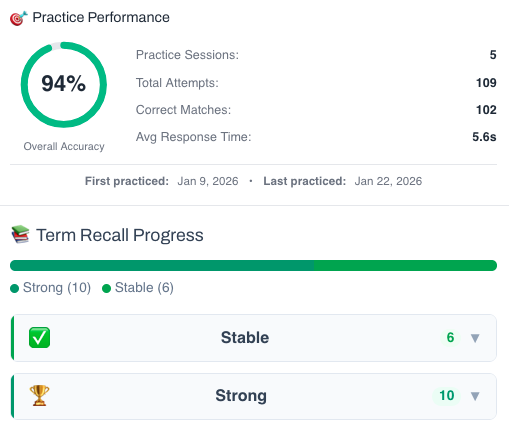
This isn’t a simple quiz — it’s a fully tracked learning system. You build knowledge through recognition, then recall, and your progress feeds directly into the Integrated Practice Bar (Writing tasks, AI Chat, and more).
- Practice sessions, accuracy, and response-time tracking
- Term strength levels (Learning → Stable → Strong)
- Personal progress history for each unit
This feature is available to YSP members.
Explore Membership BenefitsMember-Exclusive Practice Bar
Access a wide range of integrated practice for this unit — from Vocabulary and Grammar activities to AI-curated Writing tasks and Thematic Chat practice.
This feature is available to YSP members.
Explore Membership BenefitsMember-Exclusive Sentence Builder
Reconstruct scrambled sentences to practice word order and develop your grammar intuition.
This feature is available to YSP members.
Explore Membership Benefits