Counting vs. Ongoing: Present Perfect Simple and Continuous
Core PathWay
1 Section 1. Counting vs. Ongoing: Two Different Questions
Here is a simple but powerful idea: the form you choose depends on the question you are answering.
The present perfect simple answers the question How many times? It counts completed events. Each visit, attempt, or experience is a separate, finished unit. For example: I have been to Elba on holiday 10 times. That is a count — a number you could write on a list. Compare: I have seen that film three times. She has applied for that job twice. We have visited the factory four times this year.
The present perfect continuous answers a different question: How long? How often? How intensely? It describes a repeated or ongoing pattern without giving a number. For example: I have been going to Elba on holiday for years. No number — just a sense of regular, repeated activity over time. Compare: I have been watching that series lately. She has been applying for new jobs recently. We have been visiting the factory regularly.
The key difference is this: if you can answer How many times? with a real number, use the present perfect simple. If you are describing a habit, pattern, or intensity without counting, use the present perfect continuous.
2 Section 2. Non-Numeric Quantity: A Lot, Not Much, and More
Some quantity expressions do not use numbers. Words like a lot, not much, a great deal, and hardly any describe how much or how often — but without a count. When you use these expressions, the present perfect continuous is the natural choice.
This is an important rule because many learners try to use the present perfect simple here. But the simple form implies a completed, countable event — and these expressions do not count. They describe intensity or frequency in a general way.
Focus
- Non-numeric quantity expressions (a lot, not much, a great deal, hardly any) go with the present perfect continuous.
- The present perfect simple with these expressions sounds unnatural or changes the meaning.
- The adverb ‘recently’ and ‘lately’ often appear with the present perfect continuous in this pattern.
- A negative form with ‘much’ (I haven’t been doing much) is a common and natural structure.
Rules
- Use PRESENT PERFECT CONTINUOUS + non-numeric quantity to describe the general amount or intensity of a repeated activity: ‘I have been seeing a lot of Alex recently.’
- Do NOT use the present perfect simple with these expressions when describing frequency or intensity: ‘I have seen a lot of Alex recently’ sounds unnatural in this context.
- Use the present perfect simple with exact numbers only: ‘I have seen Alex three times this week’ is correct.
- In negative sentences, ‘not much’ and ‘hardly’ pair naturally with the continuous: ‘I haven’t been sleeping much lately.’ The simple negative (‘I haven’t slept recently’) means something different — it suggests not even once.
Examples
- I have been seeing a lot of Jordan recently. [continuous — non-numeric frequency] ✓ | I have seen a lot of Jordan recently. [simple — unnatural here] ✗
- I haven’t been swimming much recently. [continuous — low frequency, but some] ✓ | I haven’t swum recently. [simple — means not even once] — different meaning ⚠
- Chris has been travelling a great deal for work this month. [continuous — non-numeric intensity] ✓ | Chris has travelled a great deal for work this month. [simple — unnatural] ✗
Common mistake
3 Section 3. Writing Practice
Now put both rules into practice. Write a short paragraph using the present perfect simple for counted events and the present perfect continuous for non-numeric repetition.
4 Recap: The Rule in Two Questions
Two questions. That is really all you need.
Ask yourself: Can I put an exact number here? If yes — use the present perfect simple: I have been to Elba 10 times. She has called twice. The number is the signal.
Ask yourself: Am I describing a pattern, habit, or intensity without a number? If yes — use the present perfect continuous: I have been going there for years. He has been working a great deal lately. Expressions like a lot, not much, a great deal, hardly, recently, and for years are your signals here.
One final point to remember: I haven’t been swimming much (continuous) means you have swum a little, but not often. I haven’t swum (simple) means not even once. The difference is small in form but significant in meaning.
Member-Exclusive Practice Bar
Access a wide range of integrated practice for this unit — from Vocabulary and Grammar activities to AI-curated Writing tasks and Thematic Chat practice.
This feature is available to YSP members.
Explore Membership BenefitsMember-Exclusive Vocabulary Review & Acquisition System
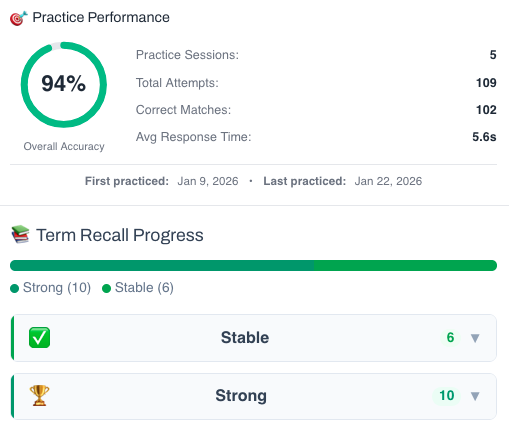
This isn’t a simple quiz — it’s a fully tracked learning system. You build knowledge through recognition, then recall, and your progress feeds directly into the Integrated Practice Bar (Writing tasks, AI Chat, and more).
- Practice sessions, accuracy, and response-time tracking
- Term strength levels (Learning → Stable → Strong)
- Personal progress history for each unit
This feature is available to YSP members.
Explore Membership Benefits🎮 Practice Games
Sentence Scrambler
Present Perfect Continuous – the Main Uses [2] – Sentence Scramble
Member-Exclusive Sentence Builder
Reconstruct scrambled sentences to practice word order and develop your grammar intuition.
This feature is available to YSP members.
Explore Membership Benefits