 ↑×
📐 Positional language (foreground, top left corner, in the distance…) is the same on every image lesson — see Where things are at the end.
What Can You See?
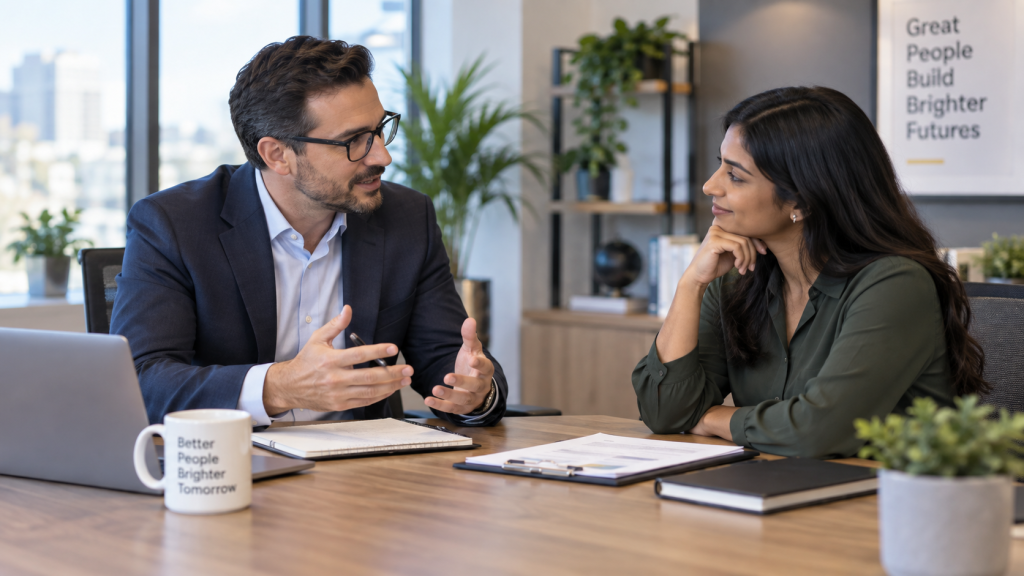
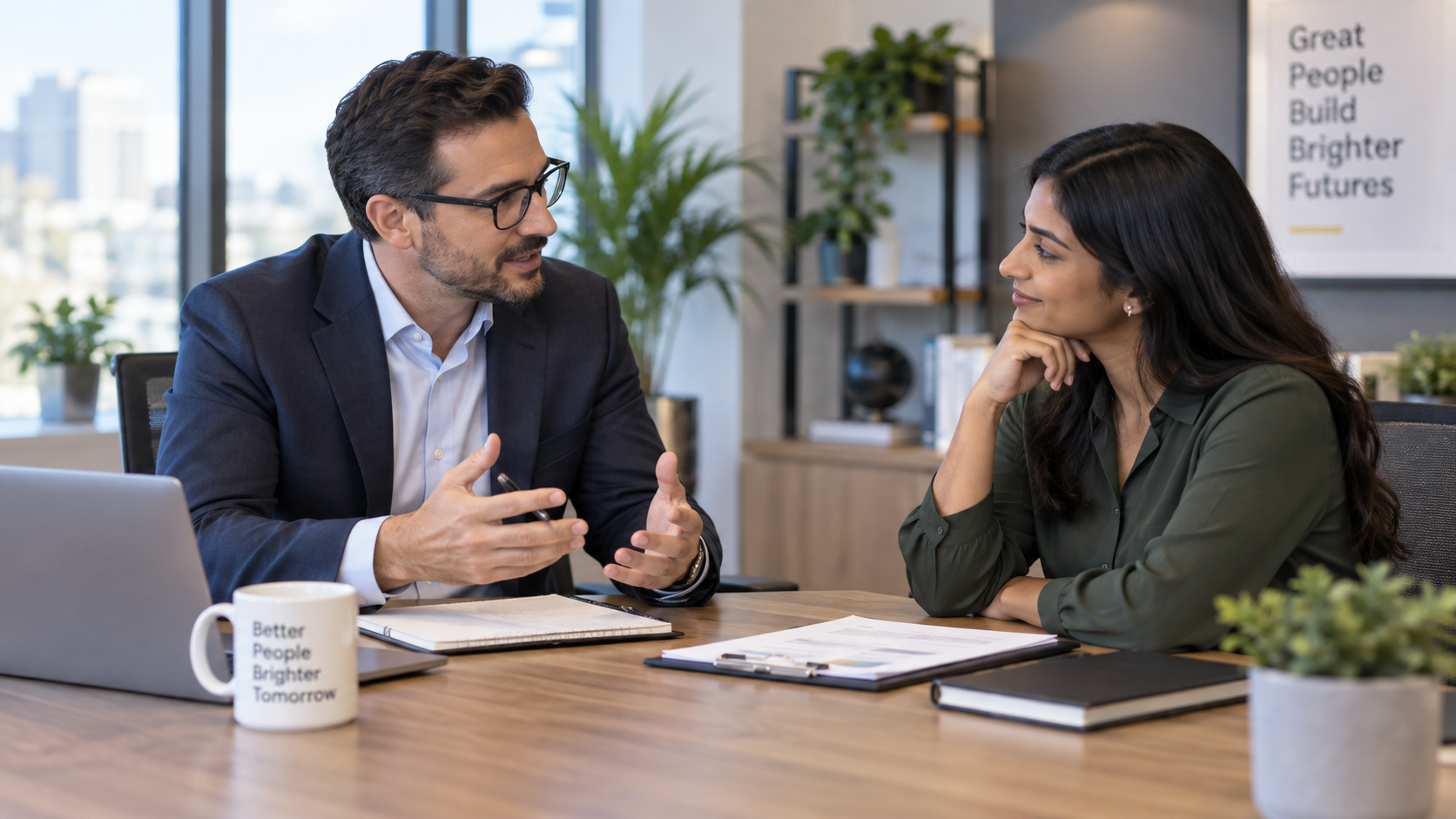
Look at the photograph. Two people are in a meeting. Study the key words below, then listen to the description. Work through each task — every task helps you with the next one.
📚 Key Vocabulary
Learn these words before you listen.
🎧 Listen and read
Before: Look at the photograph and think about what you can see.
While listening: Listen and notice the objects on the table and the two people.
After: Think about what the two people are doing right now.
💡 Press play, then scroll back up to the photo. If the photo is off-screen, a copy floats at the bottom — tap it to enlarge.
 ×
📖 1 · Short description — read along
📖 2 · Full description — read along
📖 3 · The story behind the picture — read along
🧰 Your word bank
All the target words for this picture.
📚 Word bank
All the target words for this picture. Tap a word to hear it.





✍️ First look
Write what you can see in the photograph now. Use your own words and do not worry about mistakes. You will look at this again at the end.
Step 1 · Naming objects
📚 Vocabulary
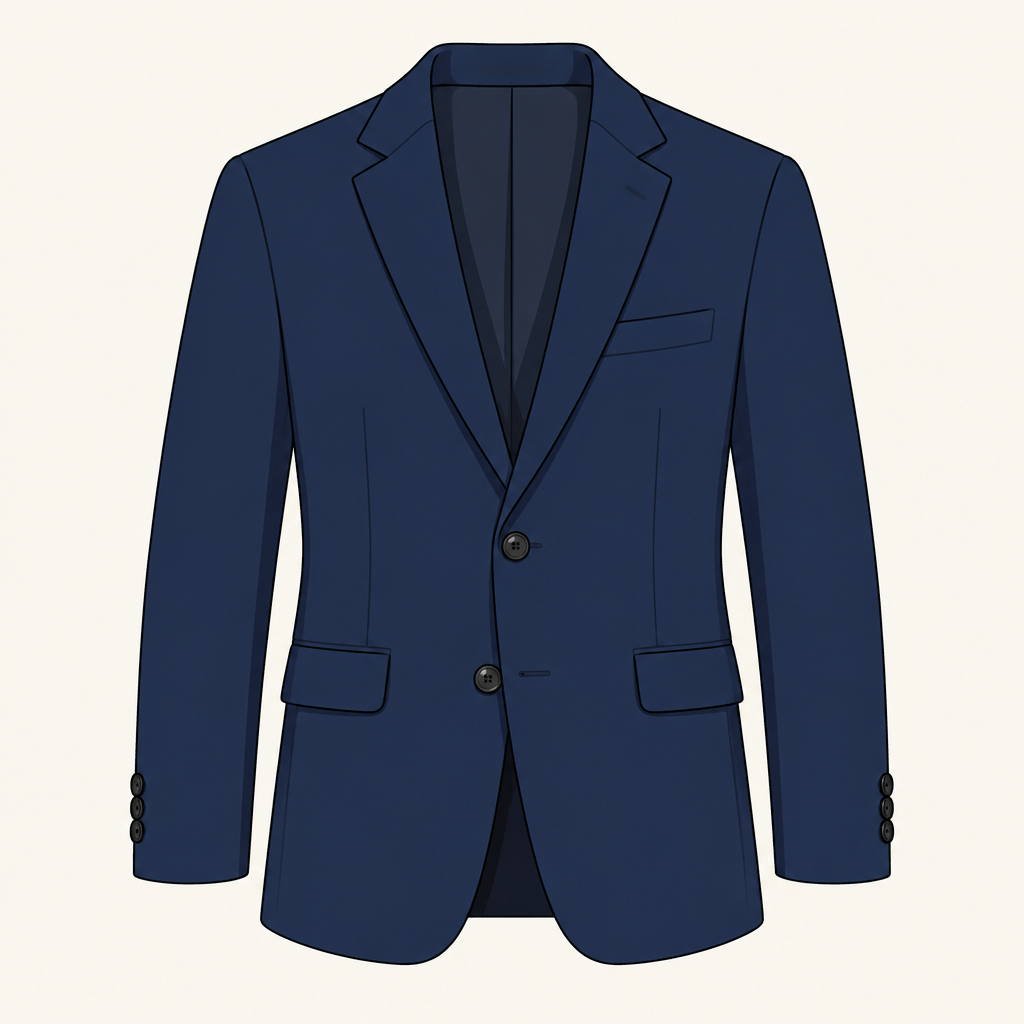
To do this task, you need the names of eight objects. Some objects are on the table. Some are worn by the people. Look at the shape and colour to help you remember the word. A laptop is a thin computer. A clipboard is a flat board with documents on it. A blazer is a smart jacket. Use one word or a short phrase for each object. Open the ‘Objects’ list to see all the words and short phrases you need.
- laptop — a silver-grey, open laptop on the table
- clipboard — two black clipboards with documents on the table
- blazer — a dark navy blazer worn by the man
🧰 Open 'Objects' to see the full list of object names and short phrases.
→ Now write your list of eight objects from the picture.
🔎 What you can see
| Object | Where | Describing words |
|---|---|---|
| man | left of centre, seated at the table | dark-haired, bearded, glasses-wearing |
| woman | right of centre, seated at the table | long dark hair, dark green blouse, attentive posture |
| wooden table | centre foreground, running horizontally across the lower portion of the frame | light-toned, smooth surface, rectangular |
| laptop | on the table, in front of the man on the left | silver-grey, open lid, thin |
| clipboard ×2 | on the table, one in front of the man, one in front of the woman | black, flat, with documents attached |
| document ×2 | clipped to clipboards on the table surface | white, printed, A4-sized |
| notebook | on the table, to the right side, near the woman | dark-coloured, closed, hardcover |
| mug | on the table, left foreground, near the laptop | white, ceramic, printed text |
| pen | held in the man's right hand | dark-coloured, slim |
| glasses | on the man's face | black frames, rectangular lenses |
| blazer | worn by the man | dark navy, tailored, lapelled |
| shirt | worn by the man, visible beneath the blazer | light blue, collared, button-up |
Showing the 12 most important of 22 objects.
Step 2 · Describing colour and material
🔧 Grammar — adjective + noun; be + adjective; made of
To do this task, you need colour words and material words. A colour word says what colour something is. A material word says what it is made of. Use this pattern: The [object] is [colour] and it is made of [material]. Some things look smooth or shiny — you can add that too. Open ‘Materials’ and ‘Colours’ for more words to help you.
- The mug is white and it is made of ceramic.
- The laptop is silver-grey and it is made of aluminium.
- The man's blazer is dark navy and it is made of fabric.
🧰 Open 'Materials' and 'Colours' to find more colour and material words.
→ Now write your five sentences about colour and material.
🧱 Colours and materials
Ready-made phrases
🎨 Language palette
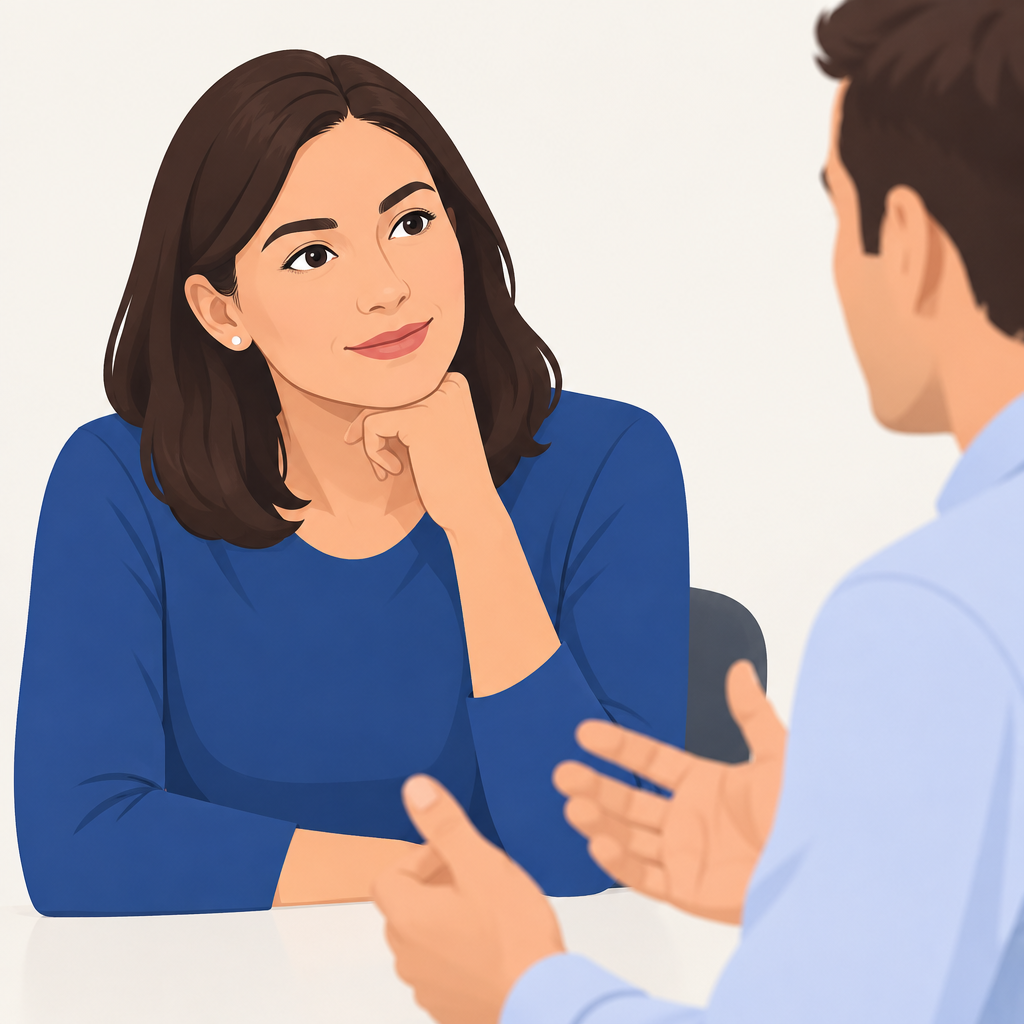
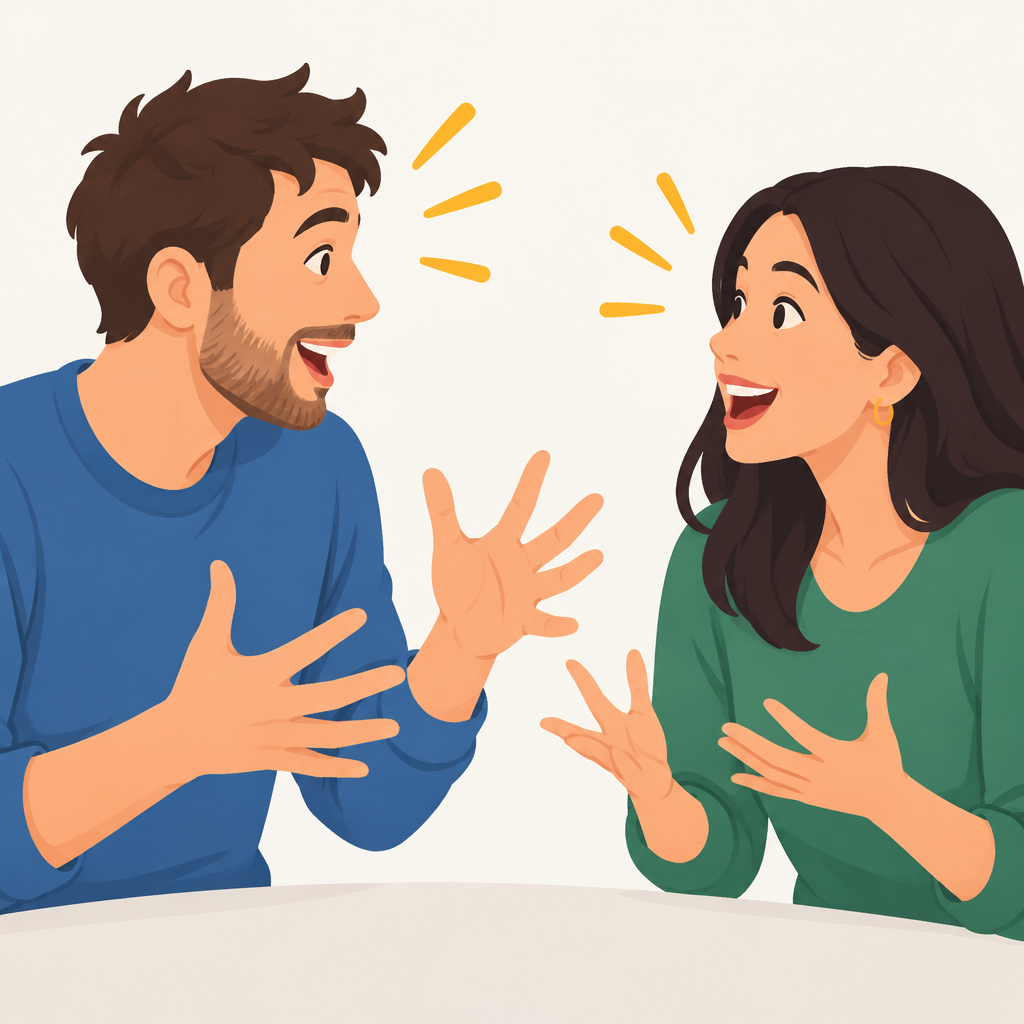
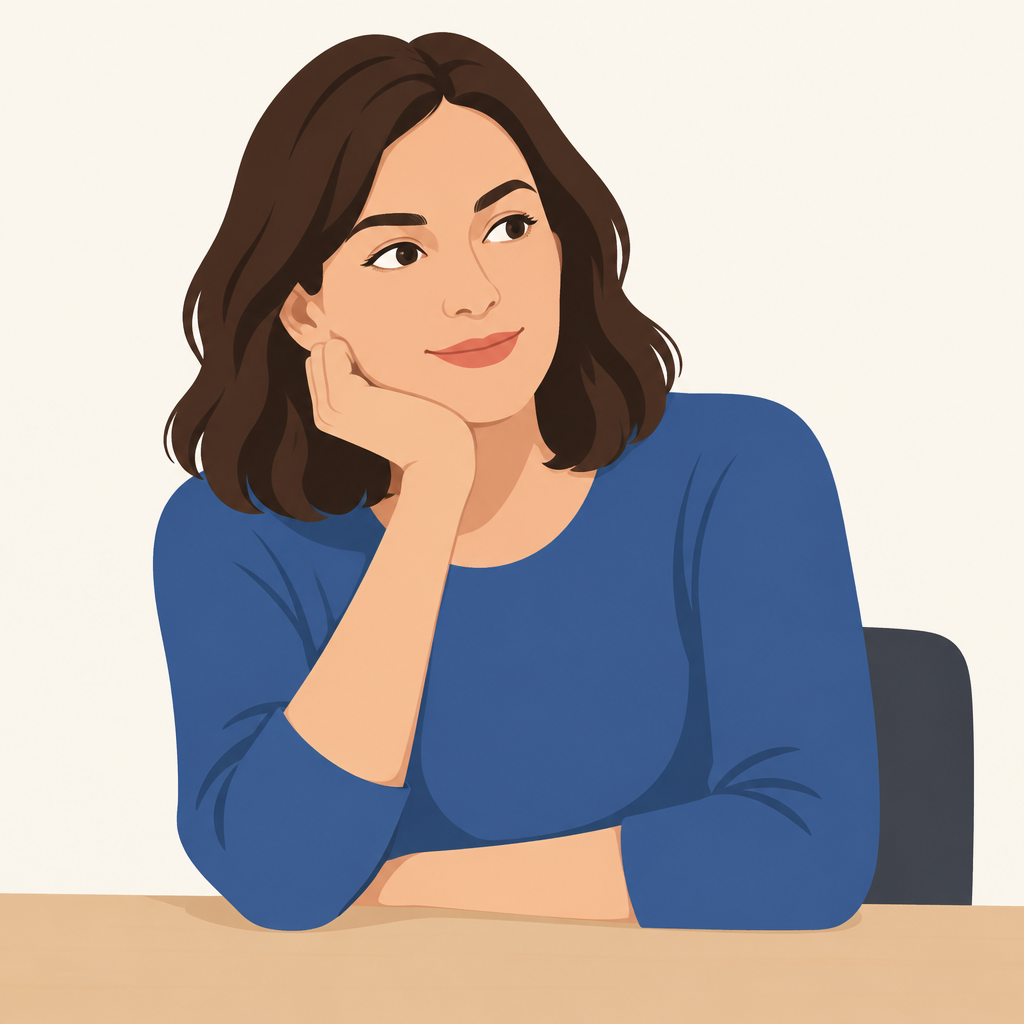
Two people are seated face-to-face at a table in a modern office, one speaking with animated hand gestures while the other listens attentively with chin resting on hand.
The things you must name
Useful supporting words
Describing words — Colour
Describing words — Size and shape
Describing words — Texture and material
Saying where things are
What things are doing
Words that go together
Example: The table is light brown and it is made of wood.
- the mug
- the laptop
- the man's blazer
- the woman's blouse
- the notebook
Step 3 · Saying where things are
🔧 Grammar — there is / there are
To do this task, you need ‘there is’ and ‘there are’ and a place word. Use ‘there is’ for one thing and ‘there are’ for two or more things. Then add a place word: on, beside, behind, between, or in front of. This tells the reader exactly where the object is. Open ‘Where things are’ and ‘Objects’ for place phrases and object names.
- There is an open laptop in front of the man on the table.
- There are two black clipboards on the table between the two people.
- There is a closed notebook beside the clipboard, near the woman.
🧰 Open 'Where things are' for more place phrases and 'Objects' for object names.
→ Now write your five sentences about where things are in the picture.
📍 Where things are
- The man is seated to the left of the woman at the same table.
- The laptop sits in front of the man on the table surface.
- The white mug sits beside the laptop, toward the left foreground.
- A clipboard with documents lies between the man and the woman on the table.
- The closed notebook is positioned to the right of the second clipboard, near the woman's side.
- The pen is held in the man's right hand as he gestures.
- The man's hands are raised above the table surface in a gesturing position.
- The woman's chin rests on her hand, which is propped up at the table.
- The bookshelf stands behind both figures in the middle ground.
- Several potted plants are placed on the shelves of the bookshelf.
- The decorative globe sits on one of the lower shelves of the bookshelf.
- The printed banner is partially visible to the right of the bookshelf in the background.
- A large window is positioned behind the man, letting in natural light from the left.
- A blurred cityscape is visible beyond the window in the upper left.
- The black-framed glasses rest on the man's face.
- A small stud earring is visible on the woman's near ear.
- The wooden table runs in front of both seated figures across the lower portion of the frame.
- An additional potted plant is visible in the far left background, near the window.
🔎 What you can see
| Object | Where | Describing words |
|---|---|---|
| man | left of centre, seated at the table | dark-haired, bearded, glasses-wearing |
| woman | right of centre, seated at the table | long dark hair, dark green blouse, attentive posture |
| wooden table | centre foreground, running horizontally across the lower portion of the frame | light-toned, smooth surface, rectangular |
| laptop | on the table, in front of the man on the left | silver-grey, open lid, thin |
| clipboard ×2 | on the table, one in front of the man, one in front of the woman | black, flat, with documents attached |
| document ×2 | clipped to clipboards on the table surface | white, printed, A4-sized |
| notebook | on the table, to the right side, near the woman | dark-coloured, closed, hardcover |
| mug | on the table, left foreground, near the laptop | white, ceramic, printed text |
| pen | held in the man's right hand | dark-coloured, slim |
| glasses | on the man's face | black frames, rectangular lenses |
| blazer | worn by the man | dark navy, tailored, lapelled |
| shirt | worn by the man, visible beneath the blazer | light blue, collared, button-up |
Showing the 12 most important of 22 objects.
These prepositions can help you: on, in front of, beside, behind, between.
Example: There is a white mug beside the laptop.
- laptop
- clipboards
- notebook
- bookshelf
- potted plants
Step 4 · Describing actions right now
🔧 Grammar — present continuous
To do this task, you need the present continuous. Use this tense for actions happening right now, in the picture. The form is: is + verb-ing. The man is doing something. The woman is doing something. Use the sentence frames to help you. Look at the hands, the body, and the face of each person to find the actions.
- The man is holding a pen and gesturing with both hands.
- The woman is leaning forward and resting her chin on her hand.
- The man is sitting at the table and speaking to the woman.
🧰 Open 'People' to find action verbs and body language phrases for this picture.
→ Now write your four present continuous sentences about the two people.
🧍 Who is doing what
- The man is seated at the table, holding a pen and gesturing with both hands while speaking toward the woman on his right.
- The woman is seated at the table with her chin resting on her hand, her body turned toward the man as he speaks.
The present continuous is: is/are + verb-ing.
Example: The man is holding a pen.
- The man is ...
- He is also ...
- The woman is ...
- She is also ...
🏁 Put it all together
You practised object names, colour and material words, ‘there is / there are’ with place words, and the present continuous. Now write a full description of the picture. Use everything you practised.
- ☐ Name the objects precisely — use words like laptop, clipboard, notebook, mug, pen, glasses, blazer, blouse, bookshelf, potted plant
- ☐ Describe colours and materials — use phrases like dark navy, white ceramic, silver-grey aluminium
- ☐ Say where things are — use there is / there are and words like on, beside, behind, between
- ☐ Describe what the people are doing — use is + verb-ing for actions happening now
💬 Discussion
• Do you use a laptop or a notebook in your work or studies?
• When you are in a meeting, do you gesture a lot or do you sit quietly?
• What do you usually have on your desk — a mug, a pen, documents?
Member-Exclusive Practice Bar
Access a wide range of integrated practice for this unit — from Vocabulary and Grammar activities to AI-curated Writing tasks and Thematic Chat practice.
This feature is available to YSP members.
Explore Membership BenefitsMember-Exclusive Vocabulary Review & Acquisition System

This isn’t a simple quiz — it’s a fully tracked learning system. You build knowledge through recognition, then recall, and your progress feeds directly into the Integrated Practice Bar (Writing tasks, AI Chat, and more).
- Practice sessions, accuracy, and response-time tracking
- Term strength levels (Learning → Stable → Strong)
- Personal progress history for each unit
This feature is available to YSP members.
Explore Membership Benefits📐 Where things are — positional language for images