 ↑×
📐 Positional language (foreground, top left corner, in the distance…) is the same on every image lesson — see Where things are at the end.
Ready to Land?
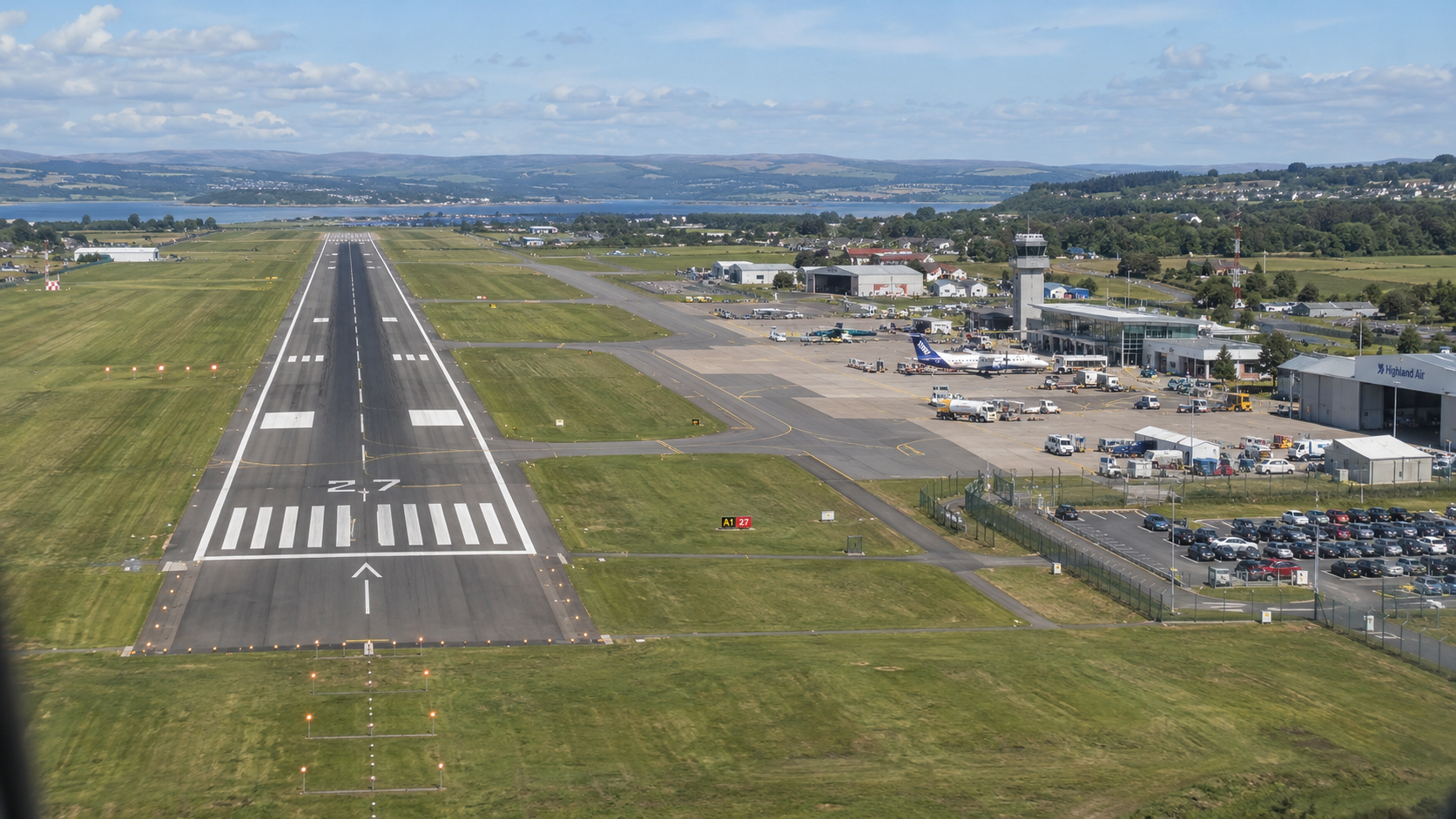
This photograph was taken from inside an aircraft seconds before touchdown at a small regional airport in the Scottish Highlands. Study the key vocabulary below, then listen to the descriptions carefully — each task builds on what came before, so the language you practise early will help you in the tasks that follow.
📚 Key Vocabulary
These terms appear in the descriptions — learn them before you listen.
🎧 Listen and read
Before: Before you listen, look at the key vocabulary and think about what an airport seen from above might look like.
While listening: As you listen, notice how the speaker moves from the runway in the foreground outward to the buildings and landscape beyond.
After: After listening, close your notes and try to recall the position of at least four features — you will need this for the tasks ahead.
💡 Press play, then scroll back up to the photo. If the photo is off-screen, a copy floats at the bottom — tap it to enlarge.
 ×
📖 1 · Short description — read along
📖 2 · Full description — read along
📖 3 · The story behind the picture — read along
🧰 Your word bank
All the target words for this picture.
📚 Word bank
All the target words for this picture. Tap a word to hear it.
Now it's your turn
Step 1 · Saying Where Things Are
🔧 Grammar — prepositions of place
To describe a layout, you need prepositions of place that show relationships between features — not just ‘next to’ or ‘near’, but more precise phrases. The fuel gives you several: ‘parallel to’, ‘beyond’, ‘adjacent to’, ‘along’, and ‘behind’. These tell the reader exactly how one feature sits in relation to another. Use them to build a chain: start with one feature, then move outward step by step. For example, begin with the runway, move to the taxiway beside it, then to the apron beyond that. This gives your paragraph a clear direction and avoids jumping around the image. Remember that ‘beyond’ means further away from the viewer, while ‘adjacent to’ means directly beside something at roughly the same distance.
- The taxiway runs parallel to and to the right of the runway along its full visible length.
- The apron lies beyond the taxiway, where three small regional aircraft are parked at stands.
- The terminal building sits adjacent to and slightly to the right of the control tower.
🧰 Open the 'Where things are' and 'Objects' toggles for a full set of place phrases and feature names from this image.
→ Now write your paragraph naming at least six features and placing each one clearly in relation to the others.
📍 Where things are
- The runway lies in the left-centre of the frame, stretching from the foreground toward the upper middle distance.
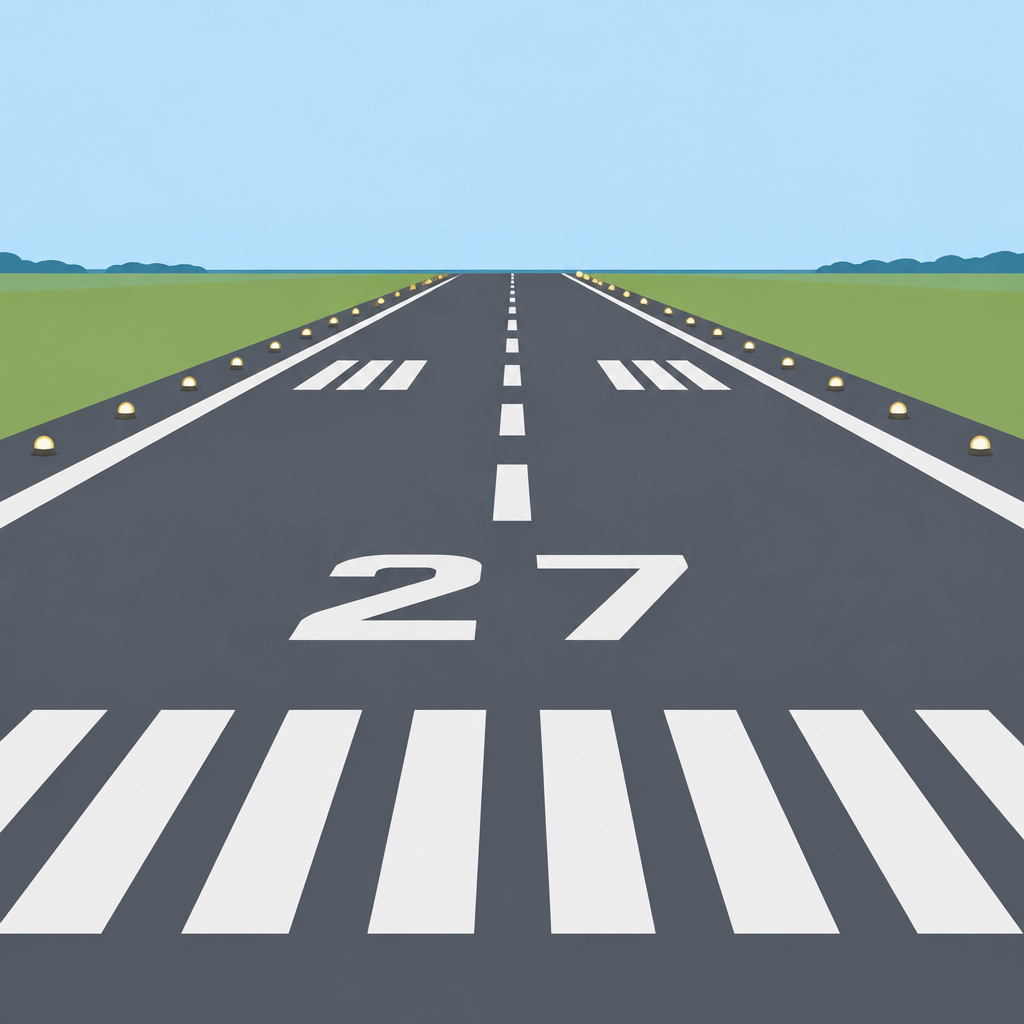
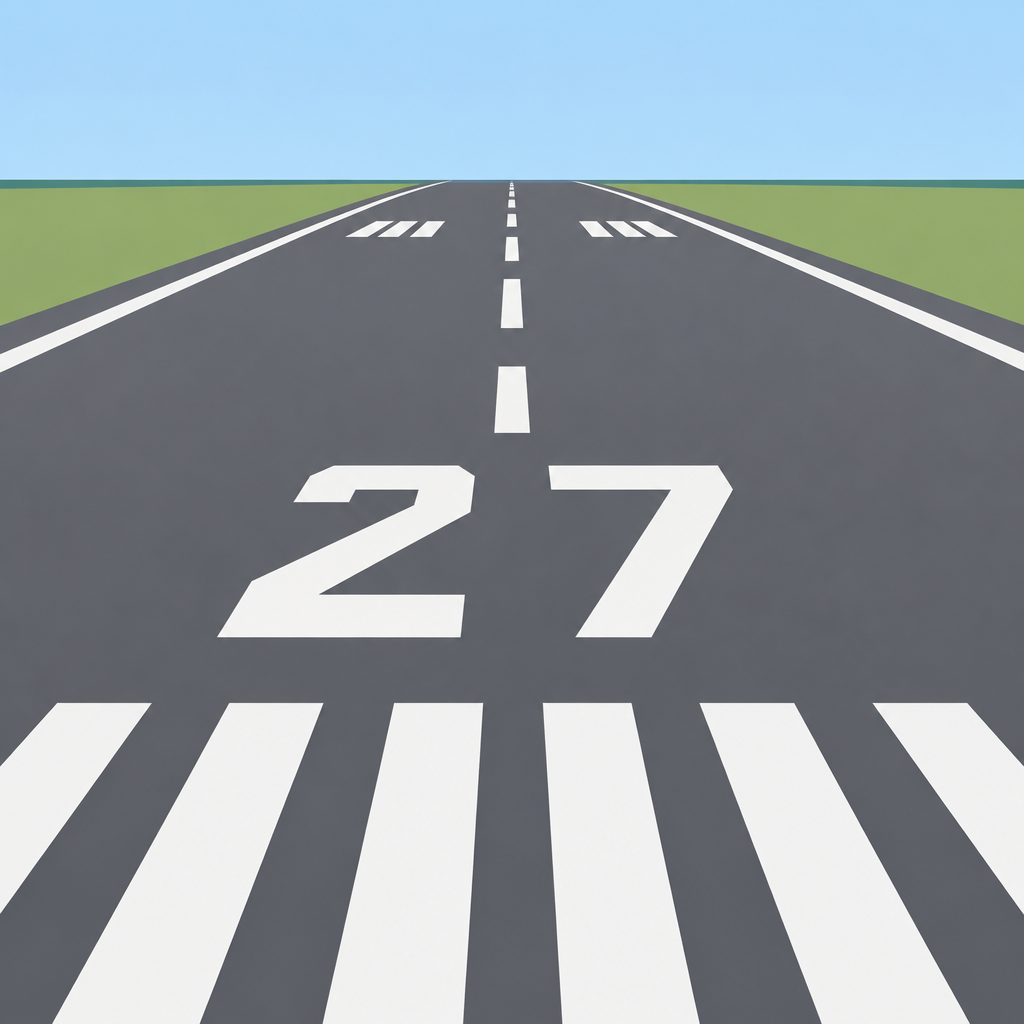
- The threshold markings are painted at the near end of the runway, closest to the viewer.
- The runway designation number '27' is painted just above the threshold markings on the runway surface.
- The taxiway runs parallel to and to the right of the runway along its full visible length.
- The apron lies beyond and to the right of the taxiway, where aircraft are parked.
- Three parked aircraft sit on the apron, facing roughly toward the terminal.
- The control tower stands behind the apron, rising above the surrounding buildings.
- The terminal building sits adjacent to and slightly to the right of the control tower.
- The Highland Air hangar is positioned at the far right of the frame, beyond the terminal.
- The car park sits between the hangar and the terminal building, separated from the airside by a fence.
- A strip of grass infield lies between the runway and the taxiway.
- Runway edge lights are spaced evenly along both sides of the runway.
- A red-and-yellow taxiway sign stands beside the taxiway close to the runway threshold.
- The estuary or firth is visible in the upper-left background, well beyond the airport boundary.
- Low hills and mountains run along the horizon behind the estuary.
- The dark edge of an aircraft window frame is visible in the lower-left corner, indicating the viewpoint is from inside an approaching aircraft.
- White cumulus clouds are scattered across the upper third of the frame against a blue sky.
- A band of dense woodland extends beyond the airport boundary on the right side of the image.
🔎 What you can see
| Object | Where | Describing words |
|---|---|---|
| runway | left-centre of frame, extending from foreground to upper-centre | black, asphalt-surfaced, wide |
| threshold markings | lower-centre of runway, near the bottom of the frame | white, broad, parallel-stripe pattern |
| runway designation number | on the runway surface just above the threshold markings | white, large, painted |
| centreline markings | along the longitudinal centre of the runway, extending into the distance | white, dashed, evenly spaced |
| touchdown zone markings | on the runway surface between the threshold and mid-runway | white, rectangular bar pairs |
| runway edge lights | along both sides of the runway, visible from foreground to mid-distance | amber-yellow, small, evenly spaced |
| threshold lights | in a bar across the runway threshold at the bottom of the frame | amber, small, bar-arranged |
| taxiway | running parallel to the runway on its right side | dark asphalt, narrower than the runway, marked with yellow centreline |
| taxiway sign | beside the taxiway, centre-right of frame near the runway threshold | red and yellow, small, mounted low |
| apron | right of centre, behind the taxiway | light grey concrete, large, flat |
| parked aircraft ×3 | on the apron, right of centre | white, turboprop or regional jet, medium-small |
| ground support vehicles | on and around the apron, near the parked aircraft | various colours, small relative to aircraft, multiple types |
| control tower | right of centre, behind the apron | grey-white, tall, slender |
| terminal building | right of centre, adjacent to and slightly right of the control tower | glass-fronted, low-rise, modern |
| aircraft hangar | far right of frame | white, large, rectangular |
| car park | right side of frame, between the hangar and terminal | surfaced, partially filled with cars |
| airport boundary fence | right side of frame, separating apron and car park from hangar area | green mesh, security fencing |
| grass infield | between the runway and taxiway, and to the left of the runway | green, mown, flat |
| estuary or firth | upper-left background | blue-grey, wide, calm-surfaced |
| hills and mountains | along the horizon, upper portion of frame | purple-grey, low-profile, distant |
| sky | upper third of frame | blue, partly cloudy, bright |
| clouds | scattered across the upper third of the frame | white, cumulus, scattered |
| aircraft window frame | lower-left corner of the frame | dark, partial, curved |
| residential buildings | beyond the airport boundary, upper-right and upper-left areas | small, scattered, mixed colours |
| trees and woodland | upper-right background, beyond the airport boundary | green, dense, deciduous |
Step 2 · Using the Passive Voice to Describe Markings
🔧 Grammar — present simple passive
The passive voice is the natural choice when you want to describe what exists or what has been done to a surface — especially when the person who did it is not important. For runway markings, we do not say who painted them; we focus on the result. The present simple passive is formed with ‘is’ or ‘are’ plus a past participle: ‘is painted’, ‘is marked’, ‘are spaced’. Use this structure when describing things that are fixed features of the image. The fuel gives you several past participles that work well here: painted, marked, spaced, bordered, arranged. Try to vary the subjects — move from the runway surface itself to the markings on it, then to the lights along its edges. This keeps your paragraph moving without repeating the same structure.
- The runway surface is marked with broad white threshold stripes painted across its near end.
- Amber runway edge lights are spaced evenly along both sides of the dark asphalt surface.
- The designation number '27' is painted on the runway surface just above the threshold markings.
🧰 Open the 'Materials' and 'Objects' toggles for the full list of runway features and their colours and textures.
→ Now write your paragraph using the passive voice in at least five sentences or clauses to describe what can be seen on and along the runway.
🧱 Colours and materials
Ready-made phrases
| Object | Colour | Material | Texture |
|---|---|---|---|
| runway surface | dark grey to black | asphalt | smooth with worn patches |
| runway markings | white | paint | flat |
| taxiway centreline | yellow | paint | flat |
| apron | light grey | concrete | flat, slightly worn |
| grass infield | mid-green | — | mown, smooth |
| control tower | grey-white | concrete or rendered masonry, glazed cab | smooth |
| terminal building | white and grey with large glass panels | glass and steel or concrete | smooth, reflective glass |
| aircraft hangar | white | metal cladding | smooth, flat-panelled |
| parked aircraft | white with blue livery detail | — | — |
| runway edge lights | amber-yellow | — | — |
| sky | mid-blue | — | — |
| clouds | white with light grey undersides | — | soft, cumulus |
| estuary water | blue-grey | — | flat, calm |
| distant hills | purple-grey | — | smooth at distance |
| airport boundary fence | green | metal mesh | open mesh |
🔎 What you can see
| Object | Where | Describing words |
|---|---|---|
| runway | left-centre of frame, extending from foreground to upper-centre | black, asphalt-surfaced, wide |
| threshold markings | lower-centre of runway, near the bottom of the frame | white, broad, parallel-stripe pattern |
| runway designation number | on the runway surface just above the threshold markings | white, large, painted |
| centreline markings | along the longitudinal centre of the runway, extending into the distance | white, dashed, evenly spaced |
| touchdown zone markings | on the runway surface between the threshold and mid-runway | white, rectangular bar pairs |
| runway edge lights | along both sides of the runway, visible from foreground to mid-distance | amber-yellow, small, evenly spaced |
| threshold lights | in a bar across the runway threshold at the bottom of the frame | amber, small, bar-arranged |
| taxiway | running parallel to the runway on its right side | dark asphalt, narrower than the runway, marked with yellow centreline |
| taxiway sign | beside the taxiway, centre-right of frame near the runway threshold | red and yellow, small, mounted low |
| apron | right of centre, behind the taxiway | light grey concrete, large, flat |
| parked aircraft ×3 | on the apron, right of centre | white, turboprop or regional jet, medium-small |
| ground support vehicles | on and around the apron, near the parked aircraft | various colours, small relative to aircraft, multiple types |
| control tower | right of centre, behind the apron | grey-white, tall, slender |
| terminal building | right of centre, adjacent to and slightly right of the control tower | glass-fronted, low-rise, modern |
| aircraft hangar | far right of frame | white, large, rectangular |
| car park | right side of frame, between the hangar and terminal | surfaced, partially filled with cars |
| airport boundary fence | right side of frame, separating apron and car park from hangar area | green mesh, security fencing |
| grass infield | between the runway and taxiway, and to the left of the runway | green, mown, flat |
| estuary or firth | upper-left background | blue-grey, wide, calm-surfaced |
| hills and mountains | along the horizon, upper portion of frame | purple-grey, low-profile, distant |
| sky | upper third of frame | blue, partly cloudy, bright |
| clouds | scattered across the upper third of the frame | white, cumulus, scattered |
| aircraft window frame | lower-left corner of the frame | dark, partial, curved |
| residential buildings | beyond the airport boundary, upper-right and upper-left areas | small, scattered, mixed colours |
| trees and woodland | upper-right background, beyond the airport boundary | green, dense, deciduous |
Step 3 · Speculating About What Happened Before
🔧 Grammar — past modals of deduction: must have, might have, may have, can't have
Past modal forms let you express how certain you are about something in the past. Use ‘must have’ when the evidence strongly points to one conclusion. Use ‘might have’ or ‘may have’ when something is possible but not certain. Use ‘can’t have’ when something is clearly impossible given what you can see. The image was taken on final approach — the aircraft is seconds from the runway. Think about what this tells you: the pilots must have received clearance from the control tower; the ground support vehicles on the apron might have been positioned there in preparation. Look at the light, the parked aircraft, and the ground crew activity to find clues. Avoid using ‘must have been’ when you mean ‘must have done’ — they have different meanings.
- The air traffic controller in the glazed cab must have cleared the aircraft to land on Runway 27.
- The ground support vehicles on the apron may have been positioned there before the aircraft arrived.
- The aircraft can't have been on its first flight of the day — the apron shows clear signs of activity.
🧰 Open the 'Look closer' toggle for details about the light, the viewpoint, and the activity visible on the apron and around the terminal.
→ Now write your paragraph speculating about what must have, might have, may have, and can't have happened in the minutes before this photograph was taken.
👁️ Look closer: how the picture is built
Where to look
- Start here: the runway threshold and designation number '27', sitting in the lower-centre of the frame
- The camera is: from above, slightly forward-looking — the camera is inside an aircraft on approach, angled downward and ahead
- In front: runway threshold with markings, threshold lights, and grass strips immediately below the aircraft
- In the middle: full runway length, parallel taxiway, apron with parked aircraft, control tower and terminal building
- At the back: residential landscape, estuary or firth, distant hills and mountains, sky with clouds
- Lines and shapes: strong converging perspective lines formed by the runway edges, drawing the eye toward the vanishing point in the upper-centre; parallel lines of the taxiway reinforce the convergence; horizontal band of the estuary and hills divides the upper third; vertical of the control tower provides a counterpoint to the dominant horizontals and diagonals
- Framing: the dark aircraft window edge in the lower-left corner frames the scene and anchors the aerial viewpoint; the wide landscape fills the frame edge to edge
- Balance: asymmetrical — the runway occupies the left-centre while the terminal, hangar, and apron cluster on the right
Light and colour
Light: natural · From: from above and slightly to the left, consistent with midday or early-afternoon sun · Quality: soft to diffuse — overcast-moderated daylight with some direct sun · Contrast: medium · Warm/cool: cool to neutral — the greens, blues, and grey-purples dominate
Notice: amber runway edge lights glow against the dark asphalt; glass terminal facade reflects ambient light; haze softens the distant hills and water
💬 Discussion
• Have you ever arrived at or departed from a small regional airport — and how did the experience compare with a large international terminal?
• Looking at the apron and the ground support vehicles, what do you think happens in the final minutes before passengers board a regional aircraft?
• The airport sits beside a tidal estuary and distant hills — do you think the surrounding landscape affects how pilots approach and land at airports like this one?
Member-Exclusive Practice Bar
Access a wide range of integrated practice for this unit — from Vocabulary and Grammar activities to AI-curated Writing tasks and Thematic Chat practice.
This feature is available to YSP members.
Explore Membership BenefitsMember-Exclusive Vocabulary Review & Acquisition System
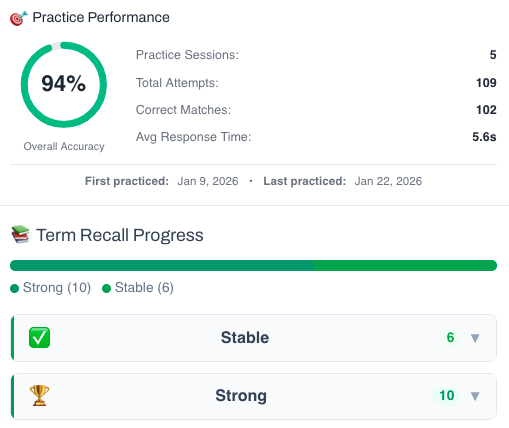
This isn’t a simple quiz — it’s a fully tracked learning system. You build knowledge through recognition, then recall, and your progress feeds directly into the Integrated Practice Bar (Writing tasks, AI Chat, and more).
- Practice sessions, accuracy, and response-time tracking
- Term strength levels (Learning → Stable → Strong)
- Personal progress history for each unit
This feature is available to YSP members.
Explore Membership Benefits📐 Where things are — positional language for images