Buildings | Pack 1 — The Words That Put a Roof Over Your Vocabulary
Core PathWay
1 Section 1. Where People Live
Ready to build your vocabulary for buildings? Here’s where we start — with the places people call home.
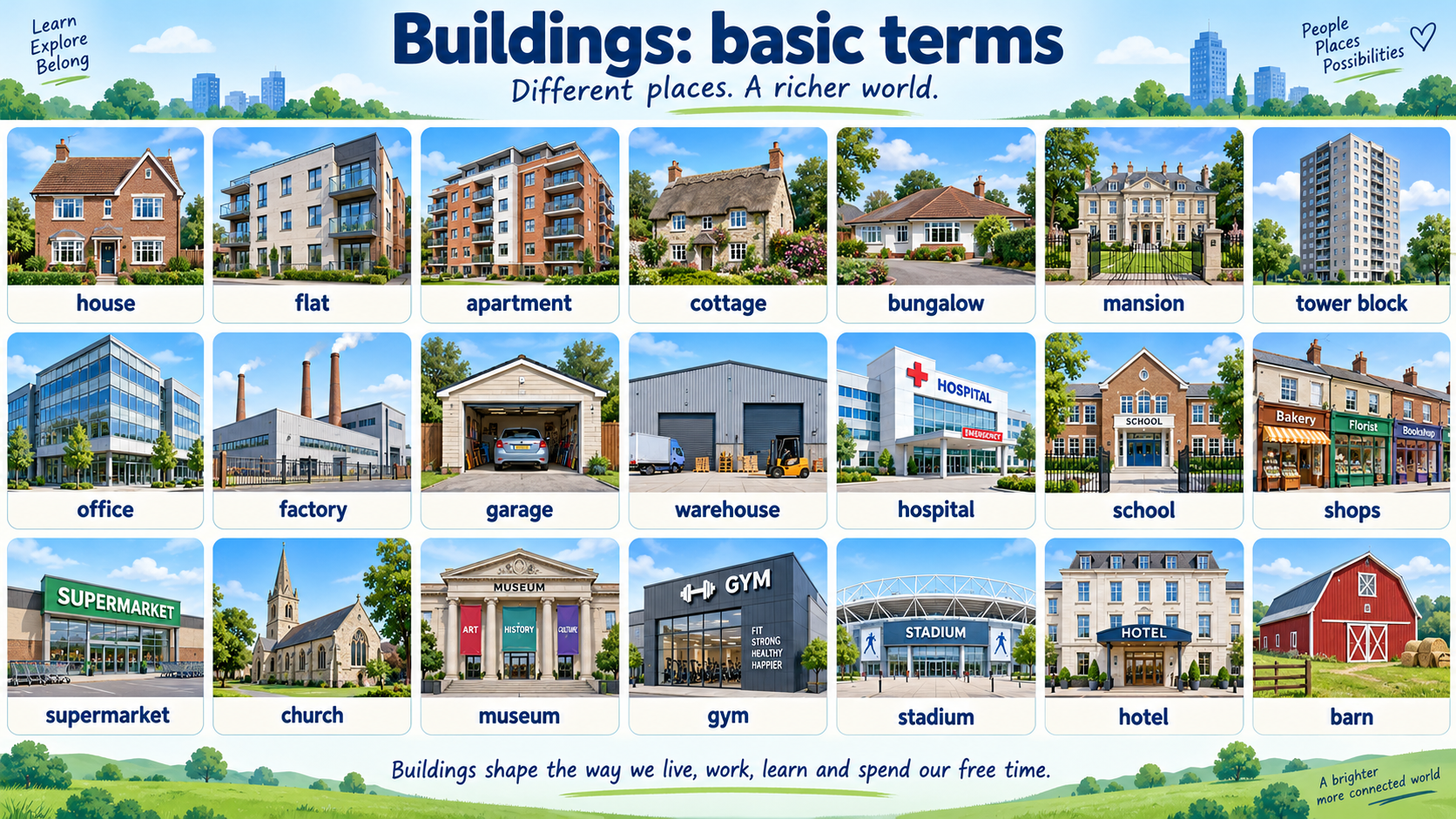
The most common word for a home is house. A house is a building made for people to live in, usually on its own piece of land with its own front door. Most houses have a garden and a private entrance.
A flat is different. It is a set of rooms for living in that is part of a larger building, with other similar sets of rooms above or below it. Many people in cities live in flats because land is expensive.
In American English, the same thing is called an apartment. The meaning is the same — a set of rooms for living in that is part of a larger building. British speakers say flat; American speakers say apartment.
If you want a quieter life in the countryside, you might live in a cottage. A cottage is a small house, usually old and in the countryside, often with a garden. Cottages are popular for holidays in Britain.
Some people live in a bungalow. A bungalow is a house that has only one floor, with no upstairs rooms. This is useful for older people or people who find stairs difficult.
And if you are very wealthy? You might live in a mansion. A mansion is a very large and expensive house, usually owned by a wealthy person. Most of us just dream about those.
Finally, there is a useful general word: dwelling. A dwelling is any building or place where a person or family lives — a general word that covers houses, flats, and other types of home. You will see this word in formal writing and official documents.
2 Section 2. Homes in the Sky — Tall Buildings
Not all homes are small and low. Some buildings reach high into the sky.
A tower block is a very tall building divided into many flats or offices, one on top of another. Tower blocks are common in large cities where many people need to live close together. They can have 20, 30, or even more floors.
Notice the pattern: a tower block can contain flats (for living) or offices (for working). The word tells you about the shape and size of the building, not just its purpose.
Here is a useful connection. The word flat describes one home inside a tower block. The word tower block describes the whole building. You need both words to talk about this type of home clearly.
And remember: if you are speaking American English, you would say apartment instead of flat — but tower block stays the same in both varieties.
3 Section 3. Where People Work
Buildings are not only for living in. Many buildings exist because people need a place to work.
An office is a room or building where people do business or professional work, usually sitting at desks. You might work in an office if you are a lawyer, an accountant, or a manager.
A factory is very different. A factory is a large building where goods are made in large amounts, usually by machines and workers. Cars, clothes, and food products are often made in factories.
Once goods are made, they need to be stored somewhere. A warehouse is a large building used for storing large amounts of goods before they are sold or sent somewhere. Warehouses are usually near roads, ports, or railways.
Here is a useful sequence to remember: goods are made in a factory → stored in a warehouse → sold in a shop. These three buildings work together in everyday business.
There is also a useful formal word: premises. Premises means a building and the land around it, used especially when talking about a place where a business operates. For example: ‘The business moved to new premises last year.’ Notice that premises is always plural — you say ‘the premises are’ not ‘the premises is’.
A garage can also be a workplace. A garage is a building or part of a building used for keeping a car, or a place where cars are repaired. So garage has two meanings: a private space for your car at home, or a business where mechanics fix cars.
4 Section 4. Public Buildings — Health, Learning, and the Law
Some buildings serve the whole community. These are public buildings — places that everyone can use.
A hospital is a large building where doctors and nurses take care of people who are ill or injured. Hospitals are open 24 hours a day and have many departments.
A school is a building where children go to learn, taught by teachers. Schools are found in almost every town and village.
A library is a building where a large collection of books and other materials is kept for people to read or borrow. Libraries are free to use in most countries.
A church is a building where Christian people go to pray and worship together. Many churches are very old and are important historical buildings as well as places of worship.
A museum is a building where important objects from history, art, or science are kept and shown to the public. Museums often have free entry.
And what about buildings that are not for everyone? A prison is a building where people are kept locked up as a punishment after being found guilty of a crime. People do not choose to go to a prison — they are sent there by a court.
Notice the contrast: a library, a museum, and a church are places people visit by choice. A prison is not.
5 Section 5. Shopping, Sport, and Staying Over
Some buildings are designed for things we do in our free time — or when we are travelling.
A shop is a building or part of a building where goods are sold to members of the public. Shops can be small, like a local bakery, or large.
A supermarket is a very large shop where people buy food and other everyday goods, usually serving themselves. In a supermarket, you pick up items yourself and pay at the checkout. A supermarket is a type of shop, but much bigger.
A hotel is a building where people pay to sleep and eat when they are travelling or away from home. Hotels have bedrooms, and usually a reception area and a restaurant.
A gym is a building or large room with equipment that people use to exercise and keep fit. You pay a monthly fee to use a gym.
A stadium is a very large building with rows of seats around a sports field, where people watch matches and events. Football matches, athletics, and concerts are often held in stadiums.
Here is a useful size comparison: a shop is small → a supermarket is very large. And a gym is usually inside a building, while a stadium is a building built around an outdoor space.
6 Section 6. Buildings on the Farm and in the City
Two more buildings complete the picture — one from the countryside, one that could be anywhere.
A barn is a large building on a farm used for storing crops or keeping animals. Barns are often red or wooden, and they are a familiar sight in the countryside.
Now step back and look at the full range of buildings you have learned. Some are for living: house, flat, apartment, cottage, bungalow, mansion, dwelling, tower block. Some are for working: office, factory, warehouse, premises, garage. Some serve the public: hospital, school, library, church, museum, prison. Some are for shopping, sport, or travel: shop, supermarket, hotel, gym, stadium. And one is for the farm: barn.
Grouping words by purpose is a useful way to remember them. When you meet a new building word, ask yourself: what is this building for? Who uses it? That question will help you remember the word much more easily.
7 Section 7. Now Hear It in Use
You have met all 25 building words. Now hear them working in a real conversation. Listen to how two people use these words naturally as they talk about finding a new place to live and work. Pay attention to which building words they choose and why.
💬 Dialogue 1: Finding the Right Place
Two friends, Priya and Dan, are sitting in a cafe. Priya is thinking about moving to a new city for a job. Dan already lives there and is helping her think through her options for a place to live and a new workplace.
Priya: “So I got the job offer. The office is in the city centre, near the big hospital on Green Street. I just need to figure out where to live.”
Dan: “That’s great news! Are you thinking about renting a flat, or would you prefer a house? There are some nice areas not far from the office.”
Priya: “Probably a flat to start with. I can’t afford a house right now — and definitely not a mansion! Is there a gym nearby? I really don’t want to give that up.”
Dan: “Yes, there’s a good gym about ten minutes’ walk from the hospital, actually. And there’s a big supermarket just around the corner from it too, so that’s really convenient. Have you looked at flats near the city centre yet?”
Priya: “Not yet. I’ve only looked online so far. I saw one flat in a tower block near the centre — it looked amazing, but I’m not sure I want to live that high up. What do you think?”
Dan: “I know the one you mean. It’s a great location, but honestly, the lift is always busy in the mornings. If you’re going to be rushing to the office every day, that could get annoying. There are some smaller buildings with flats a bit further out — much quieter.”
Priya: “That makes sense. I don’t need to be right in the centre. What about the area near the old docks? I heard there’s a lot of development there — some old warehouse buildings converted into flats.”
Dan: “Oh yes, those warehouse conversions are really popular. They’ve got really high ceilings and big windows — very stylish. They’re not cheap, though. And the area is still quite industrial, so there isn’t much around yet — no supermarket within walking distance, for example.”
Priya: “Hmm, that’s a problem. I need a supermarket close by, and the gym too. What about outside the city? Could I find something more affordable there — maybe even a small cottage or something like that?”
Dan: “A cottage would be lovely, but the commute to your office from the countryside could be really long. And you’d probably need a car. There are some nice bungalows on the edge of the city — single-storey houses, so no stairs — and the prices are more reasonable than the city centre.”
Priya: “A bungalow sounds interesting actually. I hadn’t thought about that. As long as there’s a bus to the office and a gym nearby, I think I could be happy there. Could you send me some links to look at?”
Dan: “Of course! I’ll send you a few options tonight. There’s a really good area about twenty minutes from the hospital — a mix of bungalows and houses, a supermarket, and the gym I mentioned is not far either. I think you’ll like it. When are you planning to come and have a look?”
Member-Exclusive Practice Bar
Access a wide range of integrated practice for this unit — from Vocabulary and Grammar activities to AI-curated Writing tasks and Thematic Chat practice.
This feature is available to YSP members.
Explore Membership BenefitsMember-Exclusive Vocabulary Review & Acquisition System
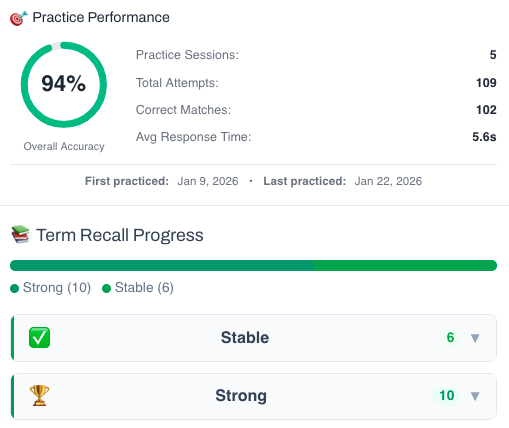
This isn’t a simple quiz — it’s a fully tracked learning system. You build knowledge through recognition, then recall, and your progress feeds directly into the Integrated Practice Bar (Writing tasks, AI Chat, and more).
- Practice sessions, accuracy, and response-time tracking
- Term strength levels (Learning → Stable → Strong)
- Personal progress history for each unit
This feature is available to YSP members.
Explore Membership Benefits