From 'Too Much' to 'Should Have': Transforming Past Regrets
Core PathWay1 Section 1. The Transformation: From What Happened to What Should Have Happened
You already know how to form ‘should have + past participle’. Now let’s look at something just as useful: how a statement about the past — especially one involving too much, too many, or not enough — maps directly onto a regret using the modal perfect.
The pattern is straightforward. A past simple statement tells us what happened. The modal perfect transformation tells us what the speaker now wishes had been different. Notice how the key quantity word shifts: ‘too much’ becomes ‘so much’, and ‘not enough’ becomes ‘harder’ or ‘more’.
Past simple → Modal perfect simple
‘I had too much coffee yesterday afternoon and then couldn’t sleep.’ → ‘I shouldn’t have had so much coffee yesterday afternoon.’
‘She didn’t study enough before the exam and failed.’ → ‘She should have studied harder before the exam.’
‘They spent too many evenings out and ran out of money.’ → ‘They shouldn’t have spent so many evenings out.’
‘He wasn’t careful enough with the deadline.’ → ‘He should have been more careful with the deadline.’
When the original statement uses a past continuous, the transformation uses the modal perfect continuous: ‘should have been + present participle’. This form signals that the action was ongoing — it was the behaviour over time, not just a single moment, that was the problem.
Past continuous → Modal perfect continuous
‘I was driving too fast on the motorway.’ → ‘I shouldn’t have been driving so fast on the motorway.’
‘She was working too many hours every week and burned out.’ → ‘She shouldn’t have been working so many hours every week.’
‘He wasn’t paying enough attention during the lecture.’ → ‘He should have been paying more attention during the lecture.’
Notice the adjective patterns too. ‘Too + adjective’ and ‘not + adjective + enough’ follow the same logic:
‘The music was too loud at the party.’ → ‘The music shouldn’t have been so loud.’
‘I wasn’t well-prepared enough for the interview.’ → ‘I should have been better prepared for the interview.’
2 Section 2. The Morning After
Sam and Jordan are catching up the morning after a very unproductive week. Sam describes what went wrong; Jordan responds with the modal perfect — sometimes sympathetically, sometimes with a knowing smile.
💬 Dialogue 1: The Morning After
Sam and Jordan meet for coffee on a Saturday morning. Sam has had a difficult week of poor decisions.
📝 Comprehension Check: A Week of Bad Choices
Answer the questions based on what you heard in the audio.
Which speaker admitted to staying up very late every night to watch a TV show?
Which speaker suggested that one episode per night would have been acceptable?
Which speaker described feeling physically unwell after consuming too many stimulant drinks?
Which speaker pointed out that attending a social event the evening before a test was a serious mistake?
Which speaker mentioned that eating poorly had left them feeling low in energy throughout the week?
Which speaker set out a specific plan for the following week, including a set bedtime and a screen-free period before sleep?
Sam: “I'm absolutely exhausted. I was binge-watching that new series until about two in the morning every single night this week. I don't know what I was thinking.”
Jordan: “Sam. You really shouldn't have been watching so many episodes on a weeknight. I mean, one episode is fine, but every night until two? You should have saved it for the weekend when you had the time.”
Sam: “I know, I know. And then on Tuesday I drank too many energy drinks to stay awake in class and ended up feeling absolutely terrible — heart racing, couldn't concentrate at all.”
Jordan: “You shouldn't have had so many — two is already pushing it, honestly. You should have just gone to bed earlier in the first place. Then you wouldn't have needed them at all.”
Sam: “Fair point. And I didn't revise enough for the Thursday test. I spent the whole Wednesday evening at that party instead of opening a single book.”
Jordan: “Ah, well, you really should have revised more on Wednesday — a lot more, by the sound of it. And you shouldn't have been out partying the night before a test. That's just asking for trouble.”
Sam: “The worst part is I was eating too much junk food all week as well — no proper meals at all, just crisps and instant noodles. I felt sluggish the entire time.”
Jordan: “You shouldn't have been eating so much junk food — your body needed actual fuel, especially with everything else going on. You should have made time for at least one decent meal a day. Even something simple.”
Sam: “And I wasn't getting nearly enough sleep on top of all that. I was running on about four hours a night. Four hours! I'm amazed I made it to the end of the week.”
Jordan: “Four hours? You should have been getting at least seven — eight would have been even better. You really shouldn't have let it get that bad, Sam. Right, here's the deal: next week, bed by eleven, no screens after ten, and harder revision sessions earlier in the week. Agreed?”
3 Section 3. Grammar Guide: The Transformation Rules
This guide shows you how past simple and past continuous statements with ‘too much’, ‘too many’, and ‘not enough’ map onto modal perfect forms. The transformation is not just a grammar exercise — it is exactly how speakers naturally move from describing a past event to expressing regret about it.
Two forms are involved: the modal perfect simple (‘should/shouldn’t have + past participle’) for completed actions, and the modal perfect continuous (‘should/shouldn’t have been + present participle’) for ongoing behaviour or habits in the past.
Focus
- Past simple + 'too much / too many' → 'shouldn't have + past participle'
- Past simple + 'not enough' → 'should have + past participle'
- Past continuous + 'too much / too many' → 'shouldn't have been + present participle'
- Past continuous + 'not enough' → 'should have been + present participle'
- 'Too + adjective' → 'shouldn't have been + so + adjective'
- 'Not + adjective + enough' → 'should have been + more/comparative adjective'
- The quantity word shifts: 'too much' → 'so much'; 'not enough' → 'more' or comparative form
Rules
- Use 'shouldn't have + past participle' when the original statement uses past simple + 'too much' or 'too many': 'I ate too much' → 'I shouldn't have eaten so much.'
- Use 'should have + past participle' when the original statement uses past simple + 'not enough': 'I didn't sleep enough' → 'I should have slept more.'
- Use 'shouldn't have been + present participle' when the original statement uses past continuous + 'too much' or 'too many': 'I was spending too much time online' → 'I shouldn't have been spending so much time online.'
- Use 'should have been + present participle' when the original statement uses past continuous + 'not enough': 'I wasn't trying hard enough' → 'I should have been trying harder.'
- For adjective patterns, 'too + adjective' transforms to 'shouldn't have been + so + adjective': 'It was too loud' → 'It shouldn't have been so loud.'
- For 'not + adjective + enough', use 'should have been + comparative adjective': 'I wasn't careful enough' → 'I should have been more careful.'
Examples
- 'I spent too many hours on social media and missed the deadline.' → 'I shouldn't have spent so many hours on social media.'
- 'She wasn't being careful enough while she was revising.' → 'She should have been more careful while she was revising.'
- 'He was talking too loudly during the presentation.' → 'He shouldn't have been talking so loudly during the presentation.'
Common mistake
4 Section 4. Writing Task: Reply to a Friend's Email
Read the email below from your friend Alex. Alex had quite a week. Write a reply using ‘should have’ and ‘shouldn’t have’ to respond to the things Alex describes. Use both the modal perfect simple and the modal perfect continuous where you can.
—
Hi,
Let me tell you about last week — it was a disaster from start to finish. On Monday I ate too much pizza for lunch and felt completely ill all afternoon, so I got almost nothing done at work. Then on Tuesday I wasn't drinking enough water during my gym session and ended up with a terrible headache that lasted all day. Wednesday was even worse — I was spending too many hours on my phone in the evening and went to bed way too late. I was so tired on Thursday that I wasn't concentrating enough during an important meeting with my manager, which was really embarrassing. To make things worse, I hadn't prepared enough notes before the meeting, so I couldn't answer half the questions. And on Friday I was driving too fast on the way home because I was in a rush, and I got stopped by the police. Not my finest week.
Hope yours was better!
Alex
—
5 Section 5. Recap: What You've Practised
On this page you have focused on one of the most natural uses of the modal perfect: turning a past statement into a regret.
The core pattern is this — a past simple statement with too much, too many, or not enough transforms into a ‘should have’ or ‘shouldn’t have’ statement. When the original uses a past continuous, the transformation uses the modal perfect continuous: ‘should/shouldn’t have been + present participle’. This form captures ongoing behaviour, not just a single moment.
Notice the quantity word shift: ‘too much’ → ‘so much’; ‘too many’ → ‘so many’; ‘not enough’ → ‘more’ or a comparative. These substitutions are what make the modal perfect version sound natural rather than mechanical.
Keep these two questions in mind when you practise: Was the original action a single completed event, or an ongoing habit? And was the problem too much of something, or not enough? Your answers will tell you exactly which form to use.
Member-Exclusive Practice Bar
Access a wide range of integrated practice for this unit — from Vocabulary and Grammar activities to AI-curated Writing tasks and Thematic Chat practice.
This feature is available to YSP members.
Explore Membership BenefitsMember-Exclusive Vocabulary Review & Acquisition System
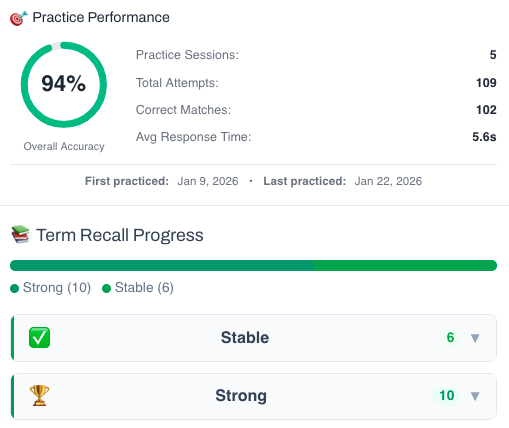
This isn’t a simple quiz — it’s a fully tracked learning system. You build knowledge through recognition, then recall, and your progress feeds directly into the Integrated Practice Bar (Writing tasks, AI Chat, and more).
- Practice sessions, accuracy, and response-time tracking
- Term strength levels (Learning → Stable → Strong)
- Personal progress history for each unit
This feature is available to YSP members.
Explore Membership Benefits