All About ‘To Happen’: Mastering a Common English Verb
Core PathWay
1 Review ‘To Happen’
As you saw on page 1, the verb ‘to happen’ has several meanings and uses in English. Here’s a quick review
Understanding how ‘happen’ works in questions is particularly important. Because ‘happen’ is intransitive, we use subject questions (questions where ‘what’ is the subject). We say ‘What happened?‘ not ‘What did happen?’ unless we’re adding emphasis or surprise.
Happen (event meaning) – things happen.
- Present Simple: Traffic accidents happen all the time in big cities.
- Present Continuous: What’s happening outside? I can hear noise.
- Present Perfect: Nothing has happened yet, so don’t worry.
- Past Simple: The accident happened at 3 p.m. yesterday.
- With modals: Something terrible might happen if we don’t act now.
- Question form: What happened at the meeting? (NOT: What did happen?)
- Negative: Nothing happened during the night. Everything was quiet.
Happen to + infinitive
- Present Simple: The melting point of gold? I happen to know the answer to that question, it’s 1,064°C. (This is specialist/insider knowledge, i.e. we don’t expect people to know this information – we would never say ” I happen to know that 2 + 2 = 4″ because everybody knows that!)
- Past Simple: We happened to be in the same restaurant last night. (by chance not because we planned to be)
- Present Perfect: Have you happened to see my keys anywhere? (polite request for information)
- With modals: You might happen to find what you need in this shop. (politely introducing information)
- Question form: Do you happen to know what time the train leaves? (polite request)
- Negative: I don’t happen to have any cash with me right now.
Happen to + someone/something
- Present Perfect: What has happened to your car? It looks damaged.
- Past Simple: Something happened to my computer and now it won’t start.
- With modals: What could happen to us if we miss the deadline?
- Question form: What happened to the old manager? (NOT: What did happen to…?)
- Negative: Don’t worry, nothing will happen to you.
- Present Continuous: What’s happening to the weather? It’s getting worse.
2 Incorrect vs Correct Usage
Compare these two witness statements about a road accident. Text 1 contains common mistakes with ‘happen’. Text 2 shows the correct forms.
Text 1: Incorrect Usage
Text 2: Correct Usage
Noticing
- Text 1 incorrectly uses ‘it happened a small accident’ – the subject must come before the verb
- Text 1 uses ‘What did happen’ for a subject question – this is wrong unless showing surprise or emphasis
- Text 1 uses ‘it happened that the driver’ – this old-fashioned structure should be ‘the driver happened to’ or ‘the driver didn’t see’
- Text 1 uses ‘it didn’t happen nothing’ – double negative and wrong word order; should be ‘nothing happened’
- Text 2 correctly places subjects before ‘happened’ in all cases
- Text 2 uses ‘What happened was’ for cleft sentences – this is natural and correct
Useful language
3 Using ‘Happen’ in Cleft Sentences and Conversation
Cleft sentences with ‘happen’ are extremely useful for explaining procedures and narrating events.
When describing a process or procedure, we often use ‘What happens (next) is that…’ This structure helps you break down complex procedures into clear steps. For example: ‘What happens when you apply for the job is that HR read your application. Then what happens next is that they contact your references. After that, what happens is that you get invited for an interview.’ This pattern is very common in business English, academic presentations, and when giving instructions.
For narrating past events, we use ‘What happened was…’ followed by a clause. This structure focuses attention on the event, i.e. it adds emphasis, and makes your story more dramatic. For example: ‘What happened was that the server crashed during the presentation’ or ‘What happened was I forgot to save my work.’ This is much more engaging than simply saying ‘The server crashed’ or ‘I forgot to save my work.’
Conversational Probing with ‘What Happened’
In conversation, questions with ‘what happened’ are incredibly useful for encouraging someone to continue their story. When someone tells you something interesting, you can show interest and get more information by asking:
– ‘Really? And then what happened?’
– ‘What happened next?’
– ‘So what happened after that?’
– ‘What happened in the end?’
These questions are natural, friendly, and help keep the conversation flowing. They show you’re listening carefully and want to hear more. Native speakers use these questions all the time when listening to stories, complaints, or explanations. They’re simple but powerful tools for active listening and building rapport in English conversations.
4 Writing Task: Product Launch Problems
Now practise using ‘happen’ and cleft sentences to narrate past events.
5 Recap: Mastering ‘To Happen’
You’ve now learned the complete system for using ‘to happen’ correctly in English.
Remember the key rule: ‘happen’ is intransitive and never takes a direct object. The thing that happens is the subject, not the object. Say ‘Something happened’ not ‘It happened something.’ This single rule will help you avoid the majority of mistakes.
You’ve practised ‘happen’ in all the main tenses (present simple, present continuous, present perfect, past simple, and with modal verbs). You’ve learned that subject questions with ‘what’ don’t use ‘did’: we say ‘What happened?’ not ‘What did happen?’ unless we’re expressing surprise.
You’ve also learned two powerful structures: ‘happen to + infinitive’ for polite questions and chance situations, and cleft sentences with ‘What happens is…’ and ‘What happened was…’ for explaining procedures and narrating events. These structures will make your English sound much more natural and fluent.
Finally, you’ve seen how useful ‘what happened’ questions are in conversation for showing interest and encouraging people to continue their stories.
Use the VAS to build solid recognition and recall of the terms below.
✔ Every correct Match = +1 point
✔ Every correct Recall = +2 points
🎓 Reach 5 points with good accuracy and the term is automatically promoted to your Personal Dictionary.
Incorrect answers lower accuracy, meaning more correct Matches or Recalls may be needed to reach promotion.
Member-Exclusive Vocabulary Review & Acquisition System
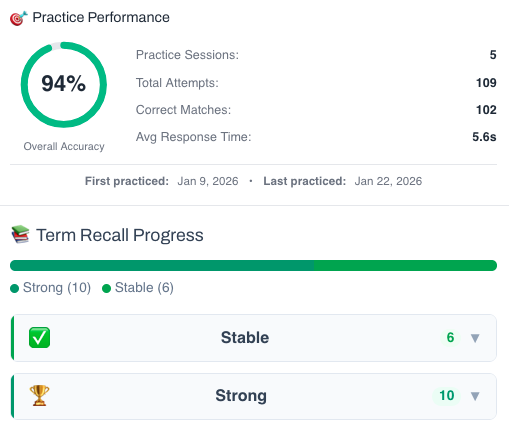
This isn’t a simple quiz — it’s a fully tracked learning system. You build knowledge through recognition, then recall, and your progress feeds directly into the Integrated Practice Bar (Writing tasks, AI Chat, and more).
- Practice sessions, accuracy, and response-time tracking
- Term strength levels (Learning → Stable → Strong)
- Personal progress history for each unit
This feature is available to YSP members.
Explore Membership BenefitsMember-Exclusive Practice Bar
Access a wide range of integrated practice for this unit — from Vocabulary and Grammar activities to AI-curated Writing tasks and Thematic Chat practice.
This feature is available to YSP members.
Explore Membership BenefitsMember-Exclusive Sentence Builder
Reconstruct scrambled sentences to practice word order and develop your grammar intuition.
This feature is available to YSP members.
Explore Membership Benefits