Countable & Uncountable Nouns: Singular, Plural, and Quantities
Core PathWay
1 Section 1. Two Kinds of Nouns
Look around you. What do you see? A chair. Some water. Three books. These are all nouns — words for things. But not all nouns work the same way.
Some nouns are countable. You can count them: one apple, two apples, three apples. Countable nouns have two forms. One thing: singular. More than one: plural.
Some nouns are uncountable. You cannot count them. Think of water. You cannot say one water, two waters. Think of music. Think of bread. These nouns have only one form.
This matters. The words you use before a noun change. Look at this:
A book. Some books. Some water.
Notice: we say a book, not a water. We say some water, not a water. Pay attention to this. It makes a big difference.
2 Section 2. Countable & Uncountable — Singular & Plural
Every noun is countable or uncountable. This tells you what words to use with it. Look at the rules below. They are simple. Use them every time you speak or write.
Focus
- Countable nouns have a singular form and a plural form.
- Uncountable nouns have only one form. No plural.
- Use a/an with a singular countable noun only.
- Use some with plural countable nouns and with uncountable nouns.
- Use any in negative sentences and in questions.
Rules
- Countable singular → use a or an: a cup, an egg.
- Countable plural → add -s or -es: cups, eggs.
- Uncountable → no a/an, no plural -s: water, music, bread.
- Affirmative → use some: I have some apples. I have some milk.
- Negative → use any: I don't have any apples. I don't have any milk.
- Question → use any: Do you have any eggs? Do you have any water?
Examples
- There is a banana on the table. There are some bananas in the bag.
- I don't have any coffee. Do you have any coffee?
- She has some bread. She doesn't have any butter.
Common mistake
Key Terms
3 Section 3. At the Market
Alex and Sam are at a food market. Listen to how they talk about what they need. Notice the words they use before each noun.
💬 Dialogue 1: Shopping at the market
Alex and Sam are at a food market. They are buying food for dinner.
Alex: “Do we have any eggs at home?”
Sam: “No, we don't have any. And there isn't any milk either.”
Alex: “OK. Let's get some eggs and some milk. Do you want a banana?”
Sam: “Yes! And there are some oranges here. They look good.”
Alex: “Great. Is there any bread?”
Sam: “Yes, there's a big loaf over there. And there are some rolls too.”
Alex: “Perfect. I don't have any money. Do you have some?”
Sam: “Yes, I have some. Let's go!”
Key Terms
4 Section 4. What You Know Now
Good work! Now you know two types of nouns.
Countable nouns have two forms. One thing: singular. More than one: plural. Use a or an with one. Use some with more than one.
Uncountable nouns have one form only. No plural. No a or an. Use some with these nouns too.
Use any in negative sentences and questions. This works with both types of noun.
Remember: a banana, some bananas, some milk, any eggs, any water. These small words matter. Use them every time.
Member-Exclusive Practice Bar
Access a wide range of integrated practice for this unit — from Vocabulary and Grammar activities to AI-curated Writing tasks and Thematic Chat practice.
This feature is available to YSP members.
Explore Membership BenefitsMember-Exclusive Vocabulary Review & Acquisition System
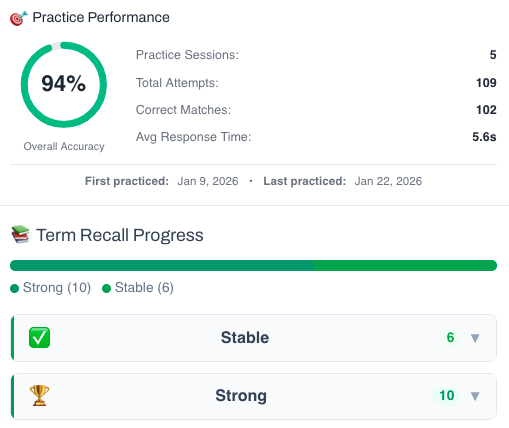
This isn’t a simple quiz — it’s a fully tracked learning system. You build knowledge through recognition, then recall, and your progress feeds directly into the Integrated Practice Bar (Writing tasks, AI Chat, and more).
- Practice sessions, accuracy, and response-time tracking
- Term strength levels (Learning → Stable → Strong)
- Personal progress history for each unit
This feature is available to YSP members.
Explore Membership Benefits>