Things You Cannot Count: A Guide to Uncountable Nouns
Core PathWay1 Section 1. Things We Can Count — and Things We Cannot
Look at these two sentences. ‘I have three bottles of water.’ ‘I have some water.’ The first sentence counts bottles. The second sentence does not count water. This is the key idea of this page.
Some nouns in English are countable. This means we can count them: one car, two cars, three cars. We can use ‘a’ or ‘an’ with them: a cup, an apple. We can make them plural: cups, apples.
Other nouns are uncountable. We cannot count them directly. Think about water. You cannot say ‘one water, two waters’ in normal English. Think about traffic. You cannot say ‘one traffic, two traffics.’ Think about oxygen. You cannot say ‘three oxygens.’ These nouns have no plural form. We do not use ‘a’ or ‘an’ with them.
Now here is something interesting. Some things are uncountable because they are truly impossible to count — like water (you cannot count individual water molecules in a glass) or air. Other things are uncountable because English treats them as a mass, even though you could technically count them. Think about rice — you could count every grain, but nobody does. Think about hair — you could count every strand, but we say ‘she has long hair’, not ‘she has 50,000 hairs.’ English treats these as a single mass, not a collection of individual things.
Uncountable nouns are easy to remember when you put them into groups. Here are five groups with five examples each:
Group 1 — Liquids: water, milk, oil, juice, blood
Group 2 — Gases: air, oxygen, steam, smoke, nitrogen
Group 3 — Materials and Substances: rice, bread, meat, wood, gold
Group 4 — Group Nouns (things we see as a mass): traffic, luggage, furniture, equipment, clothing
Group 5 — Abstract / Intangible Nouns (things you cannot touch): information, advice, luck, time, knowledge
These five groups cover most of the uncountable nouns you will meet in everyday English. Notice that every group has a different reason why the noun is uncountable. Liquids and gases flow and cannot be separated into individual units. Materials like rice or bread are masses. Group nouns describe a collection we see as one thing. Abstract nouns are ideas — you cannot hold them or count them.
2 Section 2. Counting the Uncountable — How We Measure These Nouns
We cannot count uncountable nouns directly. But we can measure them. We use a container, a unit, or a portion word before the uncountable noun. This is called a partitive expression. The pattern is always: [container/unit word] + of + [uncountable noun].
For example: a glass of water, a cup of coffee, a piece of advice.
Here is a handy guide for each group:
Liquids — use a container:
a glass of water | a cup of coffee | a bottle of milk | a carton of juice | a bowl of soup
Gases — we rarely count gases in everyday English, but in science or cooking:
a tank of oxygen | a breath of fresh air | a cloud of smoke | a puff of steam
Materials and Substances — use a unit or portion:
a grain of rice | a slice of bread | a piece of meat | a chunk of wood | a bar of gold
Group Nouns — use a piece or item:
a piece of luggage | a piece of furniture | a piece of equipment | an item of clothing | a vehicle in the traffic (we usually just say ‘a car’ instead)
Abstract Nouns — use a piece or specific unit:
a piece of information | a piece of advice | a moment of luck | a minute of time | a bit of knowledge
Now, here is something useful to know. In everyday spoken English, we often shorten these expressions. We do not always say ‘a cup of coffee.’ We often just say ‘a coffee’. This is very natural. Look at these examples:
‘Can I have a coffee, please?’ (= a cup of coffee)
‘I’d like a water.’ (= a glass/bottle of water — common in restaurants)
‘She gave me a good advice.’ ✗ — But this is wrong. We cannot say ‘a good advice.’ We must say ‘some good advice’ or ‘a piece of good advice.’ The short form only works for drinks and a few foods in informal speech.
So the rule is: you can say ‘a coffee’ or ‘a water’ informally, but you cannot say ‘an information’ or ‘a luck.’ For abstract nouns and most group nouns, always use ‘some’ or ‘a piece of.’
For time, we use specific units: a second, a minute, an hour, a day, a week. These units are countable, so we can say ‘two minutes’ or ‘three hours.’
For chicken and meat, notice that ‘chicken’ can be countable (a chicken = the animal) or uncountable (some chicken = the food). ‘Meat’ is always uncountable: a piece of meat, some meat.
3 Section 3. How Much Do You Use?
Listen to Alex, Sam, and Jordan talking about how much of different things they use or consume each week. Notice how they use ‘how much’, ‘a lot of’, ‘some’, and other quantity expressions with uncountable nouns.
💬 Dialogue 1: How Much Do You Really Use?
Three friends are having coffee together. They start talking about their weekly habits — how much water, coffee, meat, and other things they consume.
📝 Comprehension Check: Food and Drink Habits
Answer the questions based on what you heard in the audio.
Which speaker drinks about two litres of water every day?
Which speaker does NOT eat any meat?
Which speaker spends about sixty minutes a day making meals?
Which speaker had a problem with burnt food two times recently?
Which speaker says they will send helpful links this evening?
Which speaker plans to bring vegetables and rice to a group meal on Saturday?
Alex: “I drink a lot of water every day — maybe two litres. How much water do you drink, Sam?”
Sam: “Not much, honestly. I drink more coffee than water. Probably four cups of coffee a day.”
Jordan: “Four cups? That's a lot! I only have a little coffee in the morning. But I drink a lot of juice — maybe three glasses a day.”
Alex: “What about food? Do you eat much meat, Jordan?”
Jordan: “No, I don't eat any meat. I'm vegetarian. I eat a lot of rice and vegetables every day.”
Sam: “I eat some meat, but not a lot. Maybe chicken twice a week. How much bread do you eat, Alex?”
Alex: “A lot. I love bread. I eat some bread with every meal — breakfast, lunch, and dinner!”
Jordan: “How much time do you spend cooking? I don't spend much time in the kitchen — maybe twenty minutes a day.”
Sam: “I spend about an hour a day cooking. I really enjoy it. I put on some music and it feels easy. I just need a little luck when I try new recipes!”
Alex: “Ha! I need a lot of luck in the kitchen. I burned the rice last week. And the chicken the week before that.”
Jordan: “Do you have any advice for people who want to cook better, Sam? I want to spend less time in the kitchen but eat better food.”
Sam: “Yes! Start simple. Use some fresh ingredients. Cook rice and vegetables first — they are easy and fast. And don't worry — there is no bad luck in cooking, only practice.”
Alex: “That is really good advice. I need some information about easy recipes too. Can you send me some links tonight?”
Sam: “Of course! I have some good websites. I'll send you some information tonight. I have no plans this evening — a lot of free time!”
Jordan: “Perfect! Let's all cook together on Saturday. I'll bring the rice and vegetables. Alex, you bring the bread. Sam, you bring the chicken and a lot of good luck!”
4 Section 4. Your Grammar Guide — Some, Any, A Lot Of, Much, A Little
Now let’s look at the words we use with uncountable nouns to talk about quantity. These words are very important. We use them every day. Each one has a specific job.
Notice the contrast with countable nouns. We say ‘There is a lot of traffic today’ (uncountable) but ‘There are many cars today’ (countable). We say ‘How much water?’ (uncountable) but ‘How many bottles?’ (countable). This guide focuses on the uncountable side.
Focus
- SOME — use in positive (affirmative) sentences with uncountable nouns
- ANY — use in negative sentences and questions with uncountable nouns
- A LOT OF — use in positive sentences to mean 'a large quantity'; works with uncountable AND countable nouns
- MUCH — use in negative sentences and questions with uncountable nouns; in positive sentences, prefer 'a lot of'
- A LITTLE — use in positive sentences to mean 'a small quantity' of an uncountable noun
- LITTLE (without 'a') — use to mean 'almost none'; this has a negative feeling
- HOW MUCH — use to ask about the quantity of an uncountable noun
Rules
- SOME + uncountable noun → positive sentences only. Example pattern: I have some [noun]. There is some [noun].
- ANY + uncountable noun → negative sentences and questions. Example pattern: I don't have any [noun]. Is there any [noun]?
- ANY can also appear in offers when you expect a 'yes' answer — but use SOME for most offers: 'Would you like some water?' NOT 'Would you like any water?'
- A LOT OF + uncountable noun → positive sentences, large quantity. Example pattern: There is a lot of [noun]. I drink a lot of [noun].
- MUCH + uncountable noun → negative sentences and questions in natural English. In positive sentences, 'a lot of' sounds more natural than 'much'. Example: I don't drink much coffee. Do you have much time?
- A LITTLE + uncountable noun → positive sentences, small quantity, neutral or positive feeling. Example: I have a little time. Can I add a little salt?
- LITTLE (no 'a') + uncountable noun → almost none, negative feeling. Example: There is little hope. We have little time — we must hurry.
- HOW MUCH + uncountable noun → questions about quantity. Example: How much water do you drink? How much time do we have?
Examples
- SOME: 'There is some milk in the fridge.' | 'She gave me some good advice.' | 'We need some information about the flight.' | 'Would you like some water?' (offer)
- ANY: 'I don't have any luggage.' | 'Is there any meat in this dish?' | 'We don't have any time.' | 'Do you have any information about the hotel?' (question)
- A LOT OF / MUCH: 'I drink a lot of water every day.' (positive — natural) | 'I don't drink much coffee.' (negative — natural) | 'Do you have much luggage?' (question — natural) | 'I have much work.' (positive — unnatural; say 'a lot of work' instead)
- A LITTLE / LITTLE: 'I have a little time — maybe ten minutes.' (small amount, OK) | 'There is little air in this room — open a window!' (almost none, problem) | 'Add a little salt to the chicken.' (small, positive) | 'She has little luck with cooking.' (almost none, negative)
- HOW MUCH: 'How much water do you drink each day?' | 'How much meat is in the fridge?' | 'How much time do we have before the flight?' | 'How much luggage can I take on the plane?'
Common mistake
5 Section 5. Party Planning — Let's Make a Shopping List
Sam and Alex are planning a party for next weekend. Listen to how they talk about what they need. Notice the uncountable nouns and the quantity expressions they use.
💬 Dialogue 2: The Party Shopping List
Sam and Alex are sitting at a kitchen table with a notepad. They are making a shopping list for a party next Saturday.
📝 Comprehension Check: Shopping List for a Party
Answer the questions based on what you heard in the audio.
Which speaker wants to make a cold dish with rice?
Which speaker says they need six big bottles of something to drink?
Which speaker says the cooking oil at home is finished?
Which speaker asks if they know about any special food needs of the guests?
Which speaker says that at a past event, some people could not eat the food?
Which speaker says there is a small amount of beef at home already?
Sam: “OK, let's make the list. We need a lot of food and some drinks. How much water should we buy?”
Alex: “A lot. Let's get six big bottles. And we need some juice too — not everyone drinks alcohol.”
Sam: “Good idea. What about food? Do we have any meat in the freezer?”
Alex: “A little, but not much. Maybe one small pack of beef. We should buy some chicken — everyone likes chicken.”
Sam: “Agreed. And we need some bread for the table. Oh, and some rice — I want to make a cold rice salad.”
Alex: “Good plan. Do we have any olive oil at home? We need a lot of oil for cooking the chicken.”
Sam: “There isn't any left. The bottle is empty. Add it to the list. How much time do we have before the shops close?”
Alex: “About two hours. That's enough. Oh — do we need any information about the guests? Like food allergies?”
Sam: “Yes! Good point. I'll send a message to everyone now and ask. I hope we have some luck — last time, three people couldn't eat the food.”
Alex: “Ha! Well, we have some good advice from last time — always ask about allergies first. Let's not forget that.”
Sam: “You're right. OK, so the list is: a lot of water, some juice, some chicken, some bread, some rice, and a lot of olive oil. Anything else?”
Alex: “I think that's good. We have a little time now, so let's go to the shop together. And this time — a lot of luck to us both!”
6 Section 6. Writing Practice — Your Weekly Habits
Now it is your turn to write. Use what you have studied on this page. Write about your own habits — how much of different things you use or consume each week.
7 Recap — What You Have Learned
Well done! You have covered a lot of important ideas on this page. Let’s look at the key points.
First, you learned the difference between countable and uncountable nouns. Countable nouns have a plural form and can use ‘a’ or ‘an’. Uncountable nouns have no plural form and cannot use ‘a’ or ‘an’ directly.
You also learned the five groups of uncountable nouns: liquids (water, milk, juice), gases (air, oxygen, steam), materials and substances (rice, bread, meat, wood), group nouns (luggage, furniture, traffic, equipment), and abstract nouns (information, advice, luck, time, knowledge).
You learned that some things are uncountable because we truly cannot count them (like water or air). Others, like rice or hair, we could count in theory — but English treats them as a mass.
You learned how to measure uncountable nouns using partitive expressions: a glass of water, a piece of advice, a grain of rice. And you learned that in informal speech, we can say ‘a coffee’ or ‘a water’ — but not ‘an information’ or ‘a luck.’
Finally, you studied the key quantifiers for uncountable nouns:
— Use some in positive sentences: ‘I have some time.’
— Use any in negatives and questions: ‘I don’t have any luggage. Do you have any advice?’
— Use a lot of for large quantities: ‘We need a lot of water.’
— Use much in negatives and questions: ‘I don’t drink much coffee. Do you have much time?’
— Use a little for small quantities: ‘Add a little salt.’
— Use how much to ask about quantity: ‘How much meat do we need?’
These patterns appear in everyday English all the time — in shopping, cooking, travel, and conversation. The more you notice them, the more natural they will feel.
Member-Exclusive Practice Bar
Access a wide range of integrated practice for this unit — from Vocabulary and Grammar activities to AI-curated Writing tasks and Thematic Chat practice.
This feature is available to YSP members.
Explore Membership BenefitsMember-Exclusive Vocabulary Review & Acquisition System
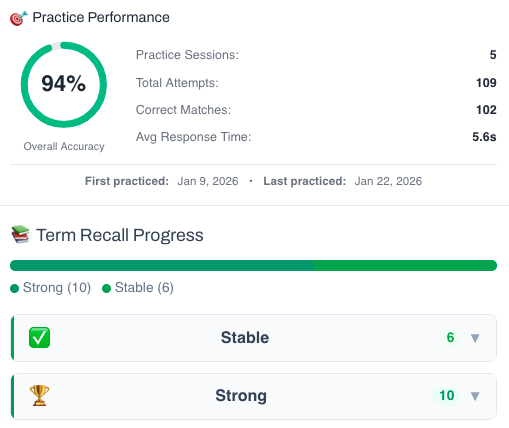
This isn’t a simple quiz — it’s a fully tracked learning system. You build knowledge through recognition, then recall, and your progress feeds directly into the Integrated Practice Bar (Writing tasks, AI Chat, and more).
- Practice sessions, accuracy, and response-time tracking
- Term strength levels (Learning → Stable → Strong)
- Personal progress history for each unit
This feature is available to YSP members.
Explore Membership Benefits🔗 Explore Linked Content
Guides in Italian
Grammatica e lessico ostici, spiegati in italiano — quando l'inglese ha bisogno di una seconda spiegazione.