Module code: 2115

📚 The Terminal that Breathes (B2)

The Airport That Ditched Air Conditioning — and Made It Work

Core PathWay

1 Key Vocabulary

You are going to hear these terms in the article – make sure you know what they mean. greeted, floor-to-ceiling, natural ventilation, built into, carbon dioxide emissions, from scratch, feasible, a risky bet, curves, funnels into, ceiling fans, perceived temperature, closed up, cope with, pitfall

2 The Airport That Ditched Air Conditioning — and Made It Work

0:00 / 4:36
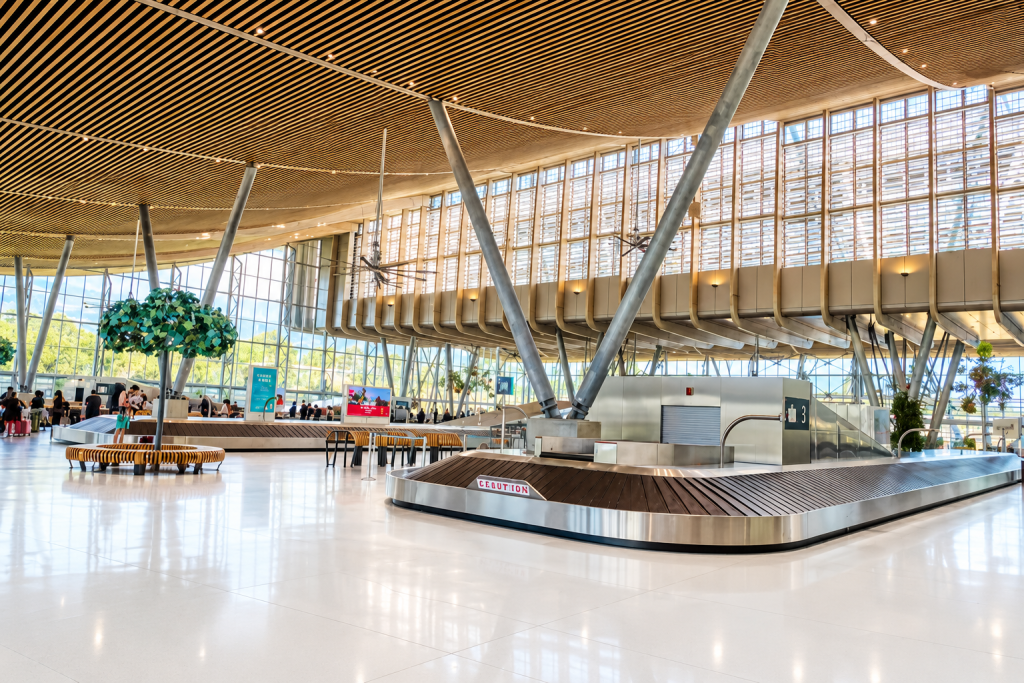
When passengers arrive at Roland Garros airport on Réunion island, they are greeted by floor-to-ceiling windows looking out onto the island’s lush green mountains. Réunion is a French territory in the Indian Ocean, just off the coast of Madagascar, and it sits in the tropical zone south of the equator. Most visitors would expect the icy blast of air conditioning the moment they step inside. However, the arrivals terminal is kept cool by a gentle tropical breeze instead — the result of natural ventilation built into the building’s unique design.
The project began in 2016, as part of a broader effort by airport management to reduce its carbon dioxide emissions — the greenhouse gases released into the atmosphere that contribute to climate change. Marc Delanoë, who was leading the airport’s environmental and energy team at the time, decided from the very beginning that the new arrivals terminal, which was being built completely from scratch, would not use air conditioning at all.
“I took on the responsibility to prove to my management that not using air conditioning was feasible,” said Delanoë, who is now the airport’s sustainable development director. “So, from the start, we never thought of air conditioning as an option for this building. It was a risky bet, but the further we went with our studies, the more we realised that we were right.”
The terminal opened in 2024. Its roof curves upward gently from both long sides of the rectangular building in a wave-like shape. Rather than meeting in the middle, the two sides of the roof stop short, creating an open gap known as a “canyon”. This gap produces an area of low pressure, which funnels wind into the building through vents on each side. The vents can be adjusted depending on the weather conditions outside.
Inside the terminal, ceiling fans — each with a diameter of 7.5 metres (24.6 feet) — help to circulate the air throughout the space. During Réunion’s wet summers, which run from approximately November to April, outdoor temperatures reach 30m degrees centigrade with high humidity. The airflow created by the design reduces the perceived temperature — that is, how hot the air actually feels to a person — by four to five degrees. This brings comfort levels close to what air conditioning would normally achieve.
In the island’s dry winter months, when coastal daytime temperatures drop to 25 degrees centigrade or below, less air is allowed to flow through the building. If a cyclone strikes, the entire building is closed up for safety.
The lead architect on the project was the firm AIA Life Designers, which argued that the building industry relies too heavily on temperature control as the only way for people to cope with heat — in other words, to manage it and stay comfortable.
“It is precisely this pitfall — understanding summer comfort solely through the lens of indoor temperature — that we want to dismantle,” said Éric Bussolino, the firm’s engineering and environment director. A pitfall is a hidden danger or a mistake that is easy to make without realising it. “This pitfall traps us in the logic of air conditioning as the only answer to comfort requirements.”
Bussolino explained the team’s goal clearly: “Our objective is to maintain an indoor air temperature identical to the outdoor temperature while generating an airflow of 1 metre per second to reduce the perceived temperature for passengers.”
AIA was selected for its expertise in airport design. The firm worked alongside a local architect, Olivier Brabant, who brought specialist knowledge of building for Réunion’s tropical maritime climate. Delanoë noted that architects on the island were already applying natural ventilation successfully across a range of buildings — offices, libraries, and even a university lecture hall designed by Brabant himself. “We simply had to change the scale,” Delanoë said.
For Delanoë, the approach also connects to the island’s architectural history. “You have to channel the air, play with the elements… That’s exactly what our ancestors did on La Réunion,” he said. “They built houses according to the direction of the wind, with a central corridor, and they opened the windows or closed the doors depending on the amount of air they wanted to let in. If they were cold, they closed them; if they were hot, they opened them.”

3 Get Ready to Speak

Think about these questions before your discussion. There are no right or wrong answers — just share your ideas and opinions.

1. Would you feel comfortable spending time in a busy airport terminal that uses no air conditioning? What would make you more or less willing to accept it?
2. The designers described their decision as “a risky bet.” Can you think of a time when you or someone you know took a risk on an unconventional idea — and was it worth it?
3. Do you think buildings in your country could realistically use natural ventilation instead of air conditioning? What would be the main challenges?
4. The article mentions that traditional houses on Réunion were designed to work with the wind rather than against it. What traditional building techniques or designs from your own culture do you find interesting or worth preserving?
5. Some people argue that modern technology has made us forget how to live with the natural environment. Do you agree? Where do you draw the line between comfort and sustainability?
6. If you were responsible for designing a new public building — a school, a hospital, or a library — how much importance would you give to environmental sustainability compared to passenger or user comfort?

🔒

Member-Exclusive Practice Bar

Access a wide range of integrated practice for this unit — from Vocabulary and Grammar activities to AI-curated Writing tasks and Thematic Chat practice.

This feature is available to YSP members.

Explore Membership Benefits


🔒

Member-Exclusive Vocabulary Review & Acquisition System

Vocabulary practice stats and progress dashboard preview

This isn’t a simple quiz — it’s a fully tracked learning system. You build knowledge through recognition, then recall, and your progress feeds directly into the Integrated Practice Bar (Writing tasks, AI Chat, and more).

  • Practice sessions, accuracy, and response-time tracking
  • Term strength levels (Learning → Stable → Strong)
  • Personal progress history for each unit

This feature is available to YSP members.

Explore Membership Benefits
Page 2 of 2 Next (Coming Soon) →