
Performance Reviews and Appraisals: Understanding the Purpose and the Language
Core PathWay
1 Section 1. Looking Back to Move Forward: Why Appraisals Matter
There is an old idea that experience is the best teacher. But experience alone is not enough — reflection is what turns experience into learning. The same is true for organisations. A business that never stops to evaluate what its people are doing, how well they are doing it, and where they could improve, is a business that is running on instinct rather than insight.
This is where the performance appraisal comes in. Also called a performance review, this is a structured process in which an employee’s work is formally evaluated over a set period. Most organisations hold an annual appraisal — a full review that takes place once a year — though many also schedule an interim review midway through the year to check progress and adjust goals before the formal cycle ends. Together, these form the backbone of what many HR professionals now call continuous performance management: the idea that feedback and development should be ongoing, not just an annual event.
But why do organisations invest time and resources in these processes? The reasons go well beyond simply checking whether targets have been met.
Improving individual performance is the most obvious purpose. A well-run appraisal identifies what an employee does well and where development is needed. Crucially, it creates a space for honest conversation — something that rarely happens naturally in the day-to-day rush of work.
Motivating staff is equally important. Research consistently shows that employees who receive regular, structured feedback feel more valued and more engaged. Knowing that their efforts are being noticed — and that their career development is being taken seriously — gives people a reason to invest in their work.
Succession planning is a strategic reason that is sometimes overlooked. Organisations need to identify future leaders and high-potential employees before those roles become vacant. The appraisal process provides a structured opportunity to spot talent, assess readiness, and plan development paths accordingly.
Encouraging better communication is perhaps the most underrated benefit. A formal review creates a protected space for conversations that might otherwise never happen — about workload, ambitions, concerns, and expectations. When done well, an appraisal can transform the relationship between a manager and their team.
Supporting fair decision-making around pay, promotion, and restructuring is another key function. Documented appraisal records provide evidence that decisions are based on performance rather than personal preference — which matters both ethically and legally.
Finally, appraisals help organisations identify training needs at both individual and team level. If several employees are struggling in the same area, that is not just a personal issue — it is an organisational signal that something needs to change.
In short, a performance appraisal is far more than a formality. Used well, it is one of the most powerful tools a business has for developing its people and strengthening its culture.
Key Terms
2 Section 2. ‘We Need a System’: Two Managers Discuss Appraisals
Alex and Sam are managers at a rapidly growing tech start-up. The company has expanded quickly, but it has never had a formal appraisal process. Listen to their conversation as they discuss whether it is time to change that — and what kind of system might work best.
💬 Dialogue 1: Building an Appraisal System from Scratch
A meeting room at a fast-growing tech start-up. Alex and Sam, both department managers, have set aside time to discuss the company’s lack of a formal appraisal process.
Alex: “I’ve been thinking about this for a while, Sam. We’ve grown from twelve people to nearly sixty in under two years, and we still don’t have any kind of formal appraisal process. I think we’ve reached the point where that’s actually becoming a problem.”
Sam: “I know what you mean. We used to just have a chat over coffee when something came up — and honestly, that worked fine when we all sat in the same room. But now? Half my team don’t even know what their targets are supposed to be.”
Alex: “Exactly. And it’s not just about targets. I’ve had two people leave in the last quarter, and when I asked them why, both of them said they felt like no one was paying attention to their development. That stings — especially when I thought we had a good culture here.”
Sam: “So what are you thinking? Do we go straight for a full performance review cycle, or do we start smaller? I’d hate to design something so complicated that managers just ignore it.”
Alex: “That’s exactly what I want to talk through. I think we start with two layers. The first is something light and ongoing — structured 1:1 check-ins, maybe monthly. Not a formal review, but documented. It keeps the conversation going without making it feel like a big event.”
Sam: “I like that as a foundation. But is it enough on its own? If someone is genuinely underperforming, a monthly chat might not give you the structure you need to actually address it properly.”
Alex: “Fair point. That’s why I think we’d also need an annual appraisal — a proper sit-down, fully documented, with a shared appraisal template so that every manager is evaluating people against the same criteria. Otherwise you end up with twelve different conversations and twelve different standards.”
Sam: “Agreed. Consistency matters a lot, especially once you’re at our size. But what about the format of the review itself? Are we talking a standard manager-to-employee conversation, or something broader?”
Alex: “That’s where it gets interesting. The simplest option is a manager assessment — the line manager evaluates the employee based on their own observations. It’s straightforward and easy to run. But it only gives you one perspective, and that perspective has blind spots. A 360-degree appraisal is more ambitious — it brings in peer feedback from colleagues, upward feedback from direct reports, and sometimes even input from clients. You get a much fuller picture of how someone is actually performing.”
Sam: “I can see the value in that, but I worry about the complexity at our stage. Peer feedback is manageable — colleagues generally know each other’s work. But upward feedback, where your team evaluates you as their manager, requires a real culture of trust. If people don’t feel safe, they’ll just write whatever they think is expected.”
Alex: “That’s a really valid concern. Maybe the 360 is something we build towards rather than launch with. For now, we could start with a self-assessment component alongside the manager assessment. At the very least, that gets employees actively reflecting on their own performance rather than just sitting there waiting to receive a verdict.”
Sam: “I like that a lot. And self-assessment tends to make the appraisal discussion itself much more balanced. When the employee has already thought about what went well and what didn’t, the conversation feels less like a judgement being handed down and more like a genuine two-way dialogue.”
Alex: “Exactly. And we should build in an interim review at the six-month mark — not a full appraisal, but a structured check-in to see whether goals are still realistic and whether anything needs to change before the year-end. A lot can shift in six months, especially in a business moving as fast as ours.”
Sam: “So the picture I’m getting is: monthly 1:1s as the ongoing layer, a mid-year interim review, and a full annual appraisal with self-assessment and manager assessment combined. That feels manageable. And if the culture develops well, we could layer in 360 feedback further down the line.”
Alex: “That’s exactly my thinking. But the system is only as good as the people running it. The appraiser — the manager conducting the review — needs to know how to have a difficult conversation without it becoming adversarial. And the appraisee — the person being reviewed — needs to feel that the process is genuinely in their interest, not just a box-ticking exercise.”
Sam: “Agreed. Let’s put together a proposal for the leadership team. I think once people see a clear structure laid out, they’ll get behind it. Right now, the absence of any system is doing more damage than we realise — and the people feeling it most are the ones we can least afford to lose.”
Key Terms
3 Section 3. Opening the Door: How to Make Appraisals Genuinely Useful
A performance appraisal is only as good as the conversation it produces. You can have the most carefully designed appraisal template, a well-trained appraiser, and a thorough self-assessment from the appraisee — and still walk away from the meeting having learned almost nothing of value. The difference between a productive appraisal and a wasted one usually comes down to a single factor: whether the conversation is genuinely open.
Fostering that openness is not as simple as telling people to ‘be honest’. It requires deliberate preparation, the right physical and psychological environment, and a set of communication techniques that experienced appraisers develop over time.
Prepare — and signal that you have prepared. Nothing closes down a conversation faster than an appraisee who senses that their manager has skimmed their file five minutes before the meeting. Before any appraisal discussion, the appraiser should review previous goals, re-read any notes from 1:1 check-ins throughout the year, and consider specific examples — both positive and developmental — that they want to raise. When the appraisee sees evidence of genuine preparation, trust increases immediately.
Start with the employee’s voice. One of the most effective techniques is to open the appraisal discussion by asking the appraisee to speak first. A simple question — ‘How do you feel the year has gone overall?’ — immediately signals that this is a two-way conversation, not a verdict being delivered from above. In organisations that use self-assessment, sharing the employee’s written reflections at the start of the meeting serves the same purpose: it centres the employee’s perspective before the manager offers their own.
Ask open questions — and then listen. Closed questions (‘Did you meet your targets?’) produce closed answers. Open questions (‘What do you think held you back from hitting that target?’) produce insight. The best appraisers are skilled listeners who resist the urge to fill silences, who follow unexpected answers with curiosity rather than redirecting back to their script, and who treat the conversation as a genuine discovery process rather than a checklist to complete.
Separate feedback from judgement. Feedback that focuses on specific behaviours and their impact (‘When the report was submitted late, the client had to reschedule — that had a knock-on effect on the whole team’) lands very differently from feedback that feels like a character assessment (‘You’re disorganised’). Specific, behaviour-focused feedback is easier to hear, easier to act on, and far less likely to put the appraisee on the defensive.
Make development the destination. The most productive appraisal discussions end with a clear, agreed plan — not just a record of what went wrong. Whether the outcome is a formal training programme, a stretch assignment, or simply a set of revised goals for the next interim review, the employee should leave the room knowing exactly what support they will receive and what is expected of them.
Organisations that embed these principles into their culture — and that treat the annual appraisal not as an isolated event but as part of a broader commitment to continuous performance management — tend to see measurable improvements in both performance and retention. The appraisal, done well, is not something that happens to employees. It is something that happens with them.
Key Terms
4 Section 4. When It Goes Wrong: A Difficult Appraisal Debrief
Not every appraisal goes according to plan. Jordan and Chris, two HR managers, are debriefing after a performance review that broke down badly. As you read, notice what went wrong — and think about what the appraiser could have done differently.
💬 Dialogue 2: The Appraisal That Went Off the Rails
The HR department of a mid-sized company. Jordan and Chris are HR managers reviewing the outcome of a recent appraisal that ended badly, with the appraisee becoming visibly distressed and the meeting ending early.
Jordan: “So I’ve read the notes from the appraisal, and I’ve spoken to both parties separately. Honestly, Chris, I’m not sure where to start. It sounds like it was difficult from the first five minutes.”
Chris: “It really was. From what I understand, the appraiser — Marcus — went straight into the areas of concern without any kind of warm-up. No acknowledgement of what had gone well, nothing. The appraisee, Priya, told me she felt like she was being put on trial.”
Jordan: “That’s a classic mistake with inexperienced appraisers. They’re so focused on getting through the difficult points that they forget the conversation needs to feel safe before it can be honest. Did Marcus even look at Priya’s self-assessment before the meeting?”
Chris: “That’s the thing — he hadn’t. Priya had spent a good hour on it, reflected carefully on the year, and had actually flagged some of the same issues herself. But Marcus hadn’t read it. So when he raised those same points as if they were revelations, Priya felt like her voice had been completely ignored.”
Jordan: “That would put anyone on the defensive. The whole point of a self-assessment is to open the conversation, not to be filed away unread. If Marcus had started the appraisal discussion by acknowledging what Priya had written, the dynamic would have been completely different.”
Chris: “Absolutely. And then the feedback itself — it wasn’t specific. Priya told me he used phrases like ‘you need to be more proactive’ and ‘your communication style is an issue’. Nothing concrete, nothing she could actually act on. She said it felt like a character attack rather than a professional conversation.”
Jordan: “That’s the difference between judgement and feedback. If Marcus had said something like, ‘There were three occasions in Q3 where the client didn’t receive an update until they chased us — that created problems downstream,’ Priya could have responded to that. She could have explained her side, or agreed and committed to a change. Instead, she just shut down.”
Chris: “And once she shut down, Marcus didn’t know what to do. He kept pushing, which made things worse. He told me afterwards that he thought he was being persistent, but Priya experienced it as being pressured. He never tried to draw her out — no open questions, nothing that gave her space to respond in her own words.”
Jordan: “That’s a skill issue, not a character issue. Marcus is a good manager in most respects, but he’s never had proper training on how to conduct an appraisal discussion. There’s a real difference between managing someone day-to-day and running a structured, high-stakes conversation about their annual performance.”
Chris: “I agree. And the format didn’t help either. There was no appraisal template being followed — Marcus was essentially improvising. So the conversation had no clear structure, no agreed agenda, and no natural point where Priya could contribute her own perspective.”
Jordan: “Right. A good template isn’t bureaucracy — it’s a map. It tells both parties what to expect, when they’ll have a chance to speak, and what the meeting is actually trying to achieve. Without that structure, you just have two people in a room with different expectations and a significant power imbalance.”
Chris: “So what do we do now? We can’t just leave it here. Priya is genuinely talented — we don’t want to lose her over a badly handled meeting. And if word gets around that appraisals are something to dread, it undermines the whole process.”
Jordan: “First, I think we need to acknowledge what happened — formally, to Priya. Not blame Marcus publicly, but make it clear that we take the process seriously and that what she experienced was not what an appraisal discussion should look like. Then we schedule a follow-up meeting, properly prepared on both sides, with the template in place.”
Chris: “And for Marcus — what’s the plan? I don’t think he acted in bad faith. He just didn’t have the tools.”
Jordan: “Training. Proper appraiser training, not just a handout. He needs to practise using open questions to draw people out, learn how to deliver behaviour-focused feedback without it feeling like an attack, and understand that reading the self-assessment before the appraisal discussion is not optional — it’s the foundation of the whole conversation. If we’re moving towards continuous performance management across the organisation, every manager needs to be equipped for this, not just the confident ones.”
Chris: “Agreed. And maybe this is the moment to make the case to leadership for a proper rollout — standardised appraisal templates, mandatory appraiser training, the works. One difficult appraisal is recoverable. A culture of poorly run appraisals isn’t.”
5 Section 5. Now It’s Your Turn: Speaking and Reflection Prompts
Now reflect on and get ready to speak about these points. There are no right or wrong answers here — the goal is to think carefully, use the vocabulary you have studied, and share your perspective with others in your group.
—
Prompt 1: The Snap Appraisal
Imagine your manager calls you into a meeting room and tells you that your annual appraisal is happening right now — with no advance warning and no time to prepare. How would you feel? Do you think a self-assessment completed under pressure is useful? Would you be able to speak honestly about your performance without preparation time, or would you find yourself saying what you thought the manager wanted to hear?
Prompt 2: The Uninvited Guest
You arrive for your regular appraisal discussion and find that the Managing Director — someone you rarely interact with directly — is sitting in the room. Your manager explains that senior leadership is ‘observing the process’. How would this change the dynamic of the conversation? Would you still feel comfortable raising concerns or admitting areas of weakness? What does this scenario tell us about the importance of psychological safety in appraisals?
Prompt 3: Giving Upward Feedback
Your organisation has introduced a 360-degree appraisal system, and you are now asked to give upward feedback on your manager’s performance — in writing, but not anonymously. Your manager has significant strengths, but there is one area where their behaviour has genuinely affected your team. Do you write honestly, or do you soften the feedback? What factors would influence your decision? What would need to be true for you to feel safe giving completely honest upward feedback?
Prompt 4: The Appraisal That Changed Everything
Think about a time — in your own career or in a situation you have witnessed — when a performance review had a significant impact, either positive or negative. What made it so memorable? Was it the way feedback was delivered? The outcome? The relationship between the appraiser and the appraisee? If you could redesign that appraisal with everything you now know, what would you change?
Prompt 5: Continuous vs Annual
Some organisations are moving away from the traditional annual appraisal towards continuous performance management, with regular 1:1 check-ins and interim reviews replacing the once-a-year formal meeting. Do you think this is an improvement? Are there situations where a formal annual review still has value that more frequent, informal conversations cannot replace? Consider both the employee’s and the organisation’s perspective.
Prompt 6: The Appraisal You Would Design
If you were the HR Director of a new company and could design the appraisal system from scratch, what would it look like? Would you use a 360-degree appraisal, a standard manager assessment, or something else? Would you include peer feedback? How would you ensure that the process felt fair, useful, and genuinely motivating — rather than just a bureaucratic requirement? What would success look like one year after launch?
6 Section 6. Recap: What You Have Covered
You have covered a lot of ground in this content. Here is a summary of the key ideas and language.
What appraisals are and why they matter. A performance appraisal — also called a performance review — is a structured process for evaluating an employee’s work over a set period. Organisations use appraisals for a wide range of reasons: to improve individual performance, to motivate staff, to support succession planning, to encourage better communication, and to identify training needs. These are not separate benefits — they reinforce each other.
The main types of appraisal. The annual appraisal is the traditional full review, but most modern organisations also use interim reviews and regular 1:1 check-ins as part of a broader commitment to continuous performance management. In terms of who provides feedback, a standard manager assessment gives one perspective, while a 360-degree appraisal gathers input from peers (peer feedback), direct reports (upward feedback), and the employee themselves (self-assessment).
The roles in an appraisal. The person who conducts the appraisal is the appraiser. The person being assessed is the appraisee. Both have responsibilities: the appraiser must prepare thoroughly and create a safe environment for honest conversation; the appraisee must reflect genuinely and engage openly in the appraisal discussion.
What makes an appraisal work. The dialogue in Section 4 showed clearly what happens when the principles from Section 3 are ignored: an unprepared appraiser, an unread self-assessment, vague feedback, and no structure. The result was a conversation that damaged trust rather than building it. In contrast, a well-run appraisal uses specific, behaviour-focused feedback, open questions, and a clear appraisal template to ensure both parties feel heard and the conversation leads somewhere useful.
The language of appraisals. You have studied the core vocabulary of this field — the terms that professionals use when designing, running, and discussing appraisal systems. Use the vocabulary recap to review and consolidate these terms before your next session.
Member-Exclusive Practice Bar
Access a wide range of integrated practice for this unit — from Vocabulary and Grammar activities to AI-curated Writing tasks and Thematic Chat practice.
This feature is available to YSP members.
Explore Membership BenefitsMember-Exclusive Vocabulary Review & Acquisition System
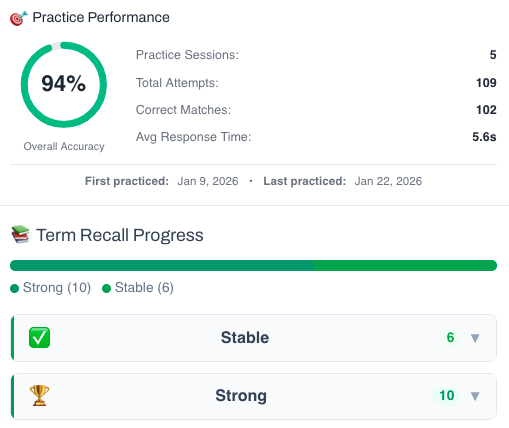
This isn’t a simple quiz — it’s a fully tracked learning system. You build knowledge through recognition, then recall, and your progress feeds directly into the Integrated Practice Bar (Writing tasks, AI Chat, and more).
- Practice sessions, accuracy, and response-time tracking
- Term strength levels (Learning → Stable → Strong)
- Personal progress history for each unit
This feature is available to YSP members.
Explore Membership Benefits🎮 Practice Games
Sentence Scrambler
Appraisals and Performance Reviews – Sentence Scramble
Member-Exclusive Sentence Builder
Reconstruct scrambled sentences to practice word order and develop your grammar intuition.
This feature is available to YSP members.
Explore Membership Benefits