What Can You See?
In this lesson, you will look closely at a painting and practise describing what you see in accurate, detailed English. First, spend a moment studying the image, then review the key vocabulary below before you listen to the descriptions. After listening, you will complete a series of writing tasks that ask you to describe and respond to the painting in your own words.
📚 Key Vocabulary
Before you listen, study these words. You will hear them in the description.
🎧 Listen
Before: Before you listen, look at the painting carefully for about 30 seconds and notice the colours, shapes, and overall mood.
While listening: As you listen, pay attention to the key vocabulary words and notice how they are used to describe specific parts of the painting.
After: After listening, read through the description again and find each vocabulary word in context to see exactly how it is used.
📖 1 · Short description 🎧
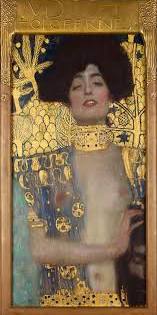
The painting shows a single female figure against a gold background, depicted from the waist up. She has dark hair, partially covered by a gold headpiece, and wears a wide jewelled collar. Her upper torso is partially bare, and a dark garment is draped across the lower part of her body. Circular gold motifs appear on the garment and in the surrounding background. Her right hand, positioned at the lower right of the canvas, holds a partially cropped dark-haired head that is cut off by the frame. The gilded frame is wide and embossed with decorative patterns. An inscription is visible across the top of the frame. The background is flat and covered in gold, with patterning that reflects Byzantine decorative traditions.
📖 2 · Full description 🎧
The painting has a quality of controlled intensity. The woman's tilted head and half-closed eyes suggest neither fear nor urgency, but something closer to satisfaction or reverie. The overwhelming gold of the background and frame creates a sense of richness that borders on the suffocating, as though the world outside this moment does not exist. The partially cropped head at the lower edge introduces an element of unease — easy to miss, yet impossible to ignore once seen. Klimt's use of flat, decorative patterning removes any sense of naturalistic depth, which gives the figure an iconic, almost ceremonial quality, as though she belongs more to myth than to any recognisable moment in time.
📖 3 · The story behind the picture 🎧
The painting depicts a moment from the biblical story of Judith, a widow who seduced and then beheaded the Assyrian general Holofernes in order to save her people. Klimt's Judith, however, does not appear to be a woman in distress or in the grip of moral conflict. She may have acted with deliberate calculation, and the expression she wears suggests the deed is already done. The head she holds has been partially hidden by the frame, as though Klimt wanted the viewer to discover it gradually — to look first at the woman's face and only then to register what her hand is holding. What happens next in the story is already settled: Judith will return to her people as a hero. But in this frozen moment, Klimt seems more interested in who she is than in what she has done.
Now it's your turn
Now that you have studied the painting and listened to how it can be described, it is your turn to put those ideas into words. Use the vocabulary you have learned and the details you noticed to complete the writing tasks below.
💬 Discussion
• Does the overall tone and palette of this painting create a positive or unsettling mood for you, and what specifically produces that effect?
• If you were to describe the focal point of this painting to someone who could not see it, which details would you choose to highlight and why?
• Have you ever visited a gallery or seen a painting in person that affected you strongly? What was it about the composition or use of contrast that made it memorable?