CAE Review Writing – The Complete Guide to a Top-Scoring Review
Core PathWay
1 🔍 What's This Task Type?
In the CAE Writing paper, the review is one of the options in Part 2. Your goal is to write a review of a book, film, concert, product, or experience. The communicative purpose is to give your personal opinion while also informing and entertaining the target reader — typically a magazine or website audience. Unlike an essay, a review is more subjective and engaging, but it must still be balanced. You need to describe, analyze, and evaluate, not just summarise. The examiner looks for Content (all points covered), Communicative Achievement (appropriate style and tone), Organisation (logical flow and cohesion), and Language (range and accuracy). A top-band review shows sophisticated vocabulary, nuanced judgments, and a clear recommendation. Remember, you’re writing for a general audience, so keep it lively but controlled.
Key Terms
💬 Balancing Praise and Criticism
Coach and student discuss how to make a review balanced rather than just positive.
2 🗺️ Planning Tips
Start by analysing the rubric carefully. Underline the key content points — for example, if the task asks you to describe the plot, comment on the acting, and say whether you’d recommend it, list these on your note paper. This is the ‘Write to the Rubric’ strategy. Then brainstorm ideas for each point: what specific details, examples, and collocations can you use? Avoid writing about unrelated topics. Next, create a structure plan: decide how many paragraphs you’ll need and what each will cover. Draw a quick outline with paragraph boxes, and in each box jot down the content point, target lexis, and linkers. For a C1 review, plan to use mixed conditionals (e.g., ‘If you’re a fan of X, you’ll love…’) and advanced vocabulary like captivate or insightful. Finally, check that you have a clear recommendation — the examiner expects a decisive conclusion.
Key Terms
💬 Avoiding a Report-Style Review
Student asks why their review sounded too formal, like a report.
3 🏗️ Structure & Format
A well-structured review typically has four paragraphs: an introduction that hooks the reader and states the subject; a main body with two paragraphs — one describing key features, the other giving your evaluation; and a conclusion with an overall recommendation. Use a title that grabs attention, e.g., ‘A Masterpiece of Modern Cinema’. For CAE, aim for 220–260 words. Use cohesive devices like ‘in addition’, ‘nevertheless’, and ‘whereas’ to link ideas. The register should be semi-formal to informal — engaging but not slangy. Avoid overly long paragraphs; keep each focused on one main point. Use advanced grammar naturally: cleft sentences (‘What really stands out is…’), participle clauses (‘Having watched it twice, I can say…’), and inversion (‘Not only is it entertaining, but it also…’). The assessment criteria reward sophisticated organisation and flexible use of cohesive devices.
Key Terms
💬 Using Advanced Grammar for Impact
Student wants to know how to include advanced grammar without sounding forced.
4 💬 Useful Language
To achieve a C1 level, use less common vocabulary and complex grammar naturally. For describing: ‘The film captivates the audience from the opening scene.’ For evaluating: ‘The performances are compelling, yet the pacing falls short.’ For recommending: ‘If you’re a fan of psychological thrillers, this is not to be missed.’ Use mixed conditionals to speculate: ‘Had the director focused more on character development, the film would have been a classic.’ Use cleft sentences for emphasis: ‘What truly sets this novel apart is its insightful portrayal of human nature.’ Use advanced passive structures for an objective tone: ‘The product is designed with the user in mind.’ Use inversion for style: ‘Not only does it entertain, but it also educates.’ Avoid overused phrases like ‘very good’ or ‘I liked it’ — instead, say ‘noteworthy‘ or ‘impressive‘.
Key Terms
5 ✅ Do's and Don'ts
Do:
– ✓ Address all content points from the rubric.
– ✓ Use a balanced approach — mention both strengths and weaknesses.
– ✓ Write a clear recommendation at the end.
– ✓ Use engaging language and a variety of cohesive devices.
– ✓ Practise writing within the word limit.
Don’t:
– ✗ Don’t just summarise the plot or product — evaluation is key.
– ✗ Don’t use overly informal slang or text-speak.
– ✗ Don’t forget the target reader — write as if for a magazine.
– ✗ Don’t include irrelevant details that waste words.
– ✗ Don’t neglect grammar accuracy; errors reduce your Language score.
Common mistakes:
– Writing a report instead of a review (reviews are more personal).
– Forgetting to give a recommendation.
– Using repetitive vocabulary.
– Overusing ‘I think’ — vary your language.
Key Terms
6 ⏱️ Timing Strategy
In the CAE Writing paper, you have 1 hour 30 minutes for both parts. For Part 2, allocate about 45 minutes for the review. Break it down as:
– 5 minutes: Read the rubric and underline content points.
– 5 minutes: Brainstorm ideas and plan your paragraphs.
– 30 minutes: Write the review, following your plan.
– 5 minutes: Review and correct errors.
During writing, keep an eye on the clock. If you find yourself stuck, move on to the next paragraph and come back later. Ensure you leave time to check for grammar, spelling, and punctuation errors. A polished review with a few minor slips will score higher than a rough draft with many mistakes. Also, remember to count your words — aim for 220–260. If you’re short, add a detail; if you’re over, cut redundant phrases.
Key Terms
Member-Exclusive Practice Bar
Access a wide range of integrated practice for this unit — from Vocabulary and Grammar activities to AI-curated Writing tasks and Thematic Chat practice.
This feature is available to YSP members.
Explore Membership BenefitsMember-Exclusive Vocabulary Review & Acquisition System
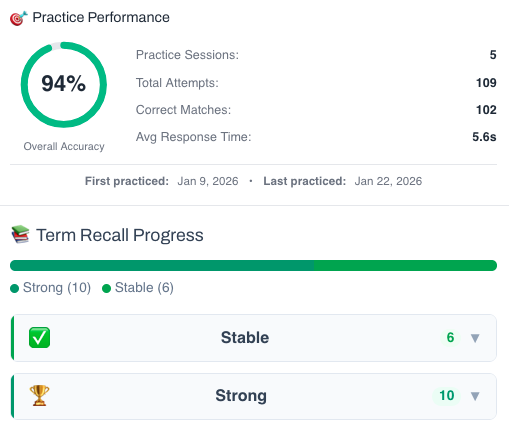
This isn’t a simple quiz — it’s a fully tracked learning system. You build knowledge through recognition, then recall, and your progress feeds directly into the Integrated Practice Bar (Writing tasks, AI Chat, and more).
- Practice sessions, accuracy, and response-time tracking
- Term strength levels (Learning → Stable → Strong)
- Personal progress history for each unit
This feature is available to YSP members.
Explore Membership Benefits🎮 Practice Games
Sentence Scrambler
CAE REVIEW – Sentence Scramble
Member-Exclusive Sentence Builder
Reconstruct scrambled sentences to practice word order and develop your grammar intuition.
This feature is available to YSP members.
Explore Membership Benefits