Ache, Pain, Hurt, Injury: Precision Language for Medical Settings
Core PathWay1 Section 1. Why Precision Matters: Describing Discomfort in Medical Settings
In a medical setting, words matter. When a patient says ‘it hurts’, that is a starting point — not a full description. A doctor needs to know much more. Is the discomfort constant or does it come and go? Is it mild or intense? Where exactly is it? The right words help doctors make faster and better decisions.
Four key terms do most of the work here: ache, pain, hurt, and injury. Each one means something different, and each one behaves differently in a sentence. For example, pain can be countable or uncountable. Hurt works as a verb. Ache works as both a noun and a verb. And injury always refers to physical damage to the body.
Adjectives are just as important as the nouns and verbs. A sharp pain feels like a knife. A dull ache is low-level and constant. A stabbing pain comes suddenly and feels intense. A recurring pain keeps coming back. A sudden pain starts without warning. These adjectives give doctors the detail they need.
When someone is in pain, they are experiencing discomfort right now. This phrase — to be in pain — is very common in medical English. You will also hear phrases like ‘the pain is getting worse’ or ‘I have a dull ache in my lower back.’ Learning these patterns will help you communicate clearly, whether you are the patient, the nurse, or the doctor.
Key Terms
2 Section 2. Deep Dive: Ache and Pain
These two terms are close in meaning, but they work differently. Pay attention to how each one is used — the grammar and the adjectives are not the same. Notice especially that pain has two grammatical lives: it can be countable or uncountable depending on what you want to say.
ache (noun and verb)
- She had a constant dull ache in her lower back that had been there for three weeks.
- After the long shift, his legs ached and he could barely walk to the car park.
pain (uncountable noun)
- The patient was clearly in pain and needed immediate attention.
- The medication helped to relieve the pain, and she was able to sleep through the night.
pain (countable noun)
- He felt a sudden, sharp pain in his left arm and sat down immediately.
- She described a stabbing pain in her side that came and went throughout the day.
3 Section 3. Dialogue: Doctor and Patient — Describing Aches and Pains
A patient visits her doctor with ongoing discomfort. Watch how the doctor asks precise questions to help the patient find the right words for what she is feeling.
💬 Dialogue 1: Getting the Details Right
A GP consultation room. The patient, Maya, has come in about ongoing discomfort. The doctor, Dr. Chen, is trying to build a clear picture of her symptoms.
📝 Comprehension Check: Back Pain Consultation
Answer the questions based on what you heard in the audio.
Which speaker asks the other person to give a number to show how bad the pain is?
Which speaker says the problem has happened before but got better without any treatment?
Which speaker says they want to look at the other person's body before talking about next steps?
What does Maya say about the mild pain she feels most of the time?
Why does Dr. Chen say it is important to find out what type of problem is causing the pain?
What does Maya say about how the pain is affecting her right now, during the appointment?
Dr. Chen: “Good morning, Maya. What brings you in today?”
Maya: “It's my back, doctor. It's been bothering me for a few weeks now. I'm not sure how to describe it exactly — I'm just in pain.”
Dr. Chen: “I understand. Let's try to get a clearer picture. Would you say it's more of a constant dull ache, or do you get sudden, sharp pains?”
Maya: “It's mostly a dull ache, I think. It's always there in the background. But sometimes I get a sharp pain when I bend down or lift something.”
Dr. Chen: “That's helpful. And when you get those sharp pains — would you describe them as stabbing? Like a sudden, intense sensation?”
Maya: “Yes, exactly. It's like a stabbing pain, right in the lower back. It only lasts a few seconds, but it's quite intense.”
Dr. Chen: “Okay. And is this a recurring problem? Have you suffered from back pain like this before, or is this the first time?”
Maya: “It's recurring, I'm afraid. I had something similar about a year ago, but it went away on its own. This time it's not going away.”
Dr. Chen: “I see. On a scale of one to ten, how would you rate the pain when it's at its worst? Ten being the most severe pain you can imagine.”
Maya: “When I get that stabbing pain, maybe a seven or eight. The dull ache in the background is more like a three or four — it's uncomfortable, but I can manage.”
Dr. Chen: “And are you in pain right now, as we're sitting here?”
Maya: “Yes, there's a constant ache right now. It's not severe, but it's been there all morning. It makes it hard to concentrate.”
Dr. Chen: “Thank you for describing that so clearly. Based on what you've told me, I'd like to examine your back and then discuss some options. We'll make sure we find the right approach for you.”
Maya: “Thank you, doctor. I just want to understand what's causing it. The severe pain when it comes on is really worrying me.”
Dr. Chen: “That's completely understandable. Knowing whether it's a muscular issue or something else will help us treat it properly. Let's start the examination now.”
4 Section 4. Deep Dive: Hurt and Injury
These two terms both relate to physical damage, but they work very differently. Hurt is a verb — it describes the experience of pain. Injury is a noun — it refers to the actual physical damage. Pay attention to the adjectives and expressions that go with each one, as these are different from the ones used with ache and pain.
hurt (verb)
- Does it hurt when I press here, or is the pain more general?
- He hurt his knee badly in the accident and could not walk without help.
injury (countable noun)
- The paramedics assessed her injuries at the scene and confirmed she had a serious head injury.
- He sustained multiple injuries in the accident, including a fractured rib and a deep laceration to his left arm.
5 Section 5. Dialogue: Triage Team — Reporting Injuries After a Road Accident
A serious road accident has brought multiple casualties to the emergency department. Listen to how the triage nurses communicate with the doctor, using precise language to describe injuries and levels of pain.
💬 Dialogue 2: Multiple Casualties: Triage Handover
The emergency department of a hospital. Two triage nurses, Sam and Jordan, are giving a rapid handover to Dr. Chris after a multi-vehicle road accident. Three patients have arrived. Speed and precision are essential.
📝 Comprehension Check: Three Casualties from a Road Traffic Accident
Answer the questions based on what you heard in the audio.
Which speaker says that the oldest male patient loses and regains consciousness?
Which speaker explains that the teenage boy's neck pain did not begin straight away?
Which speaker says that pain relief should be given to a patient without delay?
What does Jordan say about the female patient's knee?
What does Dr. Chris say about the teenage boy's neck pain?
What does Jordan say about the female patient's shoulder?
Sam: “Dr. Chris, we have three casualties from the road traffic accident on the bypass. I'll go through them quickly.”
Dr. Chris: “Go ahead. Start with the most serious.”
Sam: “Patient one is a male, approximately forty years old. He sustained multiple injuries in the collision. We're looking at a suspected head injury and possible internal injuries. He's been in and out of consciousness.”
Dr. Chris: “Is he in pain? Can he communicate at all?”
Sam: “When he's conscious, he says it hurts to breathe. He's pointing to his right side. We think he may have fractured ribs. The pain seems severe — he rated it a nine when we asked him.”
Dr. Chris: “Okay. That's a priority. Jordan, what about patient two?”
Jordan: “Patient two is a female, mid-thirties. She has a serious laceration to her left forearm and a suspected knee injury. She's in pain but she's alert and talking. She says she felt a sudden, sharp pain in her knee at the moment of impact.”
Dr. Chris: “Has the knee swollen? Could be ligament damage or a fracture.”
Jordan: “Yes, there's significant swelling. She says the pain is now a dull, constant ache, but it gets much worse when she tries to move the leg. She also mentioned that she hurt her shoulder last year — a recurring injury — so she's worried the shoulder has been hurt again too.”
Dr. Chris: “We'll assess the shoulder as well. And patient three?”
Sam: “Patient three is a teenage boy, about sixteen. Minor injuries compared to the others — a few cuts and bruises, and he's complaining of an ache in his neck. Could be whiplash. He says the ache started about twenty minutes after the accident.”
Dr. Chris: “That's typical for whiplash — the pain often comes on gradually. Is he in any distress? Any signs of a more serious injury?”
Jordan: “He's shaken but stable. He says the neck ache is about a four out of ten. No headache, no dizziness. We don't think there's a spinal injury, but we want you to check him over.”
Dr. Chris: “Good. Let's move patient one to resus immediately. I'll assess patient two next, then the boy. Sam, make sure we've documented all the injuries clearly before the families arrive.”
Sam: “Already on it. One more thing — patient two is asking about pain relief. She says the pain in her knee is getting worse and she's finding it very hard to manage.”
Dr. Chris: “Authorise appropriate analgesia for her now — we don't need to wait. No one should be in that level of pain while they're waiting. I'll be with her in five minutes.”
6 Section 6. Recap: What You Have Learned
You have now explored four key terms in depth. Here is a quick summary of the most important points.
Ache is a noun and a verb. It describes a continuous, low-level discomfort. Common adjectives: dull, constant, nagging. Common locations: back, head, muscles, joints. As a verb: ‘my back aches’, ‘her legs ached’.
Pain has two grammatical forms. As an uncountable noun, it describes the general experience: ‘to be in pain’, ‘to feel pain’, ‘to relieve pain’. As a countable noun, it describes one specific sensation: ‘a sharp pain’, ‘a stabbing pain’, ‘a recurring pain’. The adjectives sharp, dull, stabbing, burning, shooting, and throbbing all go with the countable form.
Hurt is a verb. It describes the experience of pain (‘it hurts’, ‘my knee hurts’) or the action of causing damage (‘he hurt his arm’). It does not refer to the physical damage itself.
Injury is a countable noun. It refers to actual physical damage. Use it with adjectives like serious, minor, severe, and life-threatening. In formal medical contexts, say ‘to sustain an injury’ or ‘to suffer an injury’.
In medical settings, precision is everything. The difference between ‘a dull ache’ and ‘a stabbing pain’ is not just a matter of vocabulary — it can change a diagnosis. Use these terms carefully, and pay attention to the adjectives that go with each one.
Member-Exclusive Practice Bar
Access a wide range of integrated practice for this unit — from Vocabulary and Grammar activities to AI-curated Writing tasks and Thematic Chat practice.
This feature is available to YSP members.
Explore Membership BenefitsMember-Exclusive Vocabulary Review & Acquisition System
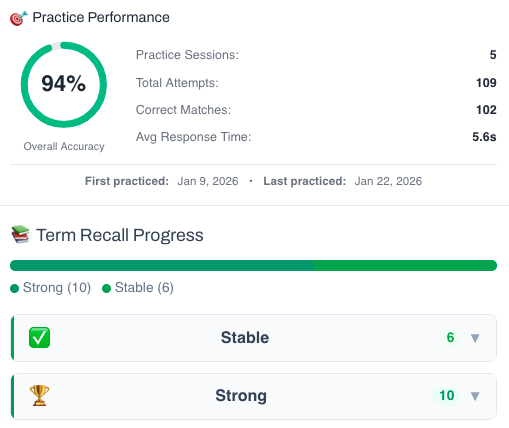
This isn’t a simple quiz — it’s a fully tracked learning system. You build knowledge through recognition, then recall, and your progress feeds directly into the Integrated Practice Bar (Writing tasks, AI Chat, and more).
- Practice sessions, accuracy, and response-time tracking
- Term strength levels (Learning → Stable → Strong)
- Personal progress history for each unit
This feature is available to YSP members.
Explore Membership Benefits🎮 Practice Games
Sentence Scrambler
Hurt – Ache – Pain – Injury – Sentence Scramble
Member-Exclusive Sentence Builder
Reconstruct scrambled sentences to practice word order and develop your grammar intuition.
This feature is available to YSP members.
Explore Membership Benefits