Countable and Uncountable Nouns in a Medical Setting
Core PathWay
1 Countable and Uncountable Nouns — The Basics
In English, nouns belong to one of two groups. Some nouns are countable — you can count them: one tablet, two tablets, three injections. Other nouns are uncountable — they refer to a substance, a concept, or a mass that we do not normally count: pain, blood, information, advice.
In a medical setting, this distinction matters a great deal. Compare these two sentences: He is experiencing pain (uncountable — pain as a general sensation) and He reports several pains in his lower back (countable — specific, distinct instances of pain). The noun is the same word, but the meaning shifts depending on how it is used.
The same pattern applies to many medical words. Medicine as an uncountable noun refers to the general substance or concept: She studied medicine for six years. But a medicine is a specific preparation: The pharmacist recommended a medicine for the cough. Treatment (uncountable) refers to the general process: The patient responded well to treatment. But a treatment is a specific course or procedure: The doctor prescribed a new treatment.
When we talk about quantities, the noun type controls which words we can use. For countable nouns, we use: many symptoms, several injections, a few tablets, few side effects, quite a few prescriptions. For uncountable nouns, we use: much blood, a little morphine, little evidence, very little information, some advice. Notice that much is mainly used in questions and negative sentences with uncountable nouns: There isn’t much research on this yet. How much morphine did the patient receive? In positive statements, we more often say a lot of research, a lot of morphine. The table below gives you a quick reference.
| Quantity idea | Countable | Uncountable |
|---|---|---|
| Used with both countable and uncountable nouns | ||
| Large amount | a lot of / lots of | a lot of / lots of |
| Some / any | some / any | some / any |
| Countable nouns only | ||
| Large amount | many | — |
| Small amount — enough for immediate needs | a few (generally means there is enough / no immediate scarcity) | — |
| Small amount — not enough | few (generally means there is a lack / not enough for immediate needs) | — |
| Fairly large | quite a few | — |
| Extremely small | very few | — |
| Uncountable nouns only | ||
| Large amount | — | much (questions and negatives only — not positive sentences) |
| Small amount — enough for immediate needs | — | a little (generally means there is enough / no immediate scarcity) |
| Small amount — not enough | — | little (generally means there is a lack / not enough for immediate needs) |
| Extremely small | — | very little |
2 Section 2. On the Ward — A Doctor and Nurse Discuss a Patient
Listen to how Dr Patel and Nurse Sam talk about a patient’s condition. Notice how they use quantity words with both countable and uncountable nouns.
💬 Dialogue 1: How Much, How Many — Talking About a Patient
A hospital ward, morning handover. Dr Patel and Nurse Sam are reviewing the overnight notes for a patient, Mr Osei.
📝 Comprehension Check: Morning Ward Round: Mr Osei’s Overnight Report
Answer the questions based on what you heard in the audio.
Which speaker says that the patient did not want a large amount of medication?
Which speaker decides to write something new for the patient and add information about what the treatment will involve?
Which speaker asks whether there was any blood found in the patient’s urine?
What does Sam say about the patient’s reaction to the antibiotic?
What does Dr Patel say about waiting for the lab results if there is a possible infection?
What does Sam say about the current number and type of problems the patient has?
Dr Patel: “Good morning, Sam. How was Mr Osei overnight? Any changes?”
Sam: “He had quite a few episodes of discomfort, Doctor. He pressed the call button three times between two and five in the morning.”
Dr Patel: “Did he describe the pain? Was it one specific pain or several different pains?”
Sam: “He described a sharp pain in his right side, and then a duller pain across his abdomen. So two distinct pains, really.”
Dr Patel: “Right. How much morphine did he receive overnight?”
Sam: “Very little, actually — just one small dose at three a.m. He said he didn’t want too much medication.”
Dr Patel: “That’s understandable. How many tablets of paracetamol has he taken in the last twenty-four hours?”
Sam: “A few — I think three. He took an ibuprofen as well, around midnight.”
Dr Patel: “Good. Is there any new information from the lab? How much blood did they take for the tests?”
Sam: “They took a small amount of blood — two vials. There’s still very little information back from the lab. We’re waiting on the results.”
Dr Patel: “And the urine sample — was there much blood in it?”
Sam: “A little, yes. Enough to flag it. The report noted a possible infection, but there’s little evidence to confirm that yet.”
Dr Patel: “How many symptoms would you say he has right now — overall?”
Sam: “Quite a few. The pain, the discomfort when urinating, a low fever, and some fatigue. He also mentioned a few side effects from the antibiotic he started yesterday.”
Dr Patel: “What kind of side effects? How much nausea?”
Sam: “A little nausea in the morning, but it passed quickly. He said there was very little discomfort after that. He seems to be tolerating the medication reasonably well.”
Dr Patel: “Good. Let’s keep monitoring him. I’ll write a new prescription and add a note to give him a little more information about what to expect from the treatment.”
Sam: “I’ll make sure he receives it before the afternoon round. Should I also flag his urine results to the specialist, given the possible infection?”
Dr Patel: “Yes, please do. There’s little point in waiting if the lab results come back positive. We need to act quickly in that case.”
Sam: “Understood. I’ll send the referral now and update his notes with the overnight symptom record.”
3 Same Word, Different Meaning — Ten Key Pairs
Many medical nouns can be used in two ways. When a noun is uncountable, it refers to a substance, a concept, or a general process. When the same noun becomes countable, it refers to a specific, individual example of that thing. Here are ten important pairs to know.
1. Pain / A pain
Pain (uncountable) is the general sensation of suffering: The patient is in a lot of pain. A pain (countable) is a specific, located instance: She felt a sharp pain in her chest.
2. Tissue / A tissue
Tissue (uncountable) is the biological material in the body: The surgeon examined the surrounding tissue carefully. A tissue (countable) is a single disposable paper for wiping: The nurse handed him a tissue.
3. Medicine / A medicine
Medicine (uncountable) refers to the field or to drugs in general: She has practised medicine for twenty years. The patient needs medicine. A medicine (countable) is a specific preparation: The doctor prescribed a medicine for the infection.
4. Treatment / A treatment
Treatment (uncountable) is the general process of caring for a patient: Early treatment is essential. A treatment (countable) is a specific course or procedure: The oncologist recommended a new treatment.
5. Therapy / A therapy
Therapy (uncountable) refers to the general concept: The patient responded well to therapy. A therapy (countable) is a specific programme: Cognitive behavioural therapy is a therapy that many patients find helpful.
6. Bone / A bone
Bone (uncountable) refers to the hard material that forms the skeleton: The X-ray showed damage to the bone. A bone (countable) is a single, individual bone: She fractured a bone in her wrist.
7. Medication / A medication
Medication (uncountable) refers to drugs in general: He is currently on medication. A medication (countable) is a specific prescribed drug: The doctor changed one of his medications.
8. Anaesthetic / An anaesthetic
Anaesthetic (uncountable) is the substance used to prevent pain during surgery: The patient was given anaesthetic before the procedure. An anaesthetic is less commonly used as a countable, but you may hear: The team used a local anaesthetic.
9. Research / —
Research is almost always uncountable in standard medical English: The research suggests a link between the two conditions. We do not normally say a research or researches. Instead, we say a study, a piece of research, several studies.
10. Advice / —
Advice is always uncountable: The doctor gave the patient some advice about diet. We never say an advice or advices. For a single item, say a piece of advice.
Notice the pattern: uncountable forms describe the substance or concept in general. Countable forms point to one specific, identifiable example. This difference changes how you count, quantify, and describe things in clinical language.
4 A Little / Little / A Few / Few — Enough or Not Enough /Good News or Bad News?
These four words all describe a small quantity. But they are not interchangeable. Two main decisions control which one to use: first, is the noun countable or uncountable? Second, is the quantity percieved as ‘enough for now’ or ‘not enough for now’? However, you also need to think about the meaning of the noun.
Step 1 — Choose the right form for the noun type.
Use a few and few only with countable nouns (plural): a few tablets, few symptoms, a few injections. Use a little and little only with uncountable nouns: a little morphine, little evidence, a little pain. Never say few information or a little symptoms — these are errors.
Step 2 — Choose between the forms with and without ‘a’.
A few and a little present the quantity as either ‘not a big amount’ or ‘no immediate sense of shortage’. Few and little present the quantity as not enough — hardly any, less than expected or needed.
Look at these medical examples:
The patient took a few paracetamol tablets. → Some tablets were taken, but not a big quantity
There were few nurses on duty that night. → Hardly any nurses — not enough.
There is a little ibuprofen left in the dispensary. → Some ibuprofen remains. Enough for now. There is no immediate need to buy more.
There is little penicillin in stock. → Hardly any penicillin — this a problem. We need to restock.
Step 3 — Think about the noun, not just the quantity: the ‘good news’ / ‘bad news’ test
Here is where it gets interesting. Few and little highlight scarcity — but whether that scarcity is good news or bad news depends on the noun.
The surgery caused little discomfort. → Very little discomfort is good news. Discomfort is undesirable, so less of it is positive.
The treatment caused a few side effects. → The quantity is small, but the overall picture is not good — because side effects are undesirable.
Few patients reported complications. → Hardly any complications. This is good news.
A few patients reported complications. → Some patients did have complications. This is bad news
The quantifier tells you about the quantity and the speaker’s viewpoint. The noun tells you whether that quantity is good news or bad news in context. Keep both in mind.
Degree forms: You can strengthen these expressions.
Quite a few symptoms means a fairly large number — more than just a few.
Very few patients means an extremely small number — but not necessarily zero.
Very little evidence means almost none — but again, not necessarily zero.
Never say very a little — this is always wrong. Say very little.
Key Terms
5 Three Doctors, A Group of Patients
Three doctors — Dr Reyes, Dr Okafor, and Dr Lin — are in a case review meeting. They are discussing a group of patients on the ward. Notice how they use quantity expressions and switch between countable and uncountable nouns.
💬 Dialogue 2: Case Review — Quantities, Conditions, and Clinical Decisions
A hospital conference room, afternoon case review meeting. Dr Reyes is leading the meeting. Dr Okafor and Dr Lin are presenting updates on their patients.
📝 Comprehension Check: Ward Round: Post-Operative and Infection Cases
Answer the questions based on what you heard in the audio.
Which speaker says that one patient chose to have less pain relief because she did not want to feel sleepy?
Which speaker says that the laboratory has not yet sent back enough information about two patients?
Which speaker says they want written updates on the infection cases before the next morning?
What does Dr Lin say about the patient who is not getting better with the antibiotic?
Why does Dr Okafor say the team should wait before deciding on treatment for the patient with bone tissue damage?
What does Dr Lin say about the patients who need their prescriptions checked before the weekend?
Dr Reyes: “Right, let’s go through the group. Dr Okafor, how many patients are we looking at in the post-operative ward?”
Dr Okafor: “Fourteen in total. Quite a few of them are recovering well — I’d say ten are progressing without any major issues.”
Dr Reyes: “And the others? How much pain are they reporting on average?”
Dr Okafor: “A little pain is expected at this stage, of course. But two patients are reporting quite a few distinct pains — not just general discomfort. I’d like to review their medication.”
Dr Lin: “Are they on morphine? How much morphine are those two receiving per day?”
Dr Okafor: “Very little, actually. One patient refused a higher dose. She said she’d rather have a little discomfort than feel drowsy all day.”
Dr Reyes: “That’s her right. Dr Lin, what about the infection cases? How many patients have confirmed infections?”
Dr Lin: “Three confirmed. Few of the others show any clear symptoms, which is reassuring. But we have very little information back from the lab on two of the borderline cases.”
Dr Reyes: “How much evidence do we have that the antibiotic is working in the confirmed cases?”
Dr Lin: “A little evidence — the fever has come down in two of the three. But there’s still little certainty about the third patient. She’s not responding as quickly.”
Dr Okafor: “Has she had any allergies flagged? I know she reported a few side effects when she was admitted.”
Dr Lin: “Yes — she has an allergy to penicillin, so we’re using a different antibiotic. The side effects from the new medication have been a little nausea and one injection-site reaction. Quite mild overall.”
Dr Reyes: “Good. How many X-rays have been ordered this week across the group?”
Dr Okafor: “Quite a few — seven or eight. Most were routine. Very few came back with anything unexpected. One showed some damage to the surrounding bone tissue, which we’re monitoring.”
Dr Reyes: “That’s worth watching closely. How much information do we have about the extent of the bone tissue damage at this point?”
Dr Okafor: “Very little so far. We’ve ordered a follow-up scan, but the results aren’t back yet. I’d prefer to wait before making any decisions about treatment.”
Dr Lin: “That makes sense. In the meantime, should we adjust his pain medication? He mentioned quite a few episodes of discomfort last night.”
Dr Reyes: “Yes, let’s review his prescription. And prescriptions generally — are there any patients who need their medication reviewed before the weekend?”
Dr Lin: “A few, yes. I’d say three or four patients need a new prescription or a change in dosage. I’ll make sure each one gets a little time with a pharmacist before discharge. They also need some advice about managing their treatment at home.”
Dr Reyes: “Good. Let’s wrap up there. I want updated notes on all the infection cases by tomorrow morning, and flag anything that changes overnight.”
6 Putting It Together — Nouns and Quantities in Clinical Language
You have now seen how countable and uncountable nouns work in medical English — and how the same word can carry two different meanings depending on how it is used. You have also seen how quantity expressions connect directly to noun type.
Here is a useful way to think about it. When a noun is uncountable, it describes a substance, a process, or a concept in general: blood, pain, research, advice, therapy, medication. These nouns answer the question How much? When a noun is countable, it describes a specific, individual item or instance: a wound, a tablet, a symptom, a prescription, a therapy. These nouns answer the question How many?
The four key quantity words — a few, few, a little, little — all describe a small quantity. But each one carries a different message. A few and a little say: some exists, and that is fine. Few and little say: hardly any exists, and that may be a problem — or, depending on the noun, it may be good news. Few complications is usually positive. A few complications may be concerning. Little discomfort after surgery is welcome. A little discomfort means some discomfort was present.
In clinical communication, choosing the right word is not just a grammar question. It is a question of accuracy. When you say a patient has few symptoms, you are saying the number is very small — which may reassure a colleague. When you say a patient has a few symptoms, you are pointing to the presence of those symptoms — which may prompt further investigation. Pay attention to this difference every time you describe a patient’s condition in English.
7 Recap — What You Have Learned
This page covered countable and uncountable nouns in medical English, and how to talk about quantities accurately.
Countable nouns name individual, specific things you can count: a tablet, a symptom, a wound, an injection, a prescription. They use many, a few, few, quite a few, very few.
Uncountable nouns name substances, concepts, or general processes: pain, blood, research, advice, morphine, penicillin. They use much, a little, little, very little.
Many medical words can be both: pain (general suffering) and a pain (a specific instance); tissue (body material) and a tissue (a paper); treatment (the general process) and a treatment (a specific course).
A few / a little = some; available; no sense of shortage.
Few / little = hardly any; scarcity; often not enough.
Remember: the meaning also depends on the noun. Few side effects is usually good news. A few side effects highlights that some exist — and that may be a concern. Always think about both the quantity and the noun together.
Member-Exclusive Practice Bar
Access a wide range of integrated practice for this unit — from Vocabulary and Grammar activities to AI-curated Writing tasks and Thematic Chat practice.
This feature is available to YSP members.
Explore Membership BenefitsMember-Exclusive Vocabulary Review & Acquisition System
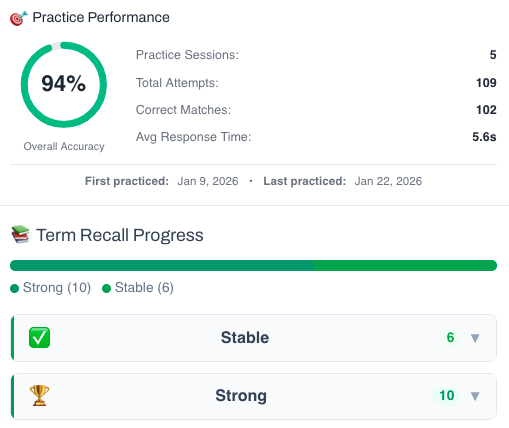
This isn’t a simple quiz — it’s a fully tracked learning system. You build knowledge through recognition, then recall, and your progress feeds directly into the Integrated Practice Bar (Writing tasks, AI Chat, and more).
- Practice sessions, accuracy, and response-time tracking
- Term strength levels (Learning → Stable → Strong)
- Personal progress history for each unit
This feature is available to YSP members.
Explore Membership Benefits🎮 Practice Games
Sentence Scrambler
Countable & Uncountable Nouns in a Medical Setting – Sentence Scramble
Member-Exclusive Sentence Builder
Reconstruct scrambled sentences to practice word order and develop your grammar intuition.
This feature is available to YSP members.
Explore Membership Benefits