📚 The Enhanced Games
📅 Talking Points — Week of 05/06/2026
PED in Sports
This article teaches learners to discuss the ethics of performance enhancement in sport using specialized vocabulary and balanced argumentation about bodily autonomy, regulations, and health consequences.
Learning objectives:
• Use 20 target terms naturally when discussing sport ethics, drug use, and regulation debates
• Present multiple perspectives on controversial topics using phrases like 'some people think' and 'other people disagree'
• Distinguish between different types of evidence: historical events (1960s deaths, 1999 WADA establishment), scientific data (60-80% training factor), and competing values (freedom vs protection)
• Express cause-and-effect relationships using simple structures: 'because of', 'this explains why', 'when X happens, Y happens'
• Construct simple arguments that acknowledge both sides: 'some people say X, but other people say Y'
🎯 Choose your preferred path: more listening or more reading?
ℹ️ Both paths include the article audio.
🎙️ The Listening Path
Listen to the pre-listening briefing, then the article, then the vocabulary debrief. Hands-free — perfect for commuting, walking, or the gym.
▶ Click here to open the Listening Path
📱 The Classic Path
Read the optional lead-in text, listen to the article audio, then test yourself with the on-screen comprehension and vocabulary quizzes.
▶ Click here to open the Classic Path
🎯 After your chosen path: Shared Practice
Member-Exclusive Practice Bar
Access a wide range of integrated practice for this unit — from Vocabulary and Grammar activities to AI-curated Writing tasks and Thematic Chat practice.
This feature is available to YSP members.
Explore Membership Benefits✍️ Discussion Prep Writing Tasks
These writing tasks help you prepare your ideas and language for the Talking Points Fluency Workshop. The workshop trainer reads your writing in advance to gauge your preparation and guide the session. Access to booking is only available once at least one task has been completed. No writing submitted? No problem — simply skip the workshop this week.
We use SHOULD to give advice, make recommendations, and say what is right or wrong. SHOULD is a modal verb. Remember: modal verbs have special grammar rules: they have no past form, we don't use 'to' after them, and they don't change in the 3rd person (no 's').
Here are 8 example sentences with SHOULD and alternative ways to say the same thing:
1. You should see a doctor. (It's a good idea to see a doctor.) 2. She should study more for the exam. (It's important for her to study more for the exam.) 3. We shouldn't eat so much sugar. (It's bad to eat so much sugar.) 4. They should arrive early for the interview. (It's better to arrive early for the interview.) 5. You shouldn't drive when you're tired. (It's dangerous to drive when you're tired.) 6. He should apologize to his friend. (It's the right thing to apologize to his friend.) 7. You should visit that new restaurant. (I recommend visiting that new restaurant.) 8. We shouldn't waste water. (It's wrong to waste water.)
Notice how SHOULD is followed directly by the verb (see, study, eat, arrive). We don't say 'should to see' or 'should sees'. The negative form is SHOULDN'T (should not). Use SHOULD when you want to tell someone what is good, right, or the best thing to do.
Member-Exclusive Vocabulary Review & Acquisition System
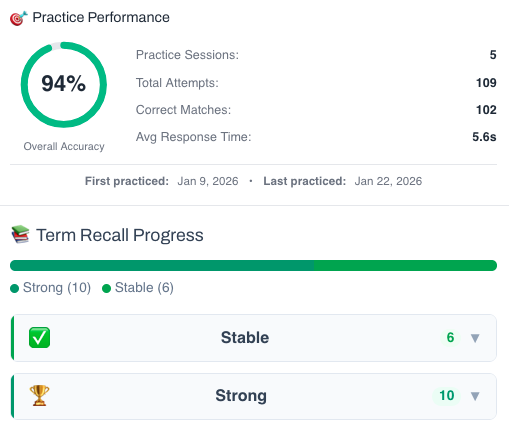
This isn’t a simple quiz — it’s a fully tracked learning system. You build knowledge through recognition, then recall, and your progress feeds directly into the Integrated Practice Bar (Writing tasks, AI Chat, and more).
- Practice sessions, accuracy, and response-time tracking
- Term strength levels (Learning → Stable → Strong)
- Personal progress history for each unit
This feature is available to YSP members.
Explore Membership Benefits