Listening Practice: Long Numbers
Section 1
When you work with numbers every day, you need to say them clearly and understand them quickly. This is very important when you talk on the phone about money, budgets, and reports. In British English, we use the word ‘and’ in a special way with numbers. This lesson will help you understand the pattern and use it correctly.
The most important rule is simple: we say ‘and’ after the word ‘hundred’ when there are more digits after it. For example, the number 101 is ‘one hundred and one’. We do NOT say ‘one hundred one’ in British English. Look at these examples: 205 is ‘two hundred and five’, 999 is ‘nine hundred and ninety-nine’.
This pattern works with bigger numbers too. We say ‘hundred thousand and’ when we have hundreds of thousands and then smaller numbers. For example, 100,001 is ‘one hundred thousand and one’. We also say ‘hundred million and’ in the same way. The number 100,000,001 is ‘one hundred million and one’.
Here is something important to remember from your last lesson: American English is different. Americans often do NOT use ‘and’ in the same places. Also, Americans sometimes say numbers in a shorter way. For example, 1,500 can be ‘fifteen hundred’ in American English, but in British English we usually say ‘one thousand five hundred’. Both ways are correct, but you need to know both patterns because you will hear American colleagues on the phone.
✓ Remember: In British English, always use ‘and’ after ‘hundred’ when more digits follow.
✓ Listen carefully: American speakers may not use ‘and’ in the same places.
✓ Practice: Say numbers out loud to build your confidence.
Key Terms
Now listen to the audio below and write down ALL the numbers you hear
🎧 Section 2: British Numbers
Now check the numbers you wrote down with the text
Section 2
‘Good morning, I’m calling to give you the final figures for the last quarter. Please write these down carefully. Our total revenue was two million, three hundred and forty-five thousand, six hundred and seventy-eight pounds. That’s £2,345,678. Our expenses came to one million, eight hundred and ninety thousand, one hundred and twenty-three pounds, so £1,890,123. This means our profit was four hundred and fifty-five thousand, five hundred and fifty-five pounds – £455,555.
For the next fiscal year, our budget is three million, seven hundred and sixty-five thousand, four hundred and thirty-two pounds, which is £3,765,432. The forecast for quarter one is nine hundred and eighty-seven thousand, six hundred and fifty-four pounds – that’s £987,654. Our accounts receivable total is one million, two hundred and thirty-four thousand, five hundred and sixty-seven pounds, £1,234,567. Finally, accounts payable stands at five hundred and sixty-seven thousand, eight hundred and ninety pounds, £567,890. Did you get all those figures?’
Notice how the speaker uses ‘and’ after every ‘hundred’ when there are more digits. This is the British pattern. The speaker also breaks the complex numbers into clear parts: millions, then thousands, then hundreds.
✓ Tip: When you listen, write the digits as you hear each part.
✓ Tip: The word ‘and’ tells you that hundreds have finished and smaller numbers are coming.
Key Terms
dictate
to say something slowly so another person can write it
over the phone
using a telephone to communicate
financial reporting
giving information about money and accounts
quarter
a period of three months in a business year
revenue
the total money a company receives
expenses
the money a company spends
profit
the money left after you pay all expenses
fiscal year
a 12-month period used for financial reports
budget
a plan that shows how much money you will spend
forecast
a prediction of what will happen in the future
accounts receivable
money that customers owe to your company
accounts payable
money that your company owes to other companies
complex number
a number with many digits that is difficult to say
Now listen to the audio below and write down ALL the numbers you hear
🎧 Section 3: American Numbers
Now check the numbers you wrote down with the text
Section 3
‘Good morning, I’m calling with the final numbers for last quarter. Please write these down. Our total revenue was four million, five hundred sixty-seven thousand, eight hundred ninety dollars. That’s $4,567,890. Our expenses came to two million, three hundred forty-five thousand, six hundred seventy-eight dollars, so $2,345,678. This means our profit was two million, two hundred twenty-two thousand, two hundred twelve dollars – $2,222,212.
For next fiscal year, our budget is five million, six hundred seventy-eight thousand, nine hundred one dollars, which is $5,678,901. The forecast for quarter one is eight hundred seventy-six thousand, five hundred forty-three dollars – that’s $876,543. Our accounts receivable total is three million, four hundred fifty-six thousand, seven hundred eighty-nine dollars, $3,456,789. Finally, accounts payable stands at nine hundred eighty-seven thousand, six hundred fifty-four dollars, $987,654. Did you catch all those numbers?’
Can you see the difference? In American English, there is NO ‘and’ between the hundreds and the tens. Americans say ‘five hundred sixty-seven’ NOT ‘five hundred AND sixty-seven’. This is the biggest difference between British and American number patterns.
Also notice that for the number 1,500, Americans might say ‘fifteen hundred’ instead of ‘one thousand five hundred’. You learned this in your last lesson. Both ways are correct in American English.
✓ Important: American English does NOT use ‘and’ after hundreds.
✓ Remember: Americans may say ‘fifteen hundred’ for 1,500 or ‘nineteen hundred’ for 1,900.
Key Terms
2,734
two thousand, seven hundred and thirty-four (British) or two thousand seven hundred thirty-four (American)
15,647
fifteen thousand, six hundred and forty-seven (British) or fifteen thousand six hundred forty-seven (American)
234,891
two hundred and thirty-four thousand, eight hundred and ninety-one (British) or two hundred thirty-four thousand eight hundred ninety-one (American)
1,500,000
one million, five hundred thousand (British and American)
3,456,789
three million, four hundred and fifty-six thousand, seven hundred and eighty-nine (British) or three million four hundred fifty-six thousand seven hundred eighty-nine (American)
12,345
twelve thousand, three hundred and forty-five (British) or twelve thousand three hundred forty-five (American)
987,654
nine hundred and eighty-seven thousand, six hundred and fifty-four (British) or nine hundred eighty-seven thousand six hundred fifty-four (American)
45,678
forty-five thousand, six hundred and seventy-eight (British) or forty-five thousand six hundred seventy-eight (American)
Section 4
Understanding complex numbers over the phone is a very important skill for your work. When people dictate financial figures, you must write them correctly. One mistake with a digit can cause big problems.
The key things to remember are:
✓ British English uses ‘and’ after ‘hundred’ when more digits follow (e.g., ‘three hundred and forty-five’).
✓ American English does NOT use ‘and’ in the same way (e.g., ‘three hundred forty-five’).
✓ Americans sometimes say ‘fifteen hundred’ for 1,500, but British speakers usually say ‘one thousand five hundred’.
✓ When you listen, write the numbers in parts: millions first, then thousands, then hundreds.
✓ The word ‘and’ in British English is a signal that helps you know where you are in the number.
Next time you have a phone call with financial numbers, listen carefully for these patterns. If you are not sure, always ask the person to repeat the number. It is better to check than to make a mistake. With practice, you will understand complex numbers quickly and easily. You are building an important professional skill!
Member-Exclusive Vocabulary Review & Acquisition System
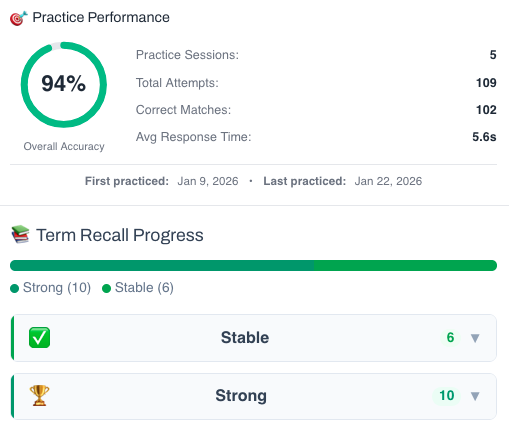
This isn’t a simple quiz — it’s a fully tracked learning system. You build knowledge through recognition, then recall, and your progress feeds directly into the Integrated Practice Bar (Writing tasks, AI Chat, and more).
- Practice sessions, accuracy, and response-time tracking
- Term strength levels (Learning → Stable → Strong)
- Personal progress history for each unit
This feature is available to YSP members.
Explore Membership Benefits