Present Perfect vs Past Simple: Understanding the Difference
Core PathWay
1 🌐 Grammar Overview
The Present Perfect and Past Simple both talk about the past, but they see time differently. The Past Simple is like looking at a photograph from the past – it describes finished actions at specific times. You use it when you know (or care about) exactly when something happened: ‘I met her in 2019’ or ‘We went to Spain last year.’ The Present Perfect is different – it’s like a bridge between past and present. It describes actions or experiences that have some connection to present moment, and the exact time doesn’t matter: ‘I’ve met her before’ or ‘We’ve been to Spain.’ The key question is: are you thinking about a specific moment in the past (Past Simple), or about the present result or relevance of a past action (Present Perfect)? This distinction matters because native speakers use these structures to show different perspectives on time.
2 🔍 Structure Analysis
Structure: Present Perfect
Form: have/has + past participle
– Positive: I/you/we/they have worked; he/she/it has worked
– Negative: I/you/we/they haven’t worked; he/she/it hasn’t worked
– Question: Have I/you/we/they worked? Has he/she/it worked?
Function: The Present Perfect creates a link between past and present. It tells us that something happened (or didn’t happen) before now, and this information is relevant or important at the present moment. It emphasizes the result or experience rather than when it occurred.
Usage Context: Use the Present Perfect when:
– The specific time isn’t mentioned or isn’t important
– You’re talking about life experiences up to now
– Something has recently happened
– An action started in the past and continues to the present
– You’re talking about an unfinished time period (today, this week, this year)
Key Uses:
1. Life experiences (without specific time): ‘I’ve visited 15 countries.’ / ‘Have you ever tried sushi?’
2. Recent events with present relevance: ‘She’s just called.’ / ‘They’ve recently moved house.’
3. Unfinished time periods: ‘I’ve had three meetings today.’ / ‘We’ve seen each other twice this week.’
4. Actions continuing from past to present: ‘He’s worked here for five years.’ / ‘I’ve known her since 2018.’
Example Sentences:
– ‘I’ve already finished the report, so we can meet now.’ (recent completion with present result)
– ‘Have you ever been to Japan?’ (asking about life experiences up to now)
– ‘She’s lived in London for ten years and loves it.’ (action continuing to present)
– ‘We haven’t received the package yet.’ (expected action in unfinished time period)
Common Errors:
✗ Using Present Perfect with specific past time: ‘I’ve seen him yesterday‘ → ✓ ‘I saw him yesterday’
✗ Forgetting the auxiliary: ‘I seen that film’ → ✓ ‘I’ve seen that film’
✗ Using wrong participle: ‘I’ve went there’ → ✓ ‘I’ve gone there’
✗ Using Past Simple with ‘yet/already’: ‘I already finished’ → ✓ ‘I’ve already finished’
—
Structure: Past Simple
Form: Verb + -ed (regular verbs) OR irregular past form
– Positive: I/you/he/she/it/we/they worked/went/was-were
– Negative: I/you/he/she/it/we/they didn’t work/go (+ base form)
– Question: Did I/you/he/she/it/we/they work/go? (+ base form)
Function: The Past Simple describes completed actions and situations in the past. It focuses on when something happened and treats the past as separate from the present moment. It’s the main tense for storytelling and describing past events in sequence.
Usage Context: Use the Past Simple when:
– You mention a specific time in the past
– You’re telling a story or describing events in order
– You’re talking about a finished time period or situation
– The action is completely in the past with no connection to now
Key Uses:
1. Specific past times: ‘I met her in 2019.’ / ‘We went there last summer.’
2. Sequential past events: ‘I woke up, had breakfast, and left the house.’
3. Finished situations: ‘He lived in Paris for three years.’ (but doesn’t live there now)
4. Past habits: ‘When I was young, I played tennis every weekend.’
Example Sentences:
– ‘I visited my grandmother last weekend and we had a great time.’ (specific past time)
– ‘Did you watch the match yesterday?’ (asking about specific past event)
– ‘She worked at Google from 2015 to 2020.’ (finished time period)
– ‘When did you arrive?’ (question about specific time in past)
Common Errors:
✗ Using Past Simple with unfinished time: ‘I saw her three times this week’ (if week isn’t finished) → ✓ ‘I’ve seen her three times this week’
✗ Forgetting ‘did’ in questions: ‘When you arrived?’ → ✓ ‘When did you arrive?’
✗ Using ‘did’ with past form: ‘Did you went there?’ → ✓ ‘Did you go there?’
✗ Wrong irregular forms: ‘I goed there’ → ✓ ‘I went there’
3 ❓ Why Study These Structures Together?
Studying the Present Perfect and Past Simple together is essential because choosing between them is one of the most challenging decisions for English learners. Both structures talk about the past, which makes them easy to confuse, but they communicate different meanings.
The Past Simple says ‘this happened at that specific time and it’s finished’ – it’s like pointing to a moment on a timeline.
The Present Perfect says ‘this happened before now, and it matters right now’ – it’s about the present relevance of past events.
Native speakers switch between these structures constantly, and choosing the wrong one can change your meaning.
For example, ‘I’ve lost my keys’ (I don’t have them now – Present Perfect) is very different from ‘I lost my keys’ (I’m just telling you about a past event – Past Simple).
By studying them side by side, you learn to ask yourself the key question: am I focusing on a specific past moment, or on how the past connects to now?
This awareness helps you communicate more precisely and understand native speakers better. The time markers that go with each structure (ago, yesterday, last week with Past Simple; ever, never, already, yet, just with Present Perfect) also become clearer when you see them in contrast.
💬 Dialogue: Lost Keys
Tom arrives home and realizes he has a problem
Use the VAS to build solid recognition and recall of the terms below.
✔ Every correct Match = +1 point
✔ Every correct Recall = +2 points
🎓 Reach 5 points with good accuracy and the term is automatically promoted to your Personal Dictionary.
Incorrect answers lower accuracy, meaning more correct Matches or Recalls may be needed to reach promotion.
Member-Exclusive Vocabulary Review & Acquisition System
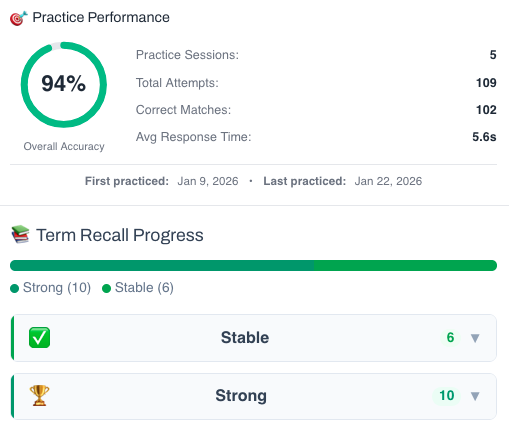
This isn’t a simple quiz — it’s a fully tracked learning system. You build knowledge through recognition, then recall, and your progress feeds directly into the Integrated Practice Bar (Writing tasks, AI Chat, and more).
- Practice sessions, accuracy, and response-time tracking
- Term strength levels (Learning → Stable → Strong)
- Personal progress history for each unit
This feature is available to YSP members.
Explore Membership BenefitsWhich sentence uses the present perfect correctly?
Complete the sentence: “She _____ to Paris twice in her life.”
Which sentence contains an error?
In the sentence “I have worked here for five years,” the present perfect is used to express:
Choose the correct sentence:
Which sentence is correct?
What is wrong with this sentence: “I have seen that movie last night”?
Complete the dialogue: A: “Is Sarah here?” B: “No, she _____ home an hour ago.”
Which sentence expresses a life experience without specifying when?
Choose the corrected version of: “How long do you live in this city?”
Which sentence is correct for talking about something that happened at an unspecified time?
In which situation would you use the past simple instead of the present perfect?
Member-Exclusive Sentence Builder
Reconstruct scrambled sentences to practice word order and develop your grammar intuition.
This feature is available to YSP members.
Explore Membership Benefits