How to Say Numbers in British and American English
Core PathWay
1 🌐 Introduction
Numbers are everywhere in English! We use them every day to talk about time, money, dates, phone numbers, and addresses. But did you know that British and American speakers say numbers in different ways? The main difference happens after the word hundred. British speakers say ‘and‘ but American speakers don’t. For example, British people say ‘one hundred and one‘ but Americans say ‘one hundred one‘. This small difference can confuse learners, especially when listening. Learning both ways helps you understand native speakers from different countries and speak with confidence about prices, years, and measurements.
💬 Dialogue 1: Talking About Prices
A customer asks about a price in a shop
2 📋 Lexical Categories
Category 1: Basic Numbers (1-20)
one – *I have one brother.*
two – *She bought two apples.*
three – *There are three chairs in the room.*
four – *My phone number ends in four.*
five – *School starts at five o’clock.*
six – *I need six eggs for the cake.*
seven – *There are seven days in a week.*
eight – *The shop opens at eight in the morning.*
nine -*She is nine years old.*
ten – *I have ten fingers.*
eleven – *The bus comes at eleven thirty.*
twelve – *There are twelve months in a year.*
thirteen – *He lives at number thirteen.*
fourteen -*The film starts at fourteen minutes past the hour.*
fifteen – *I wait fifteen minutes for the train.*
sixteen – *She is sixteen years old today.*
seventeen – *The shop closes at seventeen hundred hours.*
eighteen – *You can drive when you are eighteen.*
nineteen – *The year nineteen ninety was a long time ago.*
twenty – *This book costs twenty pounds.*
Category 2: Tens (30-90)
thirty – *The temperature is thirty degrees today.*
forty – *My dad is forty years old.*
fifty – *That dress costs fifty euros.*
sixty – *The speed limit is sixty miles per hour.*
seventy – *My grandmother is seventy this year.*
eighty – *The house number is eighty.*
ninety – *The flight takes ninety minutes.*
Category 3: Large Number Words
hundred – ten times ten, written as 100
*One hundred people came to the party.*
thousand – ten times one hundred, written as 1,000
*This car costs twenty thousand pounds.*
million – one thousand times one thousand, written as 1,000,000
*Three million people live in this city.*
billion – one thousand times one million, written as 1,000,000,000
*The company is worth five billion dollars.*
Category 4: Zero and Its Alternatives
zero – the number 0, nothing
*The temperature is zero degrees.*
nought – another British word for the number 0
*Nought point five means 0.5.*
oh – how we say 0 in phone numbers and addresses
*My number is two oh seven, not two zero seven.*
Category 5: British vs American Differences
hundred and one – British way to say 101
*British: The price is one hundred and one pounds.*
hundred one – American way to say 101
*American: The price is one hundred one dollars.*
two hundred and fifty – British way to say 250
*British: Two hundred and fifty people work here.*
two hundred fifty – American way to say 250
*American: Two hundred fifty people work here.*
and – British speakers use this word after ‘hundred’
*British people say ‘five hundred and twenty’ with ‘and’.*
Category 6: Special Number Vocabulary
point – the word we use for the decimal dot in numbers
*Three point five means 3.5.*
decimal – a number with a point in it, like 2.5 or 0.75
*The decimal number is easier to use than a fraction.*
fraction – a number that shows a part of something, like 1/2 or 3/4
*One half is a fraction.*
half – one of two equal parts, written as 1/2
*Half of ten is five.*
quarter – one of four equal parts, written as 1/4
*A quarter past three means 3:15.*
third – one of three equal parts, written as 1/3
*One third of twelve is four.*
plus – the word for the + symbol in math
*Two plus two equals four.*
minus – the word for the – symbol in math
*Five minus three equals two.*
times – the word for the × symbol in math
*Three times four equals twelve.*
divided by – the words for the ÷ symbol in math
*Ten divided by two equals five.*
equals – the word for the = symbol, it means ‘is the same as’
*Seven plus one equals eight.*
double – two of the same number together
*My phone number has double five in it: 55.*
triple – three of the same number together
*The code is triple seven: 777.*
💬 Dialogue 2: British Friend Calls American Friend
Emma from London calls Jake in New York to share some news
3 🔗 Common Collocations & Idioms
at a hundred miles an hour – very fast, doing something with lots of speed and energy
*She talks at a hundred miles an hour when she’s excited.*
back to square one – returning to the start because something didn’t work (square one = the number 1)
*The project failed, so we’re back to square one.*
give a hundred and ten percent – try as hard as you possibly can, give maximum effort
*Our team gave a hundred and ten percent in the match.*
on cloud nine – extremely happy (nine is a high number)
*She was on cloud nine after passing her exam.*
a million things to do – many, many tasks or activities (not exactly one million, just a lot)
*I can’t meet you today, I have a million things to do.*
💬 Dialogue 3: Math Class Confusion
An Italian student asks the teacher about saying numbers in math
4 👀 Grammar Spotlight
When we talk about numbers in English, we use specific grammar patterns. Cardinal numbers (one, two, three) come before nouns: *three books*, *twenty people*. For large numbers, British English uses ‘and’ after hundreds: *five hundred and sixty-two*. American English drops the ‘and’: *five hundred sixty-two*. When saying decimals, we use ‘point’: *three point seven* (3.7). For fractions, we use ordinal numbers: *one third* (1/3), *two fifths* (2/5). We use prepositions differently with numbers: *at six o’clock*, *in 2024*, *on the 15th*. Mathematical operations follow patterns: *five plus three equals eight*, *ten minus four equals six*.
5 😊 Expressive Range
Using a wide range of number vocabulary helps you communicate clearly in everyday situations. When you know both British and American ways to say numbers, you understand more native speakers and avoid confusion. Learning words like point for decimals, quarter and half for fractions, and plus or minus for calculations makes you confident in shops, at work, and in conversations. Using expressions like double or triple for repeated digits helps you give phone numbers clearly. Understanding idioms with numbers, like back to square one or on cloud nine, makes your English sound more natural and expressive. The more comfortable you are with number vocabulary, the easier it becomes to talk about prices, times, dates, and measurements without hesitation.
Listen to 20 big numbers – try to write them down. You need to listen multiple times.
💬 20 Big Numbers
Jack: “two hundred and thirty-three”
Jasmine: “four thousand six hundred and eighty-one”
Jack: “twenty-seven thousand three hundred and fifty-four”
Jasmine: “one hundred and fifty-six thousand eight hundred and twenty-nine”
Jack: “four hundred and twelve thousand seven hundred and sixty-three”
Jasmine: “eight hundred and ninety-five thousand two hundred and forty-seven”
Jack: “one million two hundred and thirty-four thousand five hundred and sixty-eight”
Jasmine: “three million six hundred and seventy-eight thousand nine hundred and twelve”
Jack: “seven million four hundred and twenty-one thousand five hundred and thirty-six”
Jasmine: “twelve million eight hundred and fifty-three thousand four hundred and nine”
Jack: “twenty-four million six hundred and seventeen thousand eight hundred and fifty-two”
Jasmine: “thirty-eight million two hundred and ninety-four thousand six hundred and fifteen”
Jack: “fifty-six million seven hundred and three thousand nine hundred and twenty-eight”
Jasmine: “seventy-nine million one hundred and forty-five thousand three hundred and sixty-seven”
Jack: “a hundred and eight million five hundred and thirty-two thousand seven hundred and ninety-four”
Jasmine: “one hundred and fifty-four million nine hundred and sixty-three thousand two hundred and eighteen”
Jack: “two hundred and six million four hundred and seventy-one thousand eight hundred and thirty-five”
Jasmine: “two hundred and fifty-nine million eight hundred and twenty-six thousand four hundred and seventy-one”
Jack: “three hundred and one million five hundred and ninety-four thousand three hundred and eight”
Jasmine: “three hundred and forty-three million two hundred and seventy thousand one hundred and two cars”
💬 Numbers & Nouns
Jack: “There are two hundred and thirty-three cars in the world.”
Jasmine: “There are four thousand six hundred and eighty-one people in the world.”
Jack: “There are twenty-seven thousand three hundred and fifty-four books in the world.”
Jasmine: “There are one hundred and fifty-six thousand eight hundred and twenty-nine dogs in the world.”
Jack: “There are four hundred and twelve thousand seven hundred and sixty-three houses in the world.”
Jasmine: “There are eight hundred and ninety-five thousand two hundred and forty-seven bicycles in the world.”
Jack: “There are one million two hundred and thirty-four thousand five hundred and sixty-eight trees in the world.”
Jasmine: “There are three million six hundred and seventy-eight thousand nine hundred and twelve birds in the world.”
Jack: “There are seven million four hundred and twenty-one thousand five hundred and thirty-six fish in the world.”
Jasmine: “There are twelve million eight hundred and fifty-three thousand four hundred and nine cats in the world.”
Jack: “There are twenty-four million six hundred and seventeen thousand eight hundred and fifty-two phones in the world.”
Jasmine: “There are thirty-eight million two hundred and ninety-four thousand six hundred and fifteen chairs in the world.”
Jack: “There are fifty-six million seven hundred and three thousand nine hundred and twenty-eight windows in the world.”
Jasmine: “There are seventy-nine million one hundred and forty-five thousand three hundred and sixty-seven bottles in the world.”
Jack: “There are one hundred and eight million five hundred and thirty-two thousand seven hundred and ninety-four apples in the world.”
Jasmine: “There are one hundred and fifty-four million nine hundred and sixty-three thousand two hundred and eighteen shoes in the world.”
Jack: “There are two hundred and six million four hundred and seventy-one thousand eight hundred and thirty-five eggs in the world.”
Jasmine: “There are two hundred and fifty-nine million eight hundred and twenty-six thousand four hundred and seventy-one cups in the world.”
Jack: “There are three hundred and one million five hundred and ninety-four thousand three hundred and eight keys in the world.”
Jasmine: “There are three hundred and forty-three million two hundred and seventy thousand one hundred and two cars in the world.”
Member-Exclusive Vocabulary Review & Acquisition System
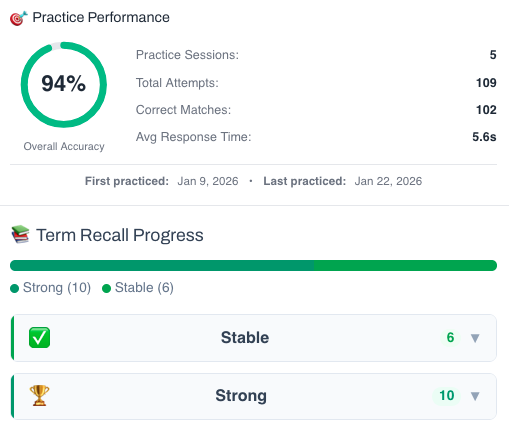
This isn’t a simple quiz — it’s a fully tracked learning system. You build knowledge through recognition, then recall, and your progress feeds directly into the Integrated Practice Bar (Writing tasks, AI Chat, and more).
- Practice sessions, accuracy, and response-time tracking
- Term strength levels (Learning → Stable → Strong)
- Personal progress history for each unit
This feature is available to YSP members.
Explore Membership Benefits