Franco’s Business Day: Daily Office Routines
Core PathWay
1 Franco’s Standard Business Day
Meet Franco. He works in an office and his days follow a regular routine. Let’s look at what Franco does on a typical workday.
Franco gets to the office at 8am every morning. When he arrives, he goes to his desk and first turns on his PC. While his computer starts, he says hello to his colleagues. Then he logs in to his computer and checks his email. He usually has about 20 new messages.
After he reads his emails, Franco replies to the most important ones. He writes short, clear answers. Sometimes he needs to deal with problems from yesterday. At 9am, Franco has a meeting with his team. They talk about their work and make plans for the week.
After the meeting, Franco goes back to his desk. He makes calls to clients and follows up on projects. At midday, he has a break for lunch. He usually eats with colleagues in the office kitchen.
In the afternoon, Franco continues his work. He does his paperwork and catches up on emails. Sometimes he needs to pick up documents from other departments. At 4pm, he plans the next day’s work. He writes a list of tasks for tomorrow.
At 6pm, Franco finishes his day. He logs out of his computer and turns off his PC. He says goodbye to his colleagues and leaves the office. Franco’s day is complete.
This is a standard business day. Most office workers do similar tasks every day. Learning these words helps you talk about your work routine.
Key Terms
2 Essential Business Collocations
In English, certain verbs go together with certain nouns. We call these partnerships ‘collocations’. In business English, four verbs are very important: HAVE, MAKE, DO, and GET. Let’s look at how we use them.
HAVE + noun is very common in business. We use HAVE for meetings, breaks, and meals. Franco has a meeting every morning at 9am. He has breakfast before work. He has a break at midday. We also say have a conversation, have a problem, and have an idea. Think of HAVE as the verb for activities and experiences.
MAKE + noun is for creating or producing things. Franco makes calls to clients. His boss makes decisions about projects. We also make plans, make coffee, and make arrangements. When you create something or produce a result, use MAKE.
DO + noun is for work and tasks. Franco does his paperwork every afternoon. We also do work, do a job, do business, and do our best. DO is the general verb for completing tasks and activities.
GET + place is for arriving and movement. Franco gets to the office at 8am. We also get home, get ready, and get back from lunch. GET is very flexible and has many uses in business English.
These four verbs are the building blocks of business vocabulary. When you learn a new business task, always check which verb goes with it. English speakers don’t say ‘do a meeting’ or ‘make paperwork’. The correct partnerships are fixed, so you need to learn them as complete phrases.
Key Terms
3 Business Phrasal Verbs Explained
Phrasal verbs are very important in business English. A phrasal verb is a verb plus a small word like ‘on’, ‘up’, or ‘out’. The meaning changes when you add these small words. Let’s look at the phrasal verbs from Franco’s day.
Turn on means start a machine. Franco turns on his computer every morning. The opposite is turn off, which means stop a machine. He turns off his computer before he goes home. These verbs work for computers, lights, phones, and machines.
Log in means enter your password to use a computer or system. Franco logs in when he starts work. Log out means close your account and stop using the system. He logs out at the end of the day. These verbs are only for computers and online systems.
Deal with means handle or solve something. Franco deals with problems and questions. When you deal with something, you take action to solve it. We use this for problems, emails, clients, and situations.
Follow up means check something again after the first time. Franco follows up on his projects. This means he checks the progress and takes more action if necessary. We follow up on emails, meetings, and requests.
Catch up means do work that you didn’t finish before. Franco catches up on emails in the afternoon. When you are late with work, you need to catch up. We catch up on emails, paperwork, and tasks.
Pick up means collect or get something. Franco picks up documents from other departments. This phrasal verb is for physical objects. We pick up papers, parcels, and items.
These phrasal verbs are very common in offices. Native speakers use them naturally every day. When you use these verbs, you sound more natural and fluent.
Key Terms
4 Recap: Talking About Your Business Day
Now you know the essential vocabulary for talking about a standard business day. You learned important collocations with HAVE, MAKE, DO, and GET. You also learned common phrasal verbs for office work.
Remember that we use different tenses for different situations. For regular routines, use present simple: ‘I usually have a meeting at midday.’ For things happening now or today, use present continuous: ‘Today I’m not having any meetings.’
Here are examples of both:
Regular routines (present simple):
– I check my email every morning.
– Franco makes calls to clients every day.
– We have a team meeting every Monday.
Today’s activities (present continuous):
– Today I’m working from home.
– Franco isn’t making any calls this afternoon.
– We’re having a special meeting this morning.
The vocabulary is the same, but the tense changes the meaning. Present simple tells us about habits and routines. Present continuous tells us about temporary situations and things happening now.
Your next-time checklist:
You now have the language tools to describe your business day clearly and naturally. Practice using these phrases when you talk about your work, and they will become automatic.
Member-Exclusive Vocabulary Review & Acquisition System
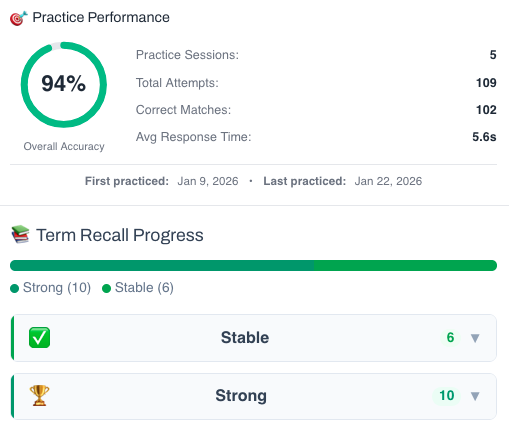
This isn’t a simple quiz — it’s a fully tracked learning system. You build knowledge through recognition, then recall, and your progress feeds directly into the Integrated Practice Bar (Writing tasks, AI Chat, and more).
- Practice sessions, accuracy, and response-time tracking
- Term strength levels (Learning → Stable → Strong)
- Personal progress history for each unit
This feature is available to YSP members.
Explore Membership Benefits