Yesterday’s Dental Appointment: Past Simple & Continuous In Context
Core PathWay
1 🌐 Introduction to ‘Past Simple & Continuous In Context – At the Dentist’
Quick Grammar Guide: Past Simple vs Past Continuous
Past Simple = finished actions in the past
– Form: verb + -ed (or irregular form)
– Example: I went to the dentist. She had a toothache.
– Use: The action is complete and finished
Past Continuous = actions in progress in the past (background actions)
– Form: was/were + verb + -ing
– Example: I was waiting in the reception. The dentist was checking my teeth.
– Use: The action was happening at that time (not finished yet)
Together: Past continuous sets the scene, past simple tells what happened
– Example: While I was sitting in the waiting room (background), the receptionist called my name (completed action).
—
Yesterday’s Dental Appointment
Yesterday morning, Emma woke up with a terrible toothache. Her molar was very sensitive and the pain was getting worse. She called the dental clinic and booked an appointment for 2 p.m.
When Emma arrived at the clinic, the receptionist gave her a form. While she was filling out the form, she noticed other patients sitting in the waiting room. Some people were reading magazines, and one man was holding his face because of swelling.
After ten minutes, the dental hygienist called Emma’s name. Emma walked into the room and sat in the dentist’s chair. Dr. Martinez, the dentist, came in and smiled. “What’s the problem today?” she asked. While Emma was explaining about her toothache, Dr. Martinez was looking at her teeth.
Dr. Martinez decided to take an X-ray. The X-ray showed a cavity in Emma’s back tooth. “You need a filling,” the dentist said. Emma felt nervous because she didn’t like the drill. Dr. Martinez gave her an injection to make her mouth numb.
While the injection was working, Dr. Martinez prepared her tools. After a few minutes, she started the treatment. Emma couldn’t feel anything! The dentist cleaned the cavity and put in the filling. The whole process took about 20 minutes.
When the treatment finished, Dr. Martinez told Emma to rinse her mouth. “Remember to floss every day,” she said. “Plaque can cause more cavities. You also need to brush your gums carefully.”
Emma paid at the reception desk and made another appointment for a checkup in six months. While she was walking home, her mouth still felt strange because it was still numb. But she was happy because the toothache was gone!
💬 Dialogue 1: Booking an Appointment
A patient calls the dental clinic to make an appointment
2 🔬 The Key Phrases you need for ‘Past Simple & Continuous In Context – At the Dentist’
1. book an appointment
This means to call or go online to choose a time to see the dentist.
– Example: I booked an appointment for next Tuesday at 10 a.m.
2. fill out a form
This means to write your information on a paper with questions.
– Example: The receptionist asked me to fill out a form with my name and address.
3. sit in the waiting room
This means to wait in the special room before you see the dentist.
– Example: I was sitting in the waiting room for 15 minutes.
4. call in a patient
This means to say someone’s name so they can come for their appointment.
– Example: The nurse called in the next patient at 3 o’clock.
5. open wide
This means to open your mouth very big so the dentist can see inside.
– Example: The dentist said “Please open wide” and looked at my teeth.
6. check for cavities
This means to look carefully at teeth to find holes or problems.
– Example: The dentist checked for cavities during my checkup.
7. need a filling
This means a dentist must put special material in your tooth to fix a hole.
– Example: The dentist said I needed a filling in my back tooth.
8. feel nervous
This means to feel worried or scared about something.
– Example: Many people feel nervous before going to the dentist.
9. take an X-ray
This means to make a special photo of your teeth to see inside them.
– Example: The dentist took an X-ray to see if there was a problem.
10. clean your teeth
This means to remove dirt and plaque from your teeth.
– Example: The dental hygienist cleaned my teeth and they looked very white.
11. rinse your mouth
This means to put water in your mouth and spit it out to clean it.
– Example: After the treatment, I had to rinse my mouth with water.
12. make an appointment
This means to arrange a time to see the dentist in the future.
– Example: I made an appointment for a checkup in six months.
💬 Dialogue 2: At the Dentist’s Office
A dentist talks to a patient during a checkup
3 🔍 Other Key Terms for ‘Past Simple & Continuous In Context – At the Dentist’
appointment
This is a time you choose to see a doctor or dentist.
– Example: My dentist appointment is on Friday at 2 p.m.
checkup
This is when the dentist looks at your teeth to make sure they are healthy.
– Example: I go for a checkup every six months.
toothache
This is pain in your tooth.
– Example: I had a bad toothache all night.
cavity
This is a hole in your tooth caused by decay.
– Example: The dentist found a small cavity in my tooth.
filling
This is the material a dentist puts in a tooth to fix a hole.
– Example: The dentist put a white filling in my tooth.
dental hygienist
This is a person who helps the dentist and cleans teeth.
– Example: The dental hygienist cleaned my teeth before the dentist came in.
waiting room
This is the room where you sit before you see the dentist.
– Example: There were five people in the waiting room.
receptionist
This is the person who answers the phone and helps patients at the desk.
– Example: The receptionist was very friendly and helpful.
X-ray
This is a special photo that shows the inside of your teeth.
– Example: The X-ray showed a problem with my back tooth.
numb
This means you cannot feel anything in that part of your body.
– Example: My mouth was numb for two hours after the injection.
injection
This is when the dentist uses a needle to put medicine in your gum.
– Example: The dentist gave me an injection so I wouldn’t feel pain.
drill
This is the tool the dentist uses to remove decay from teeth. It makes a loud noise.
– Example: I don’t like the sound of the dentist’s drill.
floss
This is special string you use to clean between your teeth.
– Example: You should floss your teeth every day.
plaque
This is the sticky, bad substance that forms on teeth.
– Example: Brushing removes plaque from your teeth.
gums
These are the pink parts in your mouth that hold your teeth.
– Example: My gums were bleeding a little.
molar
This is a big tooth at the back of your mouth.
– Example: I have a cavity in my back molar.
pain
This is the bad feeling you have when something hurts.
– Example: The pain in my tooth was very strong.
swelling
This is when a part of your body becomes bigger because of a problem.
– Example: There was some swelling on the side of my face.
sensitive
This means something hurts easily when you touch it or when it gets hot or cold.
– Example: My tooth is very sensitive to cold drinks.
💬 Dialogue 3: Talking About a Dental Visit
Two friends discuss a recent trip to the dentist
4 🧠 Worth Thinking About
Did you know that tooth enamel is the hardest substance in the human body? It’s even harder than bone! But it can still get cavities if you don’t brush and floss. Here’s something interesting: in the past, people used sticks to clean their teeth. The first toothbrush was invented in China around 1498. Also, dentists recommend changing your toothbrush every three months. And here’s a strange fact: your mouth makes about one litre of saliva every day! Saliva helps protect your teeth from bacteria. Finally, if you’re nervous about the dentist, you’re not alone – about 75% of adults feel some fear about dental visits.
Use the VAS to build solid recognition and recall of the terms below.
✔ Every correct Match = +1 point
✔ Every correct Recall = +2 points
🎓 Reach 5 points with good accuracy and the term is automatically promoted to your Personal Dictionary.
Incorrect answers lower accuracy, meaning more correct Matches or Recalls may be needed to reach promotion.
Member-Exclusive Vocabulary Review & Acquisition System
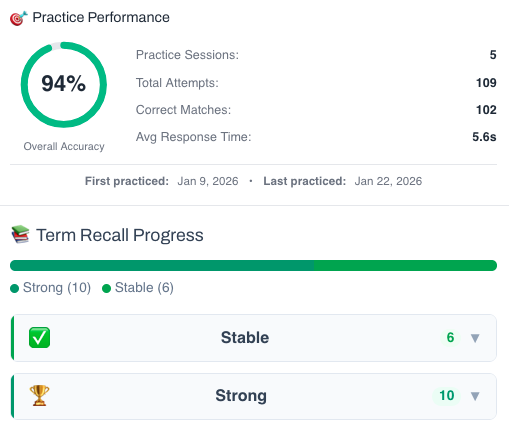
This isn’t a simple quiz — it’s a fully tracked learning system. You build knowledge through recognition, then recall, and your progress feeds directly into the Integrated Practice Bar (Writing tasks, AI Chat, and more).
- Practice sessions, accuracy, and response-time tracking
- Term strength levels (Learning → Stable → Strong)
- Personal progress history for each unit
This feature is available to YSP members.
Explore Membership BenefitsMember-Exclusive Practice Bar
Access a wide range of integrated practice for this unit — from Vocabulary and Grammar activities to AI-curated Writing tasks and Thematic Chat practice.
This feature is available to YSP members.
Explore Membership BenefitsMember-Exclusive Sentence Builder
Reconstruct scrambled sentences to practice word order and develop your grammar intuition.
This feature is available to YSP members.
Explore Membership Benefits