Essential Kitchen Equipment and Appliances
Core PathWay
1 Welcome to My Kitchen
Hello! Today I want to show you my kitchen.
In Britain, we love to talk about our kitchens. The kitchen is a very important room in the house. We cook there, we eat there, and we spend time with family there. When you visit someone’s home, they often show you the kitchen first!
In this lesson, I will take you on a tour of a typical British kitchen. You will learn the names of all the important appliances and fixtures. An appliance is a machine that helps you in the kitchen, like a fridge or oven. A fixture is something fixed in place, like a sink. You will also learn how to say what you have in your kitchen and where everything is.
Let’s start the tour!
2 Three Essential Appliances
Every kitchen needs some big, important appliances. These are the machines you use every day. Let’s look at three of the most essential ones.
We will learn what each appliance does, how to talk about it, and some useful phrases you can use. Pay attention to how we use ‘have got’ to say what we own.
oven
- turn on the oven
- preheat the oven
- put something in the oven
- take something out of the oven
- the oven is hot
- We’ve got a new electric oven in our kitchen.
- I’ve got an oven with a glass door so I can see the food cooking.
fridge
- open the fridge
- close the fridge
- put something in the fridge
- keep something in the fridge
- the fridge is full
- We’ve got a big fridge because we have a large family.
- I’ve got milk and cheese in the fridge.
dishwasher
- load the dishwasher
- unload the dishwasher
- turn on the dishwasher
- run the dishwasher
- put dishes in the dishwasher
- We’ve got a dishwasher so we don’t wash dishes by hand.
- My parents haven’t got a dishwasher so they wash everything in the sink.
Key Terms
3 A Tour of My Kitchen
Come in and look around!
My kitchen is quite small but it has everything I need. When you walk in, you see the sink first. It’s next to the window so I can look outside when I wash the dishes. The worktop is very useful. This is the flat surface where I prepare food. In American English, people say countertop but it’s the same thing.
The fridge is next to the oven. They are both big appliances so they need a lot of space. I’ve got a freezer too. It’s part of the fridge, at the bottom. I keep frozen vegetables and ice cream in the freezer. Above the worktop, I’ve got some cupboards. A cupboard is like a box with a door. I keep plates, cups, and food in my cupboards. Under the worktop, there are more cupboards and some drawers. I keep knives, forks, and spoons in the drawers.
On the countertop, I’ve got a kettle. British people love tea so the kettle is very important! I use it to boil water many times every day. I’ve also got a microwave above the worktop, on the wall. The microwave heats food very quickly. It’s perfect when I’m in a hurry.
My stove is part of the cooker. The stove is the top part with four rings. I put pans on the stove to cook pasta, soup, or vegetables. The oven is under the stove, in the same unit.
I haven’t got a dishwasher because my kitchen is too small. I wash everything by hand in the sink. Some of my friends have got dishwashers and they are very happy with them!
That’s my kitchen. It’s not big or modern but I’ve got everything I need to cook good food. What about your kitchen? What have you got?
4 Think About Your Kitchen
Now it’s your turn to think about your own kitchen. Use the new words you learned to describe what you have and where everything is. Don’t worry about making mistakes. Just try to use the vocabulary!
Reflection prompts
- What appliances have you got in your kitchen?
- Where is your fridge?
- What’s next to your sink?
- Have you got a dishwasher?
- What have you got on your countertop?
- Where do you keep your cups and plates?
Sentence stems
- I’ve got a… in my kitchen.
- My fridge is next to…
- I haven’t got a…
- The… is above the…
- I keep… in the cupboard.
- My kitchen has got…
Try to use these terms
5 You’re Ready to Talk About Kitchens!
Well done! You learned a lot of important kitchen vocabulary today.
You now know the names of essential appliances like oven, fridge, freezer, dishwasher, microwave, and stove. You know about fixtures like the sink and surfaces like the worktop and countertop. You can talk about storage with cupboard and drawer. You also learned how to describe where things are using next to, above, and under.
Talking about your kitchen is a very common conversation topic. When you meet new people, when you visit someone’s home, or when you talk about cooking, you will use this vocabulary. British people often ask ‘What have you got in your kitchen?’ or ‘Where do you keep your cups?’
Now you can answer these questions with confidence! Try to describe your kitchen to a friend or write a short description. Use ‘have got’ and the prepositions you learned. The more you practise, the easier it becomes.
Good luck, and enjoy using your new kitchen vocabulary!
6 Recap
This lesson introduced you to essential kitchen vocabulary through a friendly tour of a typical British kitchen.
You learned the names of major appliances: oven, fridge, freezer, dishwasher, microwave, and stove. You discovered important fixtures and surfaces: sink, countertop, worktop, cupboard, and drawer. You also learned a small but very important appliance: the kettle.
You practised using ‘have got’ to talk about possession. This is how British speakers say what they own: ‘I’ve got a microwave’ or ‘We haven’t got a dishwasher’. You also learned three key prepositions of place: next to, above, and under. These words help you describe where things are in your kitchen.
The deep-dive section showed you useful collocations like ‘turn on the oven’, ‘load the dishwasher’, and ‘open the fridge’. These phrases help you sound natural when you talk about using kitchen equipment.
The reflection activity encouraged you to think about your own kitchen and practise the new vocabulary. Remember, describing your kitchen is a common conversation topic in English. You now have the words and structures you need to do this with confidence!
🎮
Use the VAS to build solid recognition and recall of the terms below.
✔ Every correct Match = +1 point
✔ Every correct Recall = +2 points
🎓 Reach 5 points with good accuracy and the term is automatically promoted to your Personal Dictionary.
Incorrect answers lower accuracy, meaning more correct Matches or Recalls may be needed to reach promotion.
Member-Exclusive Vocabulary Review & Acquisition System
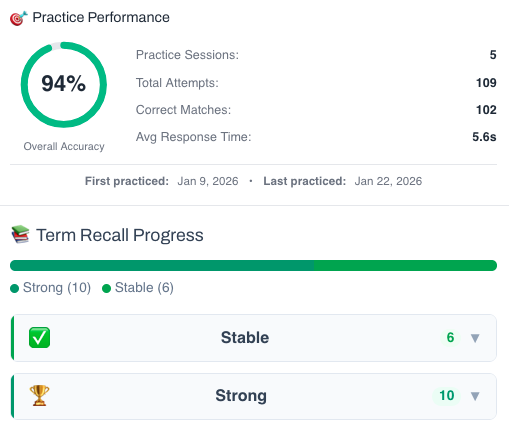
This isn’t a simple quiz — it’s a fully tracked learning system. You build knowledge through recognition, then recall, and your progress feeds directly into the Integrated Practice Bar (Writing tasks, AI Chat, and more).
- Practice sessions, accuracy, and response-time tracking
- Term strength levels (Learning → Stable → Strong)
- Personal progress history for each unit
This feature is available to YSP members.
Explore Membership BenefitsMember-Exclusive Practice Bar
Access a wide range of integrated practice for this unit — from Vocabulary and Grammar activities to AI-curated Writing tasks and Thematic Chat practice.
This feature is available to YSP members.
Explore Membership BenefitsMember-Exclusive Sentence Builder
Reconstruct scrambled sentences to practice word order and develop your grammar intuition.
This feature is available to YSP members.
Explore Membership Benefits