Learning at B1 Level: Understanding Your Journey
Core PathWay
1 You Are at B1 — Here’s What That Means
If you are reading this, you are probably at low to mid B1 level — somewhere between band 1.0 and 2.0, with writing scores around 140 to 145 points. So what does that actually mean?
You can do a lot. You can have conversations about familiar topics. You can write emails and messages that people understand. You can watch some TV shows and follow the main story. You can read articles and get the general idea. These are real skills. You have come a long way.
But you also notice problems. Grammar that felt simple before now has exceptions. You learn a new word, then discover it has three different meanings. You study phrasal verbs like ‘deal with’ and find it can mean ‘handle a problem’, ‘do business with someone’, or ‘accept a difficult situation’. English feels messier than it did at A2.
And here is something many B1 learners feel: you are working just as hard as before, but progress feels slower. You put in the same effort, but you see less improvement. This is called diminishing returns — the feeling that your work is not paying off the way it used to.
But here is the truth: you are not stuck. You are learning something harder and more valuable. At A2, English had clear rules. At B1, you are learning how English really works — with all its complexity, flexibility, and messiness. You are becoming a real communicator, not just someone who follows simple patterns. That takes time. It feels uncomfortable. But it is exactly what you need to do to reach B2 and beyond.
Complexity is not a problem. Complexity is progress.
2 How to Learn Grammar Effectively at B1
Grammar at B1 is different from grammar at A2. You are not just learning new rules — you are learning when rules change, when they have exceptions, and how native speakers actually use them in real situations. So how do you learn this effectively?
First, decide how to organise your time. Some learners prefer one focused hour per week — they sit down, study one grammar point deeply, do exercises, and finish. Other learners prefer shorter sessions — 15 minutes on Monday, 15 minutes on Wednesday, 15 minutes on Friday. Both work. The key is consistency. One hour once a week is better than three hours once a month.
Second, use multi-sensory exposure. This means you see, hear, and use the grammar in different ways. Read example sentences out loud. Listen to audio that uses the structure you are studying. Write your own sentences. Do exercises on paper, then do different exercises on screen. Your brain remembers better when it gets information through multiple channels.
Third, connect grammar to real communication. Do not just learn ‘present perfect = have + past participle’. Learn when people actually use it: ‘I’ve finished the report’ (the report is ready now), ‘I’ve lived here for three years’ (I still live here). Ask yourself: when would I say this? Why would I choose this form instead of past simple?
Finally, accept that B1 grammar is harder because it is more realistic. At A2, you learned that ‘if + present, will + verb’ makes first conditional. At B1, you learn that native speakers also say ‘if you’re coming, I’ll wait’ (present continuous in the if-clause) or ‘if it rains, I’m staying home’ (present simple in both clauses for strong decisions). These are not mistakes. They are variations. Learning them makes you sound more natural.
Use the MCQ Practice Sets on the platform to test your grammar knowledge. Use the Claude Chat Tutor in Error-Removal Mode when you are not sure if your sentence is correct. And remember: one hour of focused, multi-sensory practice beats three hours of passive reading.
3 How to Learn Vocabulary Effectively at B1
Vocabulary is the biggest challenge at B1. Not because the words are difficult, but because English words do so many different things. A word you think you know suddenly appears in a new context with a completely different meaning. So how do you actually learn vocabulary — and remember it?
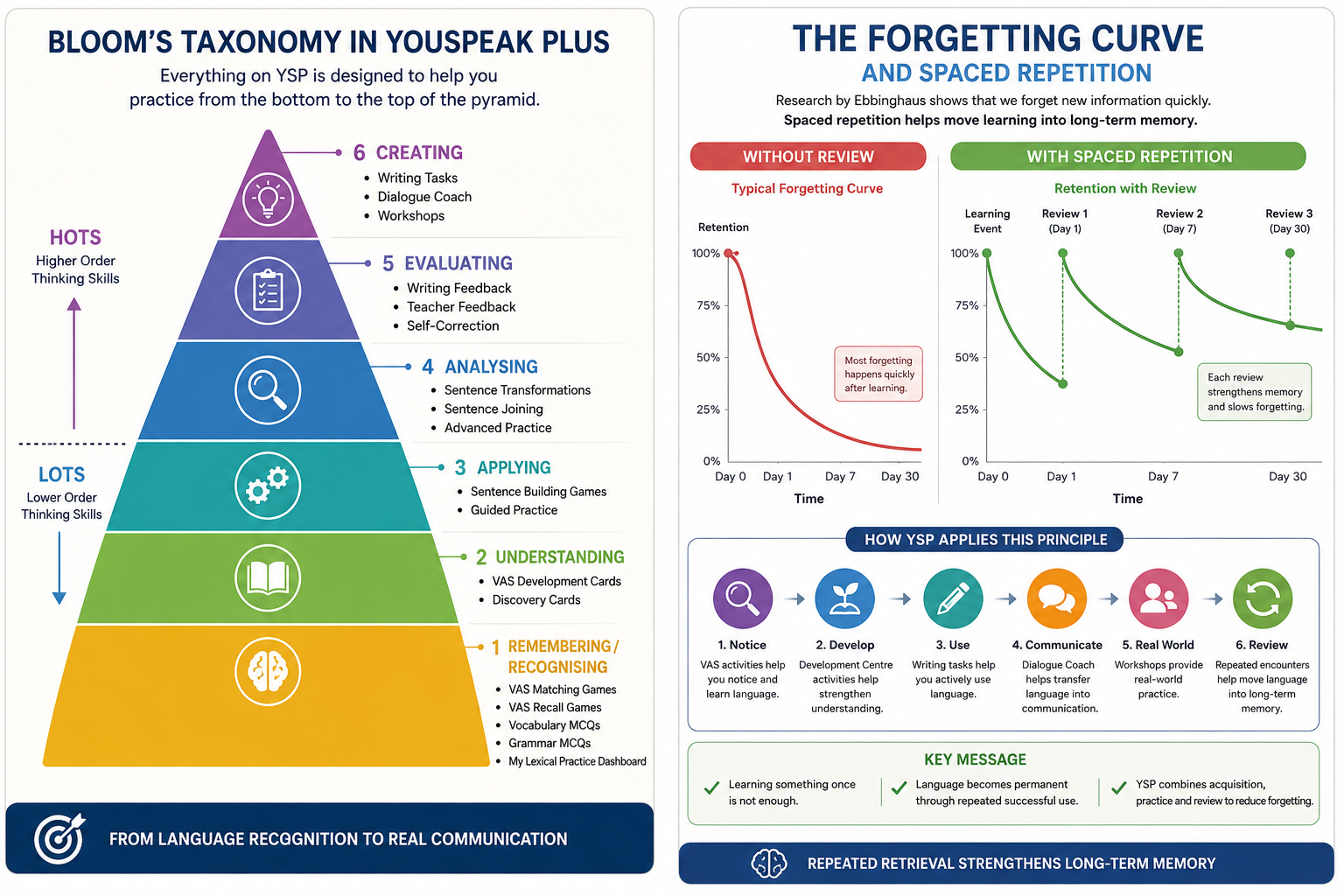
Let’s start with a problem. In 1885, a German psychologist called Hermann Ebbinghaus discovered something important: we forget most of what we learn very quickly. He called this the forgetting curve. If you learn 20 new words today and do nothing with them, you will probably remember only 5 or 6 of them next week. This is not because you have a bad memory. This is how all human brains work.
But Ebbinghaus also found the solution: spaced repetition. If you review the same words at specific times — after one day, then after three days, then after a week — your brain moves them into long-term memory. The VAS (Vocabulary Acquisition System) on this platform does exactly this. It shows you words when you are about to forget them, so every review makes the memory stronger.
But repetition is not enough. You also need multi-modal learning. This means you interact with words in different ways: you read them, you hear them, you write them, you use them in sentences. When you read a word, your brain makes one type of memory. When you hear it, your brain makes another type. When you use it in writing, your brain makes a third type. Three types of memory are much stronger than one.
Here is a practical strategy for B1 learners:
1. When you learn a new word, write it in a sentence that is true for you. Not ‘The meeting was important’, but ‘My meeting with the new client yesterday was important.’
2. If the word has multiple meanings (like ‘deal with’), learn one meaning first. Master it. Use it. Then learn the second meaning later.
3. Use the VAS games on this platform — especially the Cloze Tasks (where you complete sentences) and Sinking Ship (where you rebuild the word letter by letter). These games force your brain to retrieve the word, which is much more powerful than just reading it again.
4. Do VAS writing tasks immediately after learning new vocabulary. This moves words from passive recognition (‘I know what it means’) to active use (‘I can use it correctly in my own sentences’).
Remember: forgetting is normal. Forgetting is part of learning. The key is to review before you forget completely. That is what spaced repetition does. That is what the VAS does. Use it.
4 Why Writing Is Your Most Powerful Learning Tool
Many learners think writing is just a test — something teachers make you do to check your grammar. But writing is actually one of the most powerful ways to learn. Here is why.
When you write something down, your brain does several things at once. First, you have to remember the word or structure. Then you have to spell it correctly. Then you have to use it in a sentence that makes sense. This is called multi-modal reinforcement — your brain is working in multiple ways at the same time, which creates much stronger memories than just reading or listening.
There is also something called muscle memory. When you physically write a word (with a pen or by typing), your muscles remember the movement. This is why many people say ‘I know how to spell it when I write it, but I can’t remember it when I just think about it.’ The physical act of writing creates an extra memory trace.
But the biggest reason writing helps you learn is this: writing forces you to produce language, not just recognise it. When you read, you see the word and think ‘Yes, I know that.’ When you write, you have to pull the word out of your memory, spell it, and use it correctly. This is much harder — and that is exactly why it works. Difficult practice creates stronger learning.
Here is how to use writing as a learning tool:
• After studying new vocabulary, write 5 sentences using the new words. Make them personal and true.
• When you learn a new grammar structure, write a short paragraph (60-80 words) that uses it naturally.
• Use the Writing Tasks on this platform — especially the VAS writing tasks that ask you to use vocabulary you just learned.
• Keep a simple learning journal. Every day, write 3-4 sentences about what you studied. Use the new language you learned that day.
All writing tasks on this platform give you AI evaluation with a CEFR score and specific feedback. This means you can see exactly what you are doing well and what needs work. The feedback goes into the RSS (Results, Signals & Suggestions) system, so you can work on your specific problems.
Writing is not easy. But that is the point. The effort you put into writing is the effort that makes learning stick.
5 How I Got Past B1: A Learner’s Story
Elena had been at B1 level for almost a year. She could have conversations, she could write emails, she understood most of what she read — but she felt stuck. ‘I’m working so hard,’ she told her colleague Marcus, who was now at C1 level. ‘But I don’t feel like I’m getting better. I think I’ve hit the plateau.’
Marcus smiled. ‘I felt exactly the same way,’ he said. ‘I was at B1 for about 18 months. I kept thinking, “Why is this taking so long?” But then I changed how I was learning, and things got better.’
‘What did you change?’ Elena asked.
‘Three things,’ Marcus said. ‘First, I stopped trying to learn everything at once. I was using five different apps, watching YouTube videos, doing grammar exercises, reading articles — I was so busy that I never actually mastered anything. So I chose one platform and worked through it systematically. I focused on one topic at a time and really learned it before moving on.’
‘That makes sense,’ Elena said. ‘What was the second thing?’
‘I started using spaced repetition properly,’ Marcus said. ‘I thought I knew words because I recognised them when I read them. But when I tried to use them in conversation, they weren’t there. So I started using the VAS games every day — just 10 minutes. I did the Cloze Tasks and the Sinking Ship game because they made me produce the words, not just recognise them. After about three weeks, I noticed a real difference. Words were actually sticking.’
‘And the third thing?’
‘I started writing every day,’ Marcus said. ‘Not long pieces — just 80 to 100 words. I used the VAS writing tasks because they made me use the vocabulary I was learning that day. At first it was hard. I made mistakes. But the AI evaluation showed me exactly what I was doing wrong, and I could work on it. After two months, my writing score went from 143 to 156. That is when I knew I was really improving.’
Elena thought about this. ‘So basically, you did less — but you did it better?’
‘Exactly,’ Marcus said. ‘I stopped trying to do everything and started doing the things that actually work: focused practice, spaced repetition, and active production through writing. It took time. But it worked. You will get past B1. You just have to be strategic about how you learn.’
6 Your B1 Learning Plan: What to Do Next
You now understand what it means to be at B1 level. You know why English feels more complex. You know how to learn grammar and vocabulary effectively. You know why writing is such a powerful tool. And you have heard from a learner who successfully moved from B1 to C1.
So what should you do next?
First, accept where you are. B1 is not a problem. B1 is progress. You are learning real English now — the messy, flexible, complex language that native speakers actually use. This takes time. Be patient with yourself.
Second, be strategic. You cannot learn everything at once. Choose one area to focus on each week. This week, work on present perfect. Next week, work on business vocabulary. The week after, work on writing longer paragraphs. Focused practice beats scattered practice every time.
Third, use the tools on this platform. The VAS games give you spaced repetition automatically. The writing tasks give you AI evaluation and specific feedback. The Claude Chat Tutor helps you practice in Error-Removal Mode or Fluency Mode. The MCQ Practice Sets test your grammar. These tools work — but only if you use them consistently.
Finally, remember this: progress at B1 feels slow because you are learning something genuinely difficult. You are not just memorising rules anymore. You are learning how to communicate flexibly, naturally, and accurately in a complex language. That is hard work. But it is exactly the work that will take you to B2, then C1, and beyond.
You are not stuck. You are learning. Keep going.
Member-Exclusive Practice Bar
Access a wide range of integrated practice for this unit — from Vocabulary and Grammar activities to AI-curated Writing tasks and Thematic Chat practice.
This feature is available to YSP members.
Explore Membership Benefits
Member-Exclusive Vocabulary Review & Acquisition System
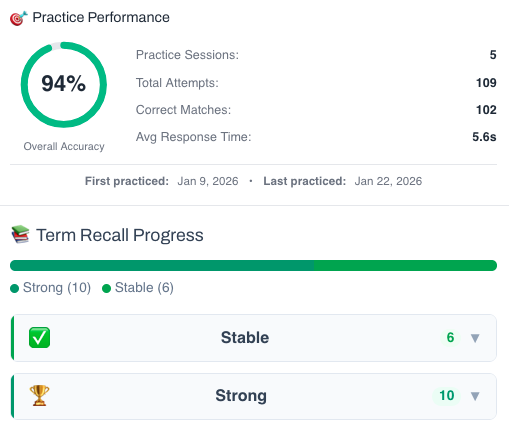
This isn’t a simple quiz — it’s a fully tracked learning system. You build knowledge through recognition, then recall, and your progress feeds directly into the Integrated Practice Bar (Writing tasks, AI Chat, and more).
- Practice sessions, accuracy, and response-time tracking
- Term strength levels (Learning → Stable → Strong)
- Personal progress history for each unit
This feature is available to YSP members.
Explore Membership Benefits🎮 Practice Games
Sentence Scrambler
How to learn at B1 level – Sentence Scramble
Member-Exclusive Sentence Builder
Reconstruct scrambled sentences to practice word order and develop your grammar intuition.
This feature is available to YSP members.
Explore Membership Benefits