The Language of Procedures: From First Step to Closed Case
Core PathWay1 Section 1. Following the Process
Procedures have their own language — and once you know it, everything becomes clearer. When you work with any official process, the first thing you need to do is follow a procedure. This means to do things in the correct order, as the rules say. A similar idea is to comply with a procedure. This means to obey the rules of a process — not just follow the steps, but act in a way that meets the official standard. There is also a more informal way to say this: to stick to the procedure. This means to stay with the correct process and not change it or skip any part. These three phrases are close in meaning, but the feeling is slightly different. ‘Follow’ focuses on doing the steps. ‘Comply with’ focuses on meeting the rules. ‘Stick to’ focuses on not going off track. When you begin a process, you also need to carry out the steps. This means to do each action in the process, one by one. And you need to complete each stage. This means to finish every part before you move forward. Think of a procedure like a journey — you cannot skip stops.
2 Section 2. Meeting the Requirements
Every procedure has things you must do or provide. These are called requirements. When you meet the requirements, you give or do everything the process asks for. If you do not meet the requirements, your request may be refused. One very common requirement is paperwork. You often need to submit the required documents. This means to send or give the official papers that the process needs. Sometimes you also need to provide supporting documents. These are extra papers that prove your information is correct — for example, a bank statement or a letter from your employer. In some cases, you need to attach a document. This means to add a file or paper to your application or email. It is a small action, but an important one. Many procedures also ask you to fill in a form. To fill in a form means to write information in the empty spaces on an official document. You can also say complete a form — this means the same thing. Finally, many official forms need you to sign and date a form. This means to write your name and the current date on the form. This shows that you agree with the information and that it is current.
3 Section 3. Getting Approval
Many procedures need someone to say ‘yes’ before you can continue. When you obtain approval, you get official permission to do something or to move forward. ‘Obtain’ is a more formal word. It means to get something, usually through effort or a process. A similar phrase is to request authorisation. This means to ask an official person or organisation for permission. ‘Authorisation’ is the noun. It means official permission that is given by someone with authority. Notice the difference: you request authorisation, but you obtain approval. Both ideas are about getting permission, but the verbs are different. Once you have permission, you can proceed to the next stage. This means to move forward to the following part of the process. ‘Proceed’ is a formal verb. It means to continue or go forward. These three phrases — obtain approval, request authorisation, and proceed to the next stage — often appear together in official processes. First you request authorisation, then you obtain approval, and then you proceed.
4 Section 4. Processing and Deciding
Once a request arrives, someone needs to deal with it. To process a request means to look at it, check it, and take the right action. This is the job of the person or organisation receiving the request. After processing, a decision is made. If the answer is yes, the organisation will approve a request. This means to officially say that something is accepted and can go ahead. If the answer is no, they will reject a request. This means to officially refuse something. A rejected request cannot continue. When a request is approved, the organisation often gives a reference number. To issue a reference number means to officially produce and give a number that identifies your case. This number is important — you use it in all future communication. After issuing the number, the organisation will usually notify the applicant. This means to officially inform the person who made the request about the decision or the next steps. ‘Notify’ is a formal verb. It means to tell someone something important, usually in writing.
5 Section 5. Managing the Documentation
After a procedure is complete, the documents do not disappear. Organisations need to keep them safely. To store the documentation means to keep all the official papers or files in a safe place, usually a system or archive. This is important for legal and practical reasons. A related idea is to retain a copy. This means to keep one copy of a document for your own records. Both organisations and individuals should retain copies of important papers. You can also say to keep a record of something. This means to save information about something so you can check it later. For example, you might keep a record of every email you send or every payment you make. Another important phrase is to record the outcome. This means to write down what happened at the end of a process — was the request approved or rejected? What was decided? Recording the outcome is an important final step. It means the information is not lost and can be checked later.
6 Section 6. Following Up and Closing the Case
A procedure is not always finished after the first decision. Sometimes you need to check what is happening. To follow up on a request means to contact someone to ask about the progress of something you already sent or asked for. For example, if you submitted a form two weeks ago and have not received a reply, you might follow up on your request by sending an email. This shows that you are still waiting and that the matter is important to you. When everything is done and there is nothing left to do, it is time to end the process. To close the case means to officially finish a procedure because it is complete. All the steps have been done, all the documents have been stored, and the outcome has been recorded. Closing the case is the final action. After this, the procedure is finished. These six sections together give you the full language of procedures — from the first step to the last.
Member-Exclusive Practice Bar
Access a wide range of integrated practice for this unit — from Vocabulary and Grammar activities to AI-curated Writing tasks and Thematic Chat practice.
This feature is available to YSP members.
Explore Membership BenefitsMember-Exclusive Vocabulary Review & Acquisition System
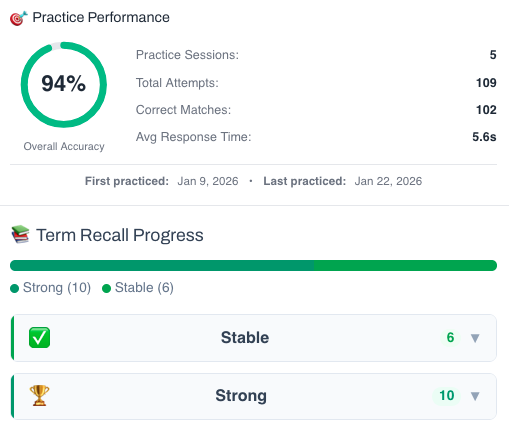
This isn’t a simple quiz — it’s a fully tracked learning system. You build knowledge through recognition, then recall, and your progress feeds directly into the Integrated Practice Bar (Writing tasks, AI Chat, and more).
- Practice sessions, accuracy, and response-time tracking
- Term strength levels (Learning → Stable → Strong)
- Personal progress history for each unit
This feature is available to YSP members.
Explore Membership Benefits