From Now to How Long: Present Continuous meets Present Perfect Continuous
Core PathWay
1 Section 1. What Are You Doing? The Present Continuous
You already know the Present Continuous. Let’s look at two things it does really well — and notice something interesting about both of them.
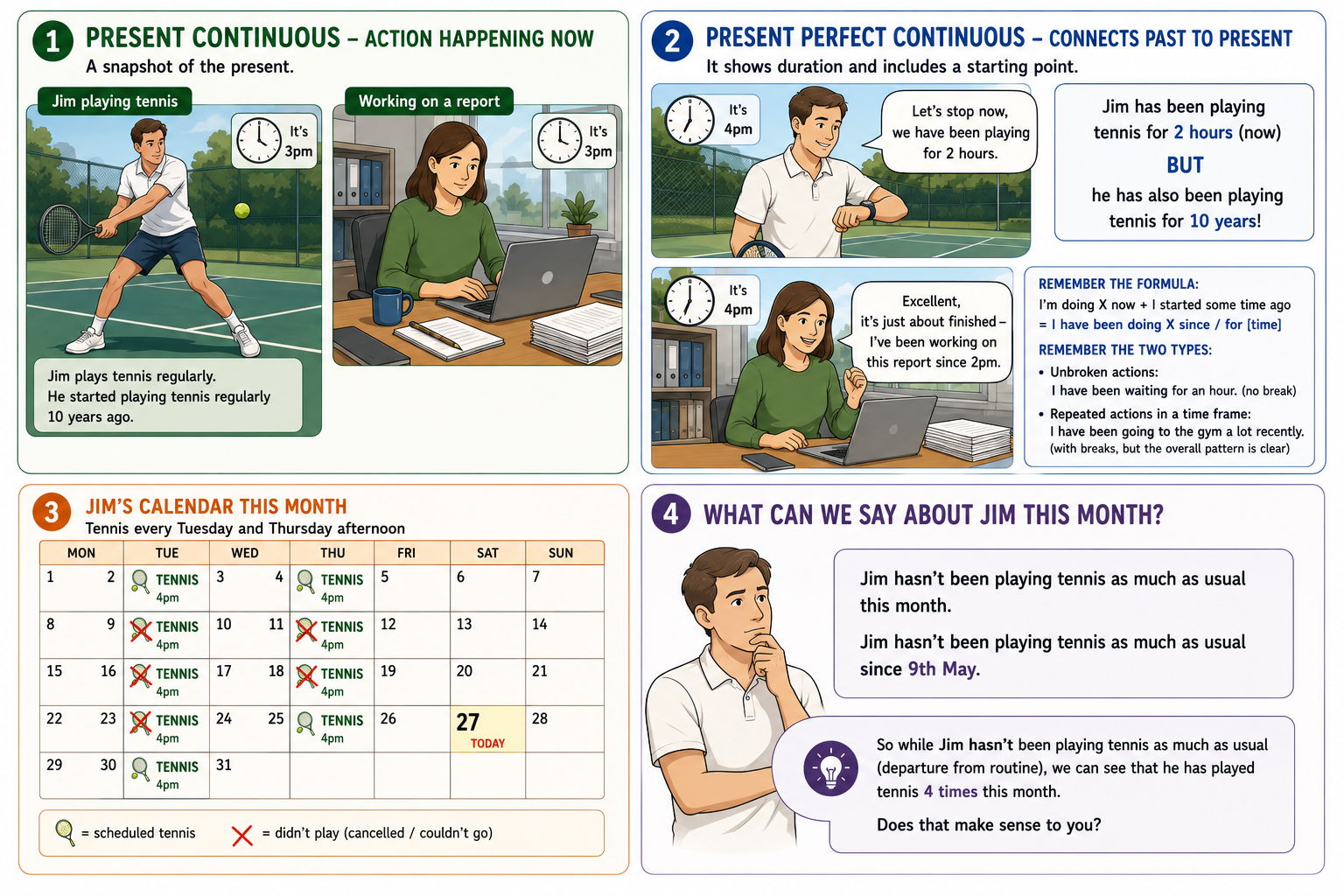
The first use is simple. We use the Present Continuous to describe an action happening now — at this exact moment. Think of it as a snapshot of right now.
• I’m working on a report at the moment.
• She’s reading her emails right now.
• They’re having a meeting.
The second use is just as common, but learners sometimes miss it. We also use the Present Continuous to describe a change from normal routine — something happening more or less than usual in this period. These sentences always have a ‘more than’, ‘less than’, or ‘a lot’ idea inside them. And notice: these are repeated actions, not one long unbroken action.
• I’m having more meetings this week than usual. (Normally I don’t have so many.)
• I’m going to the gym less than normal these days.
• I’m eating more pizza than I generally do.
The key idea: something has shifted from the normal pattern — and it’s happening in this period.
—
Listen in. Here’s a real conversation:
Alex: Hi Jim! How are things going? What are you doing these days?
Jim: Pretty busy, actually! I’m working on a big project at the moment — it’s taking up a lot of my time. And I’m having way more meetings than usual this week. I’m barely getting any time to think!
Alex: That sounds exhausting. Are you at least taking breaks?
Jim: Not really! I’m sleeping less than normal and I’m drinking way more coffee than I should. But the project is going well, so I can’t complain too much.
2 Section 2. Now Add a Starting Point — The Present Perfect Continuous
Here’s where it gets interesting. You’ve just seen two things the Present Continuous does. Now we’re going to add one simple ingredient to each — a starting point in time. And that gives us the Present Perfect Continuous.
Think of it this way:
> I’m doing X now + I started doing X some time ago = I have been doing X since / for [time period]
Let’s apply this to both uses from Section 1.
—
Use 1 — Action happening now, with a starting point:
• I’m working on a report at the moment. → I have been working on it since Monday / for four days.
• She’s reading her emails. → She has been reading her emails for an hour.
The action is still happening now. We’ve just added: when did it begin?
—
Use 2 — Change from routine, with a starting point:
• I’m having more meetings than usual. → I have been having more meetings than usual for two weeks.
• I’m going to the gym less than normal. → I have been going to the gym less than normal since January.
• I’m eating more pizza than I generally do. → I have been eating more pizza than usual since I started working from home.
—
One important distinction — two types of ‘continuous’:
Both examples use the Present Perfect Continuous, but they show different things.
Unbroken duration: I have been working since 9am. This means one continuous action — no breaks, no other activities. The working has not stopped.
Repeated actions in a time frame: I have been working a lot recently. This means the main activity is working — but of course there have been breaks. You slept. You ate. You drove. But the overall pattern across the period is: lots of work.
If you doubt this ‘unbroken duration’ vs ‘repeated in the time frame’, think about this: ‘Your heart has been beating since before you were born!’ [unbroken duration: that’s why you are still alive] vs ‘You have been eating solid food since you were a young child’ [repeatedly in the time frame – NOT unbroken duration’ – again, that’s why you are still alive!]
The tense is the same. Common sense tells you which type it is.
3 Section 3. Use Your Common Sense — Natural Ambiguity
Here’s something honest about the Present Perfect Continuous: it doesn’t always tell you exactly which type of action it is. And that’s fine — because context and common sense do the job.
Look at this sentence:
• I have been playing tennis since I was ten years old.
Does this mean playing tennis without a single break for all those years? Of course not! Common sense tells us this means: I have been playing tennis regularly / repeatedly over many years. The time frame is long, so the action must be repeated.
Now look at these:
• I have been learning Spanish for six months. → Regularly, in lessons and study sessions — not without a break.
• Jordan has been running every morning since the summer. → A repeated habit, not one continuous run.
• Sam has been feeling tired all week. → A feeling that keeps returning — not literally every second.
• I have been waiting for this email for three days! → A situation that keeps coming back to mind — not standing at the computer for 72 hours.
And sometimes the meaning really is unbroken:
• I have been standing in this queue for forty minutes. → Yes, literally standing. No break.
• It has been raining since this morning. → Still raining now, without stopping.
The language is the same. Your common sense reads the situation. This is not a problem — it’s just how natural language works.
4 Section 4. Think About Yourself — A Mini Questionnaire
Now it’s your turn. Think about your own life right now. Answer these questions honestly — there are no wrong answers!
Part A — What are you doing right now / in this period?
1. Are you working on a project or task at the moment?
2. Are you studying something new right now?
3. Are you living in the same place as usual, or somewhere different?
4. Are you spending a lot of time online these days?
Part B — What is different from your normal routine?
5. Are you sleeping more or less than usual?
6. Are you exercising more or less than normal?
7. Are you eating differently from usual?
8. Are you spending more or less time with friends or family?
9. Are you working more hours than you normally do?
10. Are you feeling more stressed, relaxed, or motivated than usual?
Part C — Now think about when things started.
Look at your answers above. For each one, ask yourself:
• When did this start?
• How long has this been happening?
• Can I use ‘since’ (a point in time) or ‘for’ (a length of time)?
For example:
Try to build two or three sentences about yourself using this formula.
5 Section 5. Writing Task — Email to a Friend
You have seen how the Present Continuous and the Present Perfect Continuous work together. Now use both in a real piece of writing. Write a short, friendly email to a friend you haven’t spoken to for a while.
6 Recap — Two Tenses, One Big Idea
Let’s bring it all together. These two tenses are not separate topics — they are partners.
The Present Continuous describes what is happening now, or what is different from your normal routine in this period. It’s a snapshot of the present.
The Present Perfect Continuous does the same thing — but adds a starting point. It connects the past to the present and shows duration.
Remember the formula:
> I’m doing X now + I started some time ago = I have been doing X since / for [time]
And remember the two types:
• Unbroken actions: I have been waiting for an hour. (no break)
• Repeated actions in a time frame: I have been going to the gym a lot recently. (with breaks, but the overall pattern is clear)
Finally, trust your common sense. I have been playing tennis since I was a child doesn’t need a grammar rule to understand — it just makes sense.
You already knew the Present Continuous. Now you have a powerful upgrade.
Member-Exclusive Practice Bar
Access a wide range of integrated practice for this unit — from Vocabulary and Grammar activities to AI-curated Writing tasks and Thematic Chat practice.
This feature is available to YSP members.
Explore Membership Benefits
Member-Exclusive Vocabulary Review & Acquisition System
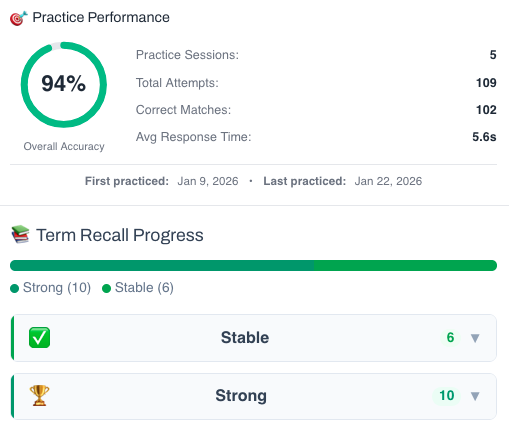
This isn’t a simple quiz — it’s a fully tracked learning system. You build knowledge through recognition, then recall, and your progress feeds directly into the Integrated Practice Bar (Writing tasks, AI Chat, and more).
- Practice sessions, accuracy, and response-time tracking
- Term strength levels (Learning → Stable → Strong)
- Personal progress history for each unit
This feature is available to YSP members.
Explore Membership Benefits🎮 Practice Games
Sentence Scrambler
Present Perfect Continuous – the Main Uses [1] – Sentence Scramble
Member-Exclusive Sentence Builder
Reconstruct scrambled sentences to practice word order and develop your grammar intuition.
This feature is available to YSP members.
Explore Membership Benefits