CAE Report Writing: Strategic Guide for C1 Excellence
Core PathWay
1 🔍 What's This Task Type?
A report is a formal, structured piece of writing that presents findings on a specific issue and often suggests recommendations. Its core purpose is to inform a reader who needs clear, factual information to make a decision. Unlike an essay, which argues a point, a report analyzes information and presents it objectively. In the CAE exam, you’ll write a report as one of the options in Part 2. The target reader is typically a superior, a committee, or an organization—someone who expects professionalism and clarity.
Think of the report as a tool for change. You’re not just describing a situation; you’re providing insights that lead to action. The examiner is looking for your ability to structure complex information logically, use formal language with precision, and make actionable suggestions. The key is to adopt an authoritative yet objective tone, presenting your analysis without personal bias.
Key Terms
💬 Clarifying the Report's Purpose
A student is confused about the difference between a report and an essay. The coach clarifies the communicative purpose.
2 🗺️ Planning Tips
Effective planning is the bedrock of a high-scoring report. Start with a thorough rubric analysis. Read the task carefully and underline every content point you must address. On your note paper, list these points—this becomes your checklist. Refer to it constantly to avoid straying off-topic.
Next, create a content point map. For each rubric requirement, jot down key ideas, data, or examples you could include. This ensures your report is comprehensive and directly answers the prompt.
Finally, build a pre-writing plan for each paragraph. In your paragraph boxes, note: the content point to cover, the lexis (e.g., ‘a significant proportion’), the linkers (e.g., ‘furthermore’, ‘however’), and the target grammar structures (e.g., passive voice). This is your gold standard—it guarantees you demonstrate a wide range of language while staying perfectly on task.
Key Terms
💬 Mastering the Formal Register
A student asks about the level of formality needed and how to achieve it.
3 🏗️ Structure & Format
A professional report follows a clear, standardized structure. Begin with a title and introduction stating the purpose and scope. Use headings and subheadings to organize information into logical sections. The body should present your data and analysis, often using bullet points for clarity. Conclude with a summary of findings and a set of clear, numbered recommendations.
For the CAE exam, aim for 220-260 words. A typical structure would be: Introduction (30-40 words), 2-3 body sections with headings (150-170 words total), and Conclusion with Recommendations (40-50 words).
Use an executive summary approach: put the most important information upfront in each section. The reader should be able to skim the headings and get the gist. This demonstrates sophisticated organizational awareness, which is key for the ‘Organisation’ criterion.
Key Terms
💬 Structuring Recommendations Effectively
A student is unsure how to present recommendations so they are clear and persuasive.
4 💬 Useful Language
The language of a report is formal and objective. Use the passive voice to sound impersonal: ‘It was observed that…’ instead of ‘I saw…’. Employ advanced conditionals for nuanced recommendations: ‘Were we to implement this, it would…’. Use modal verbs to calibrate the strength of your suggestions: ‘The committee should consider…’ vs. ‘It is strongly recommended that…’.
For sophisticated style, use participle clauses: ‘Having analyzed the data, we propose…’ and complex noun phrases: ‘The implementation of the proposed changes would…’ instead of ‘If we do these things…’.
Key phrases to master: ‘The purpose of this report is to…’, ‘Based on the findings, it is evident that…’, ‘A significant trend is…’, ‘It is recommended that…’, ‘In conclusion, the evidence suggests…’. This variety demonstrates the ‘flexibility’ and ‘control’ examiners look for in the Language criterion.
Key Terms
5 ✅ Do's and Don'ts
Do: Use a formal register throughout. ✓ Back up every point with evidence or data. ✓ Use a range of sophisticated vocabulary and grammar. ✓ Make your recommendations clear and specific. ✓ Keep your tone objective and analytical.
Don’t: Use informal language, contractions, or personal anecdotes. ✗ Don’t write long, rambling paragraphs—use bullet points for clarity. ✗ Don’t introduce new ideas in the conclusion. ✗ Don’t forget to address every part of the rubric. ✗ Don’t make vague recommendations like ‘something should be done’.
A common pitfall is treating the report like an essay. Remember, a report is about presenting information efficiently, not building an argument. Another is being too descriptive; focus on analysis and evaluation. The examiner wants to see your ability to synthesize information and draw meaningful conclusions.
Key Terms
6 ⏱️ Timing Strategy
In the CAE Writing paper, you have 1 hour 30 minutes for two tasks. For the report, allocate your time strategically. Spend 10 minutes on planning, 20 minutes on writing, and 5 minutes on reviewing. This leaves a balanced amount of time for your other task.
During planning, as per the Write to the Rubric strategy, list your content points and plan your paragraphs. During writing, refer to your plan constantly to stay on track. For review, focus on checking that you’ve covered all rubric points, your language is accurate, and your structure is logical. Look for opportunities to upgrade basic vocabulary to more sophisticated alternatives.
A common mistake is spending too long on the first task and rushing the report. Keep a steady pace. If you’re running short, it’s better to have a complete, well-structured report with slightly less sophisticated language than an incomplete one.
Key Terms
Member-Exclusive Practice Bar
Access a wide range of integrated practice for this unit — from Vocabulary and Grammar activities to AI-curated Writing tasks and Thematic Chat practice.
This feature is available to YSP members.
Explore Membership BenefitsMember-Exclusive Vocabulary Review & Acquisition System
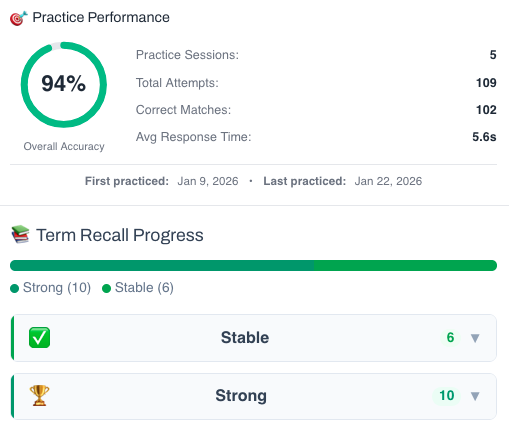
This isn’t a simple quiz — it’s a fully tracked learning system. You build knowledge through recognition, then recall, and your progress feeds directly into the Integrated Practice Bar (Writing tasks, AI Chat, and more).
- Practice sessions, accuracy, and response-time tracking
- Term strength levels (Learning → Stable → Strong)
- Personal progress history for each unit
This feature is available to YSP members.
Explore Membership Benefits🎮 Practice Games
Sentence Scrambler
CAE REPORT – Sentence Scramble
Member-Exclusive Sentence Builder
Reconstruct scrambled sentences to practice word order and develop your grammar intuition.
This feature is available to YSP members.
Explore Membership Benefits