Appraisals: Reflecting on Performance with Modal Perfects
Core PathWay
1 Section 1. What Is an Appraisal?
Once a year — sometimes more — a conversation happens that many employees quietly dread. It is the appraisal, and it is one of the most important tools in any organisation’s approach to managing people.
An appraisal is a formal meeting between an employee and their manager. Its purpose is to review how the employee has performed over a set period — usually six months or a year. During this meeting, both sides discuss achievements, areas for improvement, and goals for the future. The human resources (HR) department typically designs the appraisal process and ensures it is carried out consistently across the company.
Appraisals come in several forms. The most common is the one-to-one appraisal, where a manager meets privately with a single employee. This format allows for honest, focused discussion. A more comprehensive method is the 360-degree appraisal, in which feedback is collected from multiple sources — the employee’s manager, colleagues, direct reports, and sometimes even clients. This gives a fuller picture of how someone is perceived at work. Some organisations also use self-appraisals, where employees evaluate their own performance before the meeting, which encourages reflection and personal accountability.
Whatever the format, the goal is the same: to support professional growth, recognise good work, and identify where development is needed.
2 Section 2. Listen Out for Modal Perfects
You are about to listen to a real appraisal conversation. In it, an employee called Mike reflects on his performance over the past year. He talks about three key areas: delegation within his team, holiday scheduling, and a recent project.
As you listen, pay close attention to the language Mike uses. He does not just describe what happened — he reflects on it. He thinks about what he could have done differently, what he should have done, and what the results might have been. To do this, he uses modal perfect forms: could have, should have, would have, and might have.
These structures are very common in appraisal conversations. They allow speakers to look back at the past and comment on it — to acknowledge mistakes, suggest alternatives, or explain what the outcome might have been under different circumstances. Notice how each form carries a slightly different meaning. Should have often signals regret or a missed obligation. Could have suggests a possibility that was not taken. Would have describes a likely result. Might have introduces a more uncertain outcome.
Listen carefully and notice which modal perfect each speaker chooses — and why.
3 Section 3. The Appraisal Conversation
Listen to Mike’s appraisal. His manager invites him to reflect on the year first — before giving any formal feedback. Notice how Mike uses modal perfect forms to talk about delegation, planning, and a recent project.
💬 Dialogue 1: Mike's Annual Appraisal
An annual performance review meeting between Mike and his line manager. Mike reflects on his own performance before his manager responds and guides the conversation forward.
Appraiser: “So, before I give you any feedback myself, Michael, is there anything you'd like to say about this past year? I always think it's useful to hear your perspective first.”
Mike: “Um, yeah, well, where to start. I think there are quite a few things which could have gone better, to be honest.”
Appraiser: “Yes, such as? Don't be too hard on yourself, but I do want to hear your honest thoughts.”
Mike: “Well, I suppose the main thing is how I divided responsibilities within the department. I should have delegated more to other people instead of doing so much myself. I think that was a real mistake, looking back.”
Appraiser: “Yes, I agree entirely. And if you had delegated more, you wouldn't have become so stressed in the second quarter. I noticed that. How do you think it affected the team?”
Mike: “It's awful really, because I tend to feel that if I don't do something myself, it won't get done properly. But I could have given more responsibility to others, and that might have improved teamwork as well. People might have felt more trusted and involved.”
Appraiser: “That's a really good point about teamwork. We can come back to that in a moment. Is there anything else you'd like to comment on — anything that went well, perhaps?”
Mike: “Yes, actually. I think planning has gone really well overall. We met almost all of our deadlines, which I'm proud of. The team was generally well-organised and we kept things on track.”
Appraiser: “Good. I'm glad you mentioned deadlines — that is one area where I've seen real progress. Do you think anything within the planning area could have been improved, though?”
Mike: “Yes, of course. I could have organised holiday scheduling better. There were a couple of periods where too many people were off at the same time, and that put pressure on everyone who was still in. I should have planned that more carefully at the start of the year, and it would have improved work relationships too.”
Appraiser: “Absolutely. Holiday scheduling is something we can address together going forward. Now, what about the project you finished recently? I know that was a significant piece of work.”
Mike: “Yes, I think that went very well overall. But if I'm being honest, we could have had more cooperation from some of the other departments. I should have organised more cross-departmental meetings to get the right people involved. Then we would have had a wider range of expertise and skills, and the final result might have been even stronger.”
Appraiser: “I see. So, would I be right in saying that your main development areas are delegation, holiday scheduling, and building stronger cooperation across departments — while your real strength this year has been keeping the team on track and meeting deadlines consistently?”
Mike: “Yes, I think that's a fair summary. I could have done better in those areas, and I know that now. But I do feel that the planning and the project delivery showed that I can manage complex work when things are properly organised. I'd like to focus on delegation and cooperation as my main goals for next year.”
6 ✍️ Writing Task
You must use all four of these modal perfect forms at least once each:
• should have + past participle (e.g. should have prepared)
• could have + past participle (e.g. could have communicated)
• might have + past participle (e.g. might have achieved)
• would have + past participle (e.g. would have handled)
Think about areas such as time management, teamwork, meeting targets, communication, or professional development. Write in a professional but honest tone, as you would in a real workplace appraisal.
4 Recap: What You Have Covered
Well done — you have covered a lot of ground on this page. Here is a quick summary of the key ideas.
An appraisal is a structured performance review used by organisations to assess how employees are doing and to plan for the future. Common formats include the one-to-one appraisal, the 360-degree appraisal, and the self-appraisal. Each type serves a slightly different purpose, but all of them focus on honest reflection and professional development.
In the listening, you heard Mike use modal perfect forms — could have, should have, would have, and might have — to look back at his performance. These structures are essential in appraisal conversations because they allow speakers to reflect on past actions, acknowledge what went wrong, and suggest what the outcomes might have been under different circumstances.
As you move forward, think about how you might use these structures yourself. Whether you are preparing for a real appraisal or practising professional English, the ability to reflect clearly and honestly on your own performance is a skill that will serve you well.
Member-Exclusive Practice Bar
Access a wide range of integrated practice for this unit — from Vocabulary and Grammar activities to AI-curated Writing tasks and Thematic Chat practice.
This feature is available to YSP members.
Explore Membership BenefitsMember-Exclusive Vocabulary Review & Acquisition System
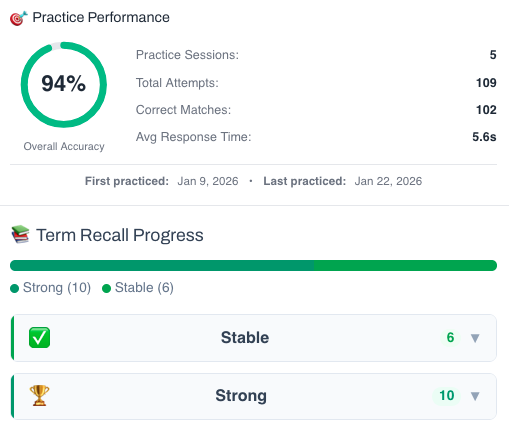
This isn’t a simple quiz — it’s a fully tracked learning system. You build knowledge through recognition, then recall, and your progress feeds directly into the Integrated Practice Bar (Writing tasks, AI Chat, and more).
- Practice sessions, accuracy, and response-time tracking
- Term strength levels (Learning → Stable → Strong)
- Personal progress history for each unit
This feature is available to YSP members.
Explore Membership Benefits