I Should Have Studied Harder — Regrets, Criticism, and Past Mistakes
Core PathWay
1 Section 1. From Advice to Regret — How ‘Should’ Works in Two Directions
You already know should. It is one of the most useful words in English. We use it to give advice and make recommendations — to say ‘this is the right thing to do in your situation.’
Think about these examples. They all say the same thing in different ways:
— You should get some rest.
— I suggest you get some rest.
— I recommend getting some rest.
— I advise you to get some rest.
— My advice is to get some rest.
All of these mean: getting rest is the correct or sensible thing to do here. Should is simply the most direct and natural way to say it.
Now, here is a question to think about. Read this situation carefully:
> The night before an important meeting, you forgot to set your alarm. The next morning, your alarm didn’t ring. You woke up late and arrived 30 minutes after the meeting started. Your manager was not happy.
You can’t change what happened. But you can talk about it. How? This is where should becomes even more powerful. We can use it to look back at a past mistake — something we didn’t do but needed to do, or something we did that turned out to be wrong.
Think about two types of past mistake:
A mistake of omission — you didn’t do something, but you should have done it.
Example: You forgot to set your alarm. → I should have set my alarm.
A mistake of commission — you did something, but you shouldn’t have done it.
Example: You stayed up until 2am watching TV. → I shouldn’t have stayed up so late.
This is the key idea of this page. You are going to learn how to use should have + past participle and shouldn’t have + past participle to talk about these two kinds of past mistake. You have already studied modal perfects like must have, might have, and could have. This is the same structure — now we are adding should have to your toolkit.
Key Terms
2 Section 2. Should for Advice — A Quick Guide
Before we move to the past, let’s make sure should for present advice is clear. This is your foundation. Understanding it well makes the past form much easier to learn.
Should is a modal verb. It does not change for he, she, or it. It is always followed by a base verb — never by to + verb.
Focus
- should + base verb = advice or recommendation
- shouldn’t + base verb = advice against something
- Should I…? = asking for advice or a recommendation
- No third-person -s: ‘she should rest’ (NOT ‘she shoulds rest’)
- No to after should: ‘you should see a doctor’ (NOT ‘you should to see a doctor’)
- No do-support: ‘Should I call?’ (NOT ‘Do I should call?’)
Rules
- Use ‘should + base verb’ to say something is the right or sensible thing to do.
- Use ‘shouldn’t + base verb’ to say something is the wrong thing to do.
- These structures work the same way as: ‘I suggest doing X’, ‘I suggest you do X’, ‘I recommend doing X’, ‘I advise you to do X’, and ‘My advice is to do X’.
- Should is softer than must. Use should for advice and recommendations. Use must only for strong obligations or rules.
- The negative is ‘shouldn’t’ — never ‘don’t should’ or ‘doesn’t should’.
Examples
- You look tired — you should take a break. (advice: this is the right thing to do) | Compare: I suggest you take a break. / My advice is to take a break.
- She shouldn’t work so late every night. It’s not good for her health. (advice against: this is the wrong thing to do) | Compare: I advise her not to work so late.
- Should I send the report now, or wait until Monday? (asking for a recommendation) | Compare: Do you think it’s a good idea to send the report now?
Common mistake
3 Section 3. Should Have + Past Participle — Talking About Past Mistakes
Now for the main event. You know how should works for present advice. To talk about the past — about things that went wrong, things we regret, or things we want to criticise — we add have and a past participle. This is the modal perfect with should, and it works exactly like the modal perfects you already know.
The core meaning is simple: the action didn’t happen, but it should have — or it happened, but it shouldn’t have.
A note on connected speech: In natural spoken English, should have is often reduced. It sounds like ‘shuduh’ (should + a weak schwa sound). The negative shouldn’t have sounds like ‘shudenuh’. You may also hear ‘should’ve’ in informal writing. Never write should of — this is a spelling mistake, even though it sounds that way in speech.
What about ‘ought to have’? This form means exactly the same thing as should have. It is sometimes used in speech, but it is less common. In fast speech, it sounds like ‘orta’ — a very reduced form. You don’t need to use it, but it is good to recognise it when you hear it.
Finally, notice how should have connects to other ways of expressing the same idea. These three structures are close in meaning:
— I should have prepared more.
— I regret not preparing more.
— I wish I had prepared more.
All three say: I didn’t prepare enough, and I feel bad about it now. Learn to recognise all three — they are all natural and common.
Focus
- should have + past participle = past regret or criticism (the action didn’t happen, but it should have)
- shouldn’t have + past participle = past regret or criticism (the action happened, but it shouldn’t have)
- The past participle must be correct: ‘gone’ not ‘went’, ‘called’ not ‘call’
- Should have / shouldn’t have = same meaning as ‘I regret…’ and ‘I wish I had/hadn’t…’
- Ought to have + past participle = same meaning as should have, but less common
- In speech: ‘should have’ = ‘shuduh’; ‘shouldn’t have’ = ‘shudenuh’; ‘ought to have’ = ‘orta’
Rules
- Use ‘should have + past participle’ for a mistake of omission: you didn’t do something, but it was necessary or correct to do it.
- Use ‘shouldn’t have + past participle’ for a mistake of commission: you did something, but it was wrong or a bad idea.
- Important: ‘He shouldn’t have said that’ means he DID say it, and it was wrong. It does NOT mean he didn’t say it.
- Never use ‘should had’: say ‘you should have told me’, NOT ‘you should had told me’.
- Never use a bare infinitive for past criticism: say ‘you should have called me yesterday’, NOT ‘you should call me yesterday’.
- The structure ‘I regret doing X’ and ‘I wish I hadn’t done X’ carry the same meaning as ‘I shouldn’t have done X’. All three express the same feeling.
Examples
- I should have set my alarm last night. I woke up late and missed the meeting. (omission: I didn’t set it, but I needed to) | Compare: I regret not setting my alarm. / I wish I had set my alarm.
- She shouldn’t have sent that email without checking it first. There were several mistakes in it. (commission: she sent it, and it was the wrong thing to do) | Compare: She regrets sending that email. / She wishes she hadn’t sent it.
- He ought to have confirmed the booking in advance. Now there’s no record of the reservation. (omission, using ‘ought to have’ — same meaning as ‘should have’; sounds like ‘orta’ in fast speech)
Common mistake
4 Section 4. ‘I Think It All Went Wrong…’ — A Workplace Conversation
Sam organised a large team meeting last week. It did not go well. Listen to Sam talking to a colleague, Jordan, about everything that went wrong — and what Sam wishes had been done differently.
💬 Dialogue 1: The Meeting That Went Wrong
The day after a large company meeting. Sam (the organiser) and Jordan (a colleague) are having coffee in the office kitchen.
Jordan: “So, how do you feel about yesterday’s meeting? I heard it was a bit of a disaster.”
Sam: “Don’t remind me. I should have started planning it two weeks earlier. I only had four days, and it just wasn’t enough time.”
Jordan: “Four days is really not much time for a big meeting. What went wrong first?”
Sam: “Well, I sent the invitations, but I shouldn’t have assumed everyone would come. I didn’t ask for confirmations, so when the meeting started, half the seats were empty. It was so embarrassing.”
Jordan: “Oh no, that sounds awful. And what about the room? Someone told me you ran out of time.”
Sam: “Yes, I should have booked the room for three hours, not two. We had to stop right in the middle of the presentation because another team needed the space. I really wish I had thought about that more carefully.”
Jordan: “That must have been so stressful. What about the technical problems? I heard the projector stopped working.”
Sam: “I know, it was a nightmare. I ought to have checked the projector the day before. Then we would have had time to fix it. Instead, I left it to the last minute and we spent twenty minutes trying to get it working while everyone just waited.”
Jordan: “Twenty minutes is a long time to keep people waiting. Did anything go right at all?”
Sam: “Not much, honestly. I regret not making a proper checklist from the start. If I had done that, I would have remembered to ask for confirmations, book the room for longer, and check the equipment in advance. It was just one problem after another.”
Jordan: “It sounds like a tough lesson. But at least you know what to do differently next time. What will you change?”
Sam: “Everything, really. I should always make a checklist first. I should ask for confirmations so I know how many people are coming. I should book the room for longer than I think I need. And I should never leave the equipment check to the last minute. I really shouldn’t have done it the way I did — but I won’t make those mistakes again.”
5 Section 5. Chains of Consequence — Linking ‘Should Have’ with Other Modal Perfects
One of the most powerful things you can do with should have is connect it to a consequence — what happened (or didn’t happen) because of the mistake. This is where should have meets the other modal perfects you already know.
Think about it like this: a past mistake often creates a chain of events. You can describe that chain in one sentence by linking should have / shouldn’t have with would have, might have, or could have.
Using ‘would have’ — for near-certain consequences
When the consequence is very likely — almost certain — we use would have:
I should have set my alarm. Then I wouldn’t have been late for the meeting.
She should have checked the report. She would have found the mistake before sending it.
The meaning is: if the first thing had happened, the second thing would almost certainly have been different.
Using ‘might have’ or ‘could have’ — for possible consequences
When the consequence is possible but not certain, we use might have or could have:
Sam should have booked a longer room. Then the meeting might have finished on time.
I shouldn’t have stayed up so late. I could have been much more focused today.
The meaning is: the consequence was possible — but not guaranteed.
How to link the two clauses
You need a linking word to connect the two parts of the sentence. Here are the most natural options:
— Use then at the start of the second clause: I should have left earlier, then I wouldn’t have missed the bus.
— Use and then: She shouldn’t have skipped the meeting, and then she would have known about the changes.
— Use which: He should have saved the document, which means he might have avoided losing all his work.
— Use so: I should have prepared more, so I might have felt less nervous.
— Use a comma + relative clause: I shouldn’t have ignored the warning signs, which could have saved us a lot of time.
Here is a full example that shows a chain of events:
I should have set my alarm the night before the meeting. Then I wouldn’t have woken up late, and I wouldn’t have missed the first part of the presentation. I might have been able to contribute more to the discussion, which could have made a real difference to the outcome.
Notice how each sentence builds on the last. This is how fluent English speakers talk about past regrets — not just one mistake, but the whole chain of consequences that followed.
6 Section 6. Writing Task — A Very Bad Day
It is time to practise. Use everything you have learned on this page — should have, shouldn’t have, and modal perfects for consequences — to write about a bad day that started with one small mistake.
SITUATION: Last Monday was one of the worst days you can remember. It all started because you missed your bus. You were late for work, which caused a chain of problems for the rest of the day.
YOUR TASK: Write 80-100 words about your bad day. Use the sentence starter below to begin. Then describe: (1) why you missed the bus — what did you do wrong the night before or that morning? (2) how being late affected the rest of your day — what went wrong because of it? (3) what you wish you had done differently.
START YOUR WRITING WITH THIS SENTENCE:
‘Last Monday was a disaster, and it was entirely my own fault.’
YOU MUST USE:
— at least THREE examples of ‘should have + past participle’ or ‘shouldn’t have + past participle’
— at least ONE example of ‘would have’, ‘might have’, or ‘could have’ to describe a consequence
— at least ONE of these expressions: ‘I regret…’, ‘I wish I had…’, or ‘I wish I hadn’t…’
Write in a neutral, personal register — as if you are writing in your diary or telling a friend what happened.
7 Recap — What You Have Learned
Well done for reaching the end of this page. Let’s look back at the key ideas.
Should is used for advice and recommendations in the present. It means ‘this is the right or sensible thing to do.’ Structures like I suggest doing X, I recommend doing X, and I advise you to do X all carry a similar meaning.
To talk about past mistakes, we use the modal perfect with should:
— Should have + past participle = a mistake of omission (you didn’t do it, but you should have)
— Shouldn’t have + past participle = a mistake of commission (you did it, but you shouldn’t have)
These forms connect naturally to I regret doing / not doing X and I wish I had / hadn’t done X — three ways to express the same feeling.
Remember ought to have + past participle: it means the same as should have, but it is less common. In fast speech it sounds like ‘orta’. And remember: in natural speech, should have sounds like ‘shuduh’, and shouldn’t have sounds like ‘shudenuh’. Always write should have — never should of.
Finally, you saw how to build a chain of consequences by linking should have / shouldn’t have with would have (near-certain result) or might have / could have (possible result). Use linking words like then, and then, which, and so to connect the two parts of your sentence smoothly.
The next time something goes wrong, you have the language to talk about it — clearly, naturally, and with confidence.
Member-Exclusive Practice Bar
Access a wide range of integrated practice for this unit — from Vocabulary and Grammar activities to AI-curated Writing tasks and Thematic Chat practice.
This feature is available to YSP members.
Explore Membership BenefitsMember-Exclusive Vocabulary Review & Acquisition System
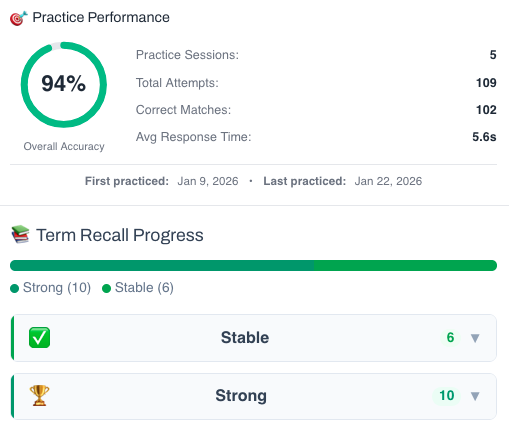
This isn’t a simple quiz — it’s a fully tracked learning system. You build knowledge through recognition, then recall, and your progress feeds directly into the Integrated Practice Bar (Writing tasks, AI Chat, and more).
- Practice sessions, accuracy, and response-time tracking
- Term strength levels (Learning → Stable → Strong)
- Personal progress history for each unit
This feature is available to YSP members.
Explore Membership Benefits