The Language of Misconduct, Discipline, and Performance
Core PathWay
1 Section 1. Conduct and Capability — Two Very Different Problems
Want to talk confidently about workplace discipline and performance? It starts with these words.
In HR, not every problem is the same. Some employees break workplace rules. Others simply struggle to do their job well. English has different words for each situation — and using the right word matters.
Misconduct is behaviour that breaks workplace rules or standards. For example, arriving late repeatedly, being rude to colleagues, or falsifying records. Most cases of misconduct are serious, but they can be dealt with through a formal process.
Some behaviour is so serious that it has a stronger name: gross misconduct. This means the misconduct is bad enough to justify dismissal without notice. Theft or violence are typical examples.
Not every employee problem is about conduct, though. Sometimes an employee wants to do their job well but cannot reach the required standard. This is called underperformance — or poor performance. It is also known as a capability issue. The word ‘capability’ refers to a person’s ability or skills. So a capability issue is treated as an ability problem, not a discipline problem.
This distinction is important. A disciplinary procedure — sometimes called a disciplinary policy — is the organisation’s documented process for dealing with misconduct. A capability procedure — also called a capability process — is a separate, more supportive process for dealing with performance concerns. They are not the same thing, and HR professionals are careful to use the right one.
2 Section 2. Starting a Formal Process — Allegations and Investigations
When a conduct concern is reported, the formal process begins. Here is the key vocabulary for this early stage.
First, there is usually an allegation. An allegation is a claim that an employee has done something wrong. It is important to remember: an allegation is not proven. It is only a claim at this point.
Before any formal action is taken, the employer needs to find out what actually happened. This is called an investigation. As part of this, the employee may be invited to an investigatory meeting. This is an initial meeting — it is not a punishment. Its purpose is to establish the facts before deciding whether to move forward.
During an investigation, the employer may decide to suspend the employee. Suspension means the employee is temporarily removed from the workplace while the investigation takes place. In most cases, suspension is on full pay. It does not mean the employee is guilty — it is simply a way to manage the situation while facts are gathered.
These early steps are important. They show that the employer is following a fair process before reaching any conclusions.
3 Section 3. The Disciplinary Hearing and Its Outcomes
If the investigation shows that there is a case to answer, the process moves to a disciplinary hearing.
A disciplinary hearing is a formal meeting. At this meeting, the allegation of misconduct is put to the employee. The employee can respond, explain, and provide evidence. It is their chance to be heard.
After the hearing, the employer makes a decision. This is called a finding. A finding of misconduct is the formal conclusion that the allegation has been proven. If the finding goes against the employee, a sanction is applied. A sanction is the formal action taken as a result of the process.
The decision is confirmed in a disciplinary outcome letter. This is a written document that tells the employee exactly what action will be taken.
Before deciding on a sanction, the employer should consider mitigating circumstances. These are factors that may reduce the employee’s responsibility or make the outcome less severe. Personal problems at home, or a previously clean disciplinary record, could be mitigating circumstances.
A disciplinary record is the documented history of any warnings or actions taken against an employee. An employee with no previous warnings is in a better position than one who has been warned before.
Every employee also has a right of appeal. This means they can ask for the decision to be reviewed by a more senior manager. If that manager agrees the decision was wrong, they can overturn the decision on appeal — in other words, reverse it. This protects fairness in the process.
4 Section 4. The Warning Ladder — From Verbal to Final
Not every case of misconduct leads to dismissal. In many cases, the sanction is a warning. There is a clear order to these warnings.
The first level is a verbal warning. Despite the name, a verbal warning is usually confirmed in writing for the record. It is the lowest-level formal warning and is used for less serious issues.
If the problem continues — or if the first issue was more serious — the next step is a (first) written warning. This is a formal written warning for a first or continuing conduct or performance issue.
If the behaviour or performance does not improve after a written warning, the employer may issue a final written warning. This is the last warning before dismissal becomes a realistic option. At this stage, the employee is effectively put on notice — formally warned that their conduct or performance must improve or further action will follow.
The phrase to put someone on notice is used in HR to describe this moment. It signals that the situation is serious and that the employee must change their behaviour.
All of these warnings become part of the employee’s disciplinary record and remain active for a set period.
5 Section 5. Managing Poor Performance — PIPs, SMART Goals, and Review Periods
When the issue is underperformance rather than misconduct, the employer uses a capability procedure. The goal is to support the employee, not simply to punish them.
A key tool in this process is the performance improvement plan — usually called a PIP. A PIP is a formal document. It sets out the improvements the employee must make and the timeframe for making them.
The goals inside a PIP are usually written as SMART objectives — also called SMART goals. SMART stands for Specific, Measurable, Achievable, Relevant, and Time-bound. For example, ‘Increase customer satisfaction scores by 10% within 60 days’ is a SMART goal. It is clear, it can be measured, and it has a deadline.
The period during which progress is monitored is called the review period. This is typically 30 to 90 days. During the review period, the manager and employee meet regularly to check progress.
At the start of the capability process, the employer will also restate the performance expectations — the clear standards the employee is expected to meet. This makes sure the employee knows exactly what is required.
The employee will then either meet those targets or fail to meet them. If they meet their targets during the review period, the capability process usually ends. If they fail to meet their targets, the employer may move to a more serious stage — which could eventually include dismissal.
Member-Exclusive Practice Bar
Access a wide range of integrated practice for this unit — from Vocabulary and Grammar activities to AI-curated Writing tasks and Thematic Chat practice.
This feature is available to YSP members.
Explore Membership BenefitsMember-Exclusive Vocabulary Review & Acquisition System
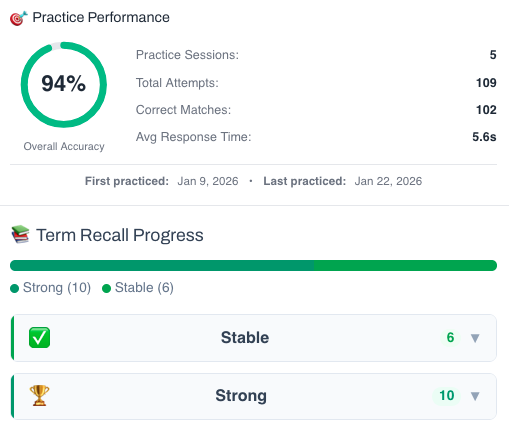
This isn’t a simple quiz — it’s a fully tracked learning system. You build knowledge through recognition, then recall, and your progress feeds directly into the Integrated Practice Bar (Writing tasks, AI Chat, and more).
- Practice sessions, accuracy, and response-time tracking
- Term strength levels (Learning → Stable → Strong)
- Personal progress history for each unit
This feature is available to YSP members.
Explore Membership Benefits