Just What Is Present Perfect? Understanding the Name
Core PathWay
1 Section 1. What Does ‘Present Perfect’ Actually Mean?
A student asks a question that many learners never ask — but should. Listen to how the tutor answers it.
💬 Dialogue 1: The Name That Explains Everything
A one-to-one grammar lesson. The student has just seen the term ‘Present Perfect’ written on the board for the first time.
Sam: “I have a question. Why is it called ‘Present Perfect’? Does the name mean something, or is it just a label?”
Tutor: “That is a great question — and yes, the name means everything. Let’s start with the second word: ‘perfect’. In grammar, ‘perfect’ does not mean ‘very good’. It means ‘finished and complete’. So a ‘perfect’ action is an action that is done.”
Sam: “OK, so ‘perfect’ just means finished. Not good or correct. That is a bit surprising.”
Tutor: “Exactly. Now look at the first word: ‘present’. What does ‘present’ mean to you?”
Sam: “Present means now. Today. This moment.”
Tutor: “Perfect. So we have two ideas in one name. ‘Finished’ and ‘now’. Put them together. What do you think the tense is about?”
Sam: “Something that is finished… but it connects to now? Finished… but in present time? How can something be finished and present at the same time?”
Tutor: “Good question. Think of it like this. Imagine a bridge. One foot is in the past — that is where the action happened. One foot is in the present — that is where you feel the result. The action is finished, but the result is here, right now. For example: ‘I have lost my keys.’ The losing happened in the past. But the result? I don’t have my keys right now. That is a present problem.”
Sam: “Oh. So ‘I have lost my keys’ means the keys are gone now. The past action has a result in the present. I can see that.”
Tutor: “Exactly right. And there is a second use too. Not just a result — but a situation that started in the past and is still true now. For example: ‘I’ve lived here since 2019.’ I started living here in 2019. And I still live here today. The past and the present are connected.”
Sam: “So it is different from Past Simple? Like, ‘I lived there’ — that is finished, right? No connection to now?”
Tutor: “Exactly. Past Simple says: finished, done, no connection to now. Present Perfect says: the past and the present are still connected. So the name is like a map. Read the name — ‘Present Perfect’ — and you know the tense. Something finished in the past, but with meaning right now.”
2 Section 2. ‘Have’ Is Present — So Everything Else Must Be Too
Here is one rule. Learn it well. It changes how you think about this tense.
The word ‘have’ is a present tense verb. Always. Right now, today, at this moment — ‘have’ lives in the present. This is not an option. It is a fact.
Because of this, every time signal that goes with ‘have’ must also be present. Think about this: you cannot say ‘I have a car yesterday.’ Why? Because ‘have’ is present, and ‘yesterday’ is past. They do not match. They cannot be in the same sentence.
Now look at the Present Perfect: ‘I have had a car since 2020.’ The verb is still ‘have’. It is still present. So the time word — ‘since 2020’ — must point to something that reaches the present. ‘Since 2020’ means: it started in 2020 and it is still true now. That works. That matches.
This is the test. Ask yourself: is my time word a present time word — something that includes right now? Words like today, this week, this year, since, for — these all include the present moment. They are fine with ‘have’.
But words like yesterday, last year, in 2005, ago — these are finished. They do not include now. They cannot go with ‘have’. Use the past simple instead: ‘I bought this car last year.’
The past participle — the third part of the verb, like eaten, gone, seen, lived — does not change this rule. The past participle shows that the action happened before now. But ‘have’ keeps the whole sentence in the present. Think of it this way: ‘have’ is the anchor. It holds everything in present time. The past participle looks back, but ‘have’ keeps one foot firmly in today.
So the formula is simple: have/has + past participle + a present time word (or no time word at all, when the result is visible right now). Every part of that formula points to the present — or to a past that is still touching the present.
3 Section 3. Three Students, Three Problems
These three students are at the same level. They all find Present Perfect difficult — but for different reasons. Listen to what they say.
💬 Dialogue 2: The Confusion Is Real
Three students — Alex, Jordan, and Chris — are talking between classes. They have all just finished a grammar exercise on Present Perfect Simple and Continuous.
Alex: “I failed that exercise. I never know when to use Present Perfect and when to use Past Simple. They feel the same to me.”
Jordan: “I know what you mean. And for me, the biggest problem is ‘for’ and ‘since’. I always mix them up. I wrote ‘since three months’ and my teacher corrected it again. I don’t understand why.”
Chris: “My problem is different. I think I understand Present Perfect Simple. But Present Perfect Continuous? I have no idea why it exists. What is the difference between ‘I have worked here’ and ‘I have been working here’? They sound the same to me.”
Alex: “OK but wait — Jordan, why is ‘since three months’ wrong? I think I wrote that too.”
Jordan: “I think ‘since’ needs a point in time. Like ‘since Monday’ or ‘since 2020’. But ‘three months’ is not a point — it is a length of time. So you need ‘for’. ‘For three months.’ But I always forget in the moment.”
Chris: “Oh, that makes sense. But I make a different mistake. I sometimes say ‘I am here since Monday’ instead of ‘I have been here since Monday’. My teacher says it is completely wrong but it feels natural to me.”
Alex: “I do that too! I say ‘How long are you in this company?’ and people look at me strangely. Is that wrong?”
Jordan: “Yes, I think it should be ‘How long have you been in this company?’ Because the situation started in the past and it is still true now. But it is hard to remember. In my language, we just use present simple for that.”
Chris: “Same in my language. So I always want to say ‘I work here for five years’ — present simple, because it is still true now. But that is wrong in English too, right?”
Alex: “I think so. You need Present Perfect. ‘I have worked here for five years.’ Because it started in the past and you are still here. But honestly, I just guess. I don’t have a system.”
Jordan: “That is exactly it. I don’t want more rules to memorise. I want to understand why. Then I can work it out myself.”
Chris: “Well, at least we are all confused together. That is something. Maybe the next lesson will help.”
Alex: “Ha! Yes. At least I know I am not the only one. Let’s hope the explanation is clear. I really need it.”
4 Section 4. What the Experts Say
Two experienced language trainers have just listened to Alex, Jordan, and Chris. Here is what they think — and what they plan to do about it.
💬 Dialogue 3: The Trainers’ View
Two language trainers, Morgan and Riley, are talking after observing the students’ conversation. They reflect on what they heard.
Morgan: “Did you hear Alex? ‘They feel the same to me.’ That is the root problem. Students don’t see the difference between Present Perfect and Past Simple because they haven’t understood what ‘present meaning’ really is yet.”
Riley: “Exactly. And it is not just about rules. If a student doesn’t understand that Present Perfect always has a connection to now, no rule will fix that. The concept has to come first.”
Morgan: “And Jordan’s ‘for’ and ‘since’ problem — that is not really a grammar problem. It is a concept problem. Jordan doesn’t yet see that ‘for’ measures a duration — a length of time — and ‘since’ marks a starting point. Once you see that, the rule makes sense.”
Riley: “Right. And the error ‘I am here since Monday’ — that comes from something deeper too. If a student uses present simple there, it means they don’t yet feel that Present Perfect carries present meaning. They think it is a past tense. So they avoid it and use present simple instead.”
Morgan: “Yes. And the same with ‘How long are you in this company?’ Many learners do that by habit. They use present simple because the situation is happening now. But they miss the past connection. ‘How long have you been in this company?’ — that question reaches back into the past and asks about the whole duration.”
Riley: “Chris’s question about Simple versus Continuous — that is a good sign, actually. Chris is thinking. That is the right question to ask. But it is a question for later. Let’s not put everything on the table at once.”
Morgan: “Agreed. The best starting point is the name itself. ‘Present Perfect.’ Read it carefully. ‘Present’ tells you it is about now. ‘Perfect’ tells you the action is finished. Put those two ideas together and you have the tense. Understand the name, understand the tense.”
Riley: “And a solid understanding of Present Simple and Present Continuous has to come first too. Without that foundation, Present Perfect is just confusing. Students need to know what ‘present’ means before they can see how Present Perfect uses it differently.”
Morgan: “Absolutely. It is a journey. Not a short one. But the map is here. If students follow the steps — understand the name, understand the concept, then look at the uses one by one — they will get there.”
Riley: “And moments like that conversation between Alex, Jordan, and Chris — those are useful. When students name their confusion clearly, they are already halfway to understanding it.”
Morgan: “Exactly. The confusion is real. But it is not a dead end. Every question they asked today is a question we can answer — step by step, clearly, in the right order.”
5 Recap: One Foot in the Past, One Foot in the Present
Here is what this page showed you.
The name ‘Present Perfect’ is not random. ‘Perfect’ means finished and complete. ‘Present’ means now. So the tense talks about something that finished — but that is still connected to now. The past reaches into the present.
The word ‘have’ is always present. Because of this, every time word you use with it must include the present moment. Words like today, this week, since, for work. Words like yesterday, last year, ago do not — those go with the Past Simple.
Three students showed us the real difficulties: mixing up Present Perfect and Past Simple, confusing for and since, and not understanding the difference between Present Perfect Simple and Continuous. These are common problems. You are not alone if you feel them too.
Two trainers reminded us of something important: a clear understanding of the Present Simple and Present Continuous is the foundation. Without that foundation, Present Perfect is hard to see clearly.
This is the start of a long journey. But the map is available here. Each page ahead will answer one more question and make the picture clearer. Keep going.
Member-Exclusive Practice Bar
Access a wide range of integrated practice for this unit — from Vocabulary and Grammar activities to AI-curated Writing tasks and Thematic Chat practice.
This feature is available to YSP members.
Explore Membership BenefitsMember-Exclusive Vocabulary Review & Acquisition System
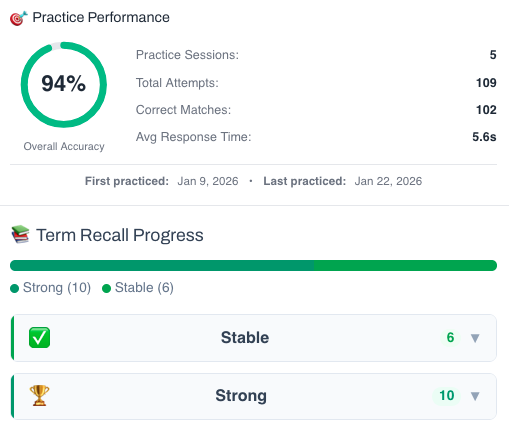
This isn’t a simple quiz — it’s a fully tracked learning system. You build knowledge through recognition, then recall, and your progress feeds directly into the Integrated Practice Bar (Writing tasks, AI Chat, and more).
- Practice sessions, accuracy, and response-time tracking
- Term strength levels (Learning → Stable → Strong)
- Personal progress history for each unit
This feature is available to YSP members.
Explore Membership Benefits