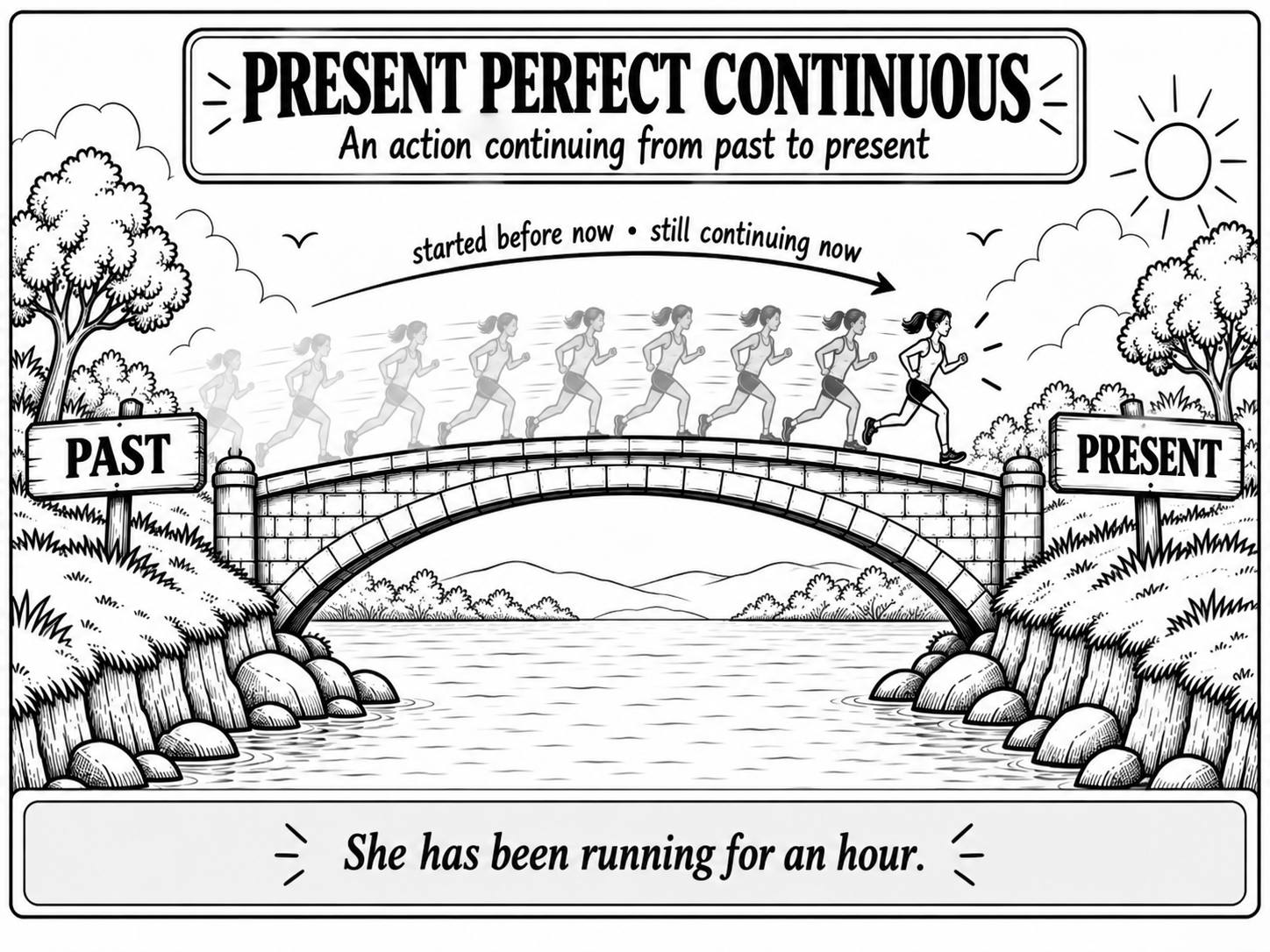
I’ve Been Running for an Hour: Present Perfect Continuous for Duration
Core PathWay
1 Section 1. From States to Actions: A New Challenge
You already know how to use the Present Perfect Simple with state verbs and for / since. Think about sentences like I have been here for an hour or She has known him since 2018. These sentences describe states — situations that don’t involve physical activity or movement. The verb be in I have been here is a state verb. Nothing is happening. It just is.
Now think about action verbs — verbs like run, work, study, train, and cook. These describe things you actively do. So here is the challenge: if you start running at 9 a.m. and it is now 10 a.m. — and you are still running — how do you describe that? Do you say I have run for an hour? It sounds possible, but it isn’t the natural choice. Why not? Because run is not a state. It is an action in progress. And when an action is in progress — when it is still happening right now — we use a different form.
This is where the Present Perfect Continuous comes in. Also called the Present Perfect Progressive, this form is built for exactly this situation: an action that started in the past and is still continuing now. I have been running for an hour. That’s the form. That’s the pattern. And by the end of this page, it will feel completely natural to you.
2 Section 2. Why Not ‘I’ve Run for an Hour’? — A Student-Teacher Conversation
A student has just learned Present Perfect for duration and is puzzled. Why can’t they say I’ve run for an hour when they are literally running right now? Jack, the teacher, explains.
💬 Dialogue 1: Running in Circles — Why We Need the Continuous
An online lesson. The student has been studying Present Perfect duration and has a question about a sentence they heard at the gym.
Sofia: “Jack, I have a question. If I’m running right now and I started an hour ago, can I say ‘I’ve run for an hour’? I learned that Present Perfect can show duration, so I think it should be correct.”
Jack: “Great question — and you’re right that Present Perfect can show duration. But here’s the thing: which Present Perfect? There are actually two. The one you used — ‘I’ve known her for years’ — works with state verbs like ‘know’ or ‘like’. Running is not a state. It’s an action verb. And right now, that action is still happening.”
Sofia: “So the problem is that ‘run’ is an action verb, not a state verb?”
Jack: “Exactly. Think about it this way. If someone asks ‘What are you doing right now?’, you say ‘I’m running’ — that’s Present Continuous, because the action is happening at this moment. But Present Continuous only describes now. It has no past. You started running an hour ago, so you need a form that connects the past to now. That form is the Present Perfect Continuous: ‘I have been running for an hour’.”
Sofia: “Oh, I see. So ‘Present Continuous’ is just now, but ‘Present Perfect Continuous’ goes from the past to now? The word ‘Perfect’ is the part that connects me to the past?”
Jack: “Spot on. The names actually tell you the story. Present Continuous — only now. Present Perfect Continuous — past to now. The ‘Perfect’ part is what reaches back. Now, here’s something else to notice. How do we say when the action started? We say ‘I started running an hour ago.’ Why ‘running’ and not ‘to run’?”
Sofia: “Is it because ‘started’ takes a gerund? Like ‘I started working’ or ‘I started cooking’? So ‘start’ is always followed by the -ing form?”
Jack: “Exactly right. The verb ‘start’ is always followed by a gerund — the -ing form. So we get three sentences: ‘I started running an hour ago. I am still running now. I have been running for an hour.’ Look at those three sentences. What do they all have in common?”
Sofia: “’Running’! The -ing form is in all three sentences. It’s like a thread that connects them — ‘started running’, ‘am running’, ‘have been running’.”
Jack: “Exactly. ‘Running’ is the thread that connects them. When you use ‘start’ plus a gerund, then Present Continuous, then Present Perfect Continuous, the -ing form runs through all three. That’s not a coincidence. It’s the same action in progress, just described from three different angles: when it began, what’s happening now, and how long it has been going on. So, to go back to your original question — is ‘I’ve run for an hour’ wrong?”
Sofia: “It’s not exactly wrong, but it’s not the best choice when the action is still in progress. ‘I’ve run for an hour’ might sound like I’ve finished. ‘I’ve been running for an hour’ makes it clear the action is still happening right now.”
Jack: “That’s a very precise way to put it. ‘I’ve run for an hour’ can suggest the running is finished — like a result. ‘I’ve been running for an hour’ makes it clear the action is still in progress. So the rule is simple: use the Present Perfect Continuous when the action started in the past and hasn’t stopped. Use ‘for’ to say how long. And remember — ‘started running’, ‘am running’, ‘have been running’. Same action, three angles.”
Key Terms
3 Section 3. Grammar Guide: Present Perfect Continuous for Duration
Now let’s look at the full picture. The Present Perfect Continuous is the form we use when an action started in the past and is still connected to now — either because it is still happening at this very moment, or because it happens repeatedly over a period of time. Both uses involve action verbs and both use for or since to name the duration.
The form is: have/has + been + verb-ing. The time expressions for and since tell us how long. Below you will find the key rules, patterns, and the most common mistakes to avoid.
Focus
- Use PRESENT PERFECT CONTINUOUS (have/has been + verb-ing) for actions that started in the past and are still happening NOW at this very moment.
- Use PRESENT PERFECT CONTINUOUS for actions that happen repeatedly over a period of time — even if you are not doing the action at this exact second.
- Use FOR with a period of time: for an hour, for two years, for six months, for ages.
- Use SINCE with a starting point in time: since 9 a.m., since Monday, since 2022, since I was a student.
- Use SINCE + [point in time] + AGO only when the starting point is expressed as ‘X time ago’: ‘I have been working here since three years ago.’ NOTE: ‘for three years’ is more natural and more common in everyday speech.
- Use FOR AGES as a common informal expression meaning ‘a very long time’: ‘I’ve been waiting for ages.’
- Action verbs — run, work, study, train, cook, swim, read, travel, wait — are the natural partners for this form.
- Do NOT use stative verbs (know, own, believe, want, love) with Present Perfect Continuous. Use Present Perfect Simple for those.
Rules
- FORM: Subject + have/has + been + verb-ing (+ for/since + time expression). Example: She has been training since January.
- FOR vs SINCE: Use FOR with a length of time (for two hours, for a week). Use SINCE with a specific starting point (since Tuesday, since 2019).
- SINCE + AGO: You can say ‘since three years ago’ but ‘for three years’ is more natural. Avoid ‘since three years’ — this is a very common error.
- TWO SITUATIONS — STILL HAPPENING NOW: ‘I’ve been running for an hour’ (said while still running — the action is happening at this moment).
- TWO SITUATIONS — REPEATED OVER TIME: ‘I’ve been working here for two years’ (said while not at work, e.g. at a restaurant — the action happens regularly over that period, not necessarily right now).
- NEGATIVE: Subject + have/has + not + been + verb-ing. Example: He hasn’t been sleeping well since the move.
- QUESTION: Have/Has + subject + been + verb-ing + for/since…? Example: How long have you been studying English?
- SHORT ANSWERS: Yes, I have. / No, I haven’t. / Yes, she has. / No, she hasn’t.
Examples
- I started running at 9 a.m. It is now 10 a.m. and I am still running. → I have been running for an hour. [action still happening at this moment]
- Alex works at the company. He started two years ago. He is at a party now, not at work. → ‘I’ve been working there for two years.’ [repeated action over a period — not happening at this exact second]
- Sam began studying for the exam on Monday. Today is Friday and she is still studying. → She has been studying since Monday. / She has been studying for five days.
Common mistake
4 Section 4. In Tip-Top Shape — A Fitness Conversation
Three friends — Chris, Jordan, and Alex — meet at a café after their Saturday morning activities. They are all feeling great and start talking about their fitness routines. Listen to how they use the Present Perfect Continuous to talk about how long they have been doing their activities.
💬 Dialogue 2: In Tip-Top Shape
A café on a Saturday morning. Chris has just come from a run, Jordan from a yoga class, and Alex from the gym. All three are in good spirits.
Chris: “I feel amazing today. I’ve just been for a run — I’ve been running every Saturday morning since last spring and it honestly changes everything. There’s nothing like it.”
Jordan: “I know exactly what you mean. That post-workout feeling is the best. How long have you been running? Like, in total?”
Chris: “About eight months now. I started running in March — I started slowly, just twenty minutes at first. Now I’m doing a full hour every session. It built up gradually.”
Alex: “Eight months is impressive. I’ve been going to the gym since January, so about the same. I started doing weight training about six months ago and I haven’t stopped since.”
Jordan: “I’ve been doing yoga for about a year and a half. I go three times a week. This morning I had a ninety-minute class — I’m still feeling the stretch in my legs right now!”
Alex: “Ninety minutes of yoga? I’d fall asleep! I need something more intense. Have you been working with a personal trainer, Jordan, or are you going to classes on your own?”
Jordan: “Just classes for now — no personal trainer. The instructor is great though. She’s been teaching yoga for over ten years. What about you, Alex? Are you training alone?”
Alex: “Mostly on my own, but I’ve been following an online programme since February. It tells me exactly what to do each day. I’m seeing real results now — I feel so much stronger.”
Chris: “That’s great. And are you still doing those early morning sessions? I remember you telling me you were getting to the gym at six in the morning.”
Alex: “Yes! I’ve been getting up at five forty-five every weekday since I started the programme. It was really hard at first, but now it just feels normal. My body is used to it.”
Jordan: “Honestly, all three of us are in tip-top shape. How long has it been since we all felt this good? I think this is the healthiest I’ve been in years.”
Chris: “For me it’s been building for about a year. I’ve also been watching what I eat since the summer — more vegetables, less processed food. It all adds up. Small changes make a big difference.”
Alex: “Same here. I’ve been meal prepping every Sunday for the past three months. It saves so much time during the week and I’m eating so much better. I started meal prepping after I read an article about nutrition — best decision I’ve made.”
Jordan: “Right, we should celebrate all this healthy living. How long have we been sitting here talking about fitness? We haven’t even ordered yet. Let’s get something — something healthy, obviously.”
Key Terms
5 Section 5. Write It Yourself
Now it’s your turn to use the target forms. Write about your own daily or weekly activities — or imagine you are someone who has a very active lifestyle.
6 Section 6. Recap: The Key Ideas from This Page
Let’s pull the key ideas together.
The Present Perfect Continuous — have/has been + verb-ing — is the form we use when an action verb describes something that started in the past and is still connected to now. There are two situations: the action is still happening at this very moment (I’ve been running for an hour — said while still running), or the action happens repeatedly over a period of time (I’ve been going to the gym since January — said at a café, not at the gym).
The time expressions for and since work exactly as you already know: for goes with a period of time (for two years, for ages, for six months), and since goes with a starting point (since Monday, since 2020, since I started the programme). The expression for ages is very common in informal speech and means ‘a very long time’.
Remember the -ing thread: when you say I started running, then I am running, then I have been running — the same -ing form runs through all three. This is because start takes a gerund, the present continuous describes the action now, and the present perfect continuous connects the past to now. All three share the same action.
Finally, keep the contrast clear: state verbs (know, own, believe) use the Present Perfect Simple for duration. Action verbs (run, work, study, train) use the Present Perfect Continuous. That is the essential difference between the page you studied before this one and the page you have just completed.
Member-Exclusive Practice Bar
Access a wide range of integrated practice for this unit — from Vocabulary and Grammar activities to AI-curated Writing tasks and Thematic Chat practice.
This feature is available to YSP members.
Explore Membership BenefitsMember-Exclusive Vocabulary Review & Acquisition System
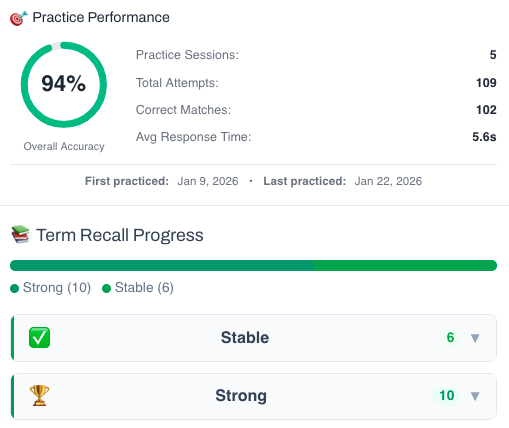
This isn’t a simple quiz — it’s a fully tracked learning system. You build knowledge through recognition, then recall, and your progress feeds directly into the Integrated Practice Bar (Writing tasks, AI Chat, and more).
- Practice sessions, accuracy, and response-time tracking
- Term strength levels (Learning → Stable → Strong)
- Personal progress history for each unit
This feature is available to YSP members.
Explore Membership Benefits🎮 Practice Games
Sentence Scrambler
I’ve been running for an hour – Sentence Scramble
Member-Exclusive Sentence Builder
Reconstruct scrambled sentences to practice word order and develop your grammar intuition.
This feature is available to YSP members.
Explore Membership Benefits🔗 Explore Linked Content
Dialogues
Extra listening practice on the Hub's grammar or vocabulary points