Present Perfect Continuous in Action: Three Real-World Listening Contexts
Core PathWay1 Section 1. At the Olympics: Athletes Talk Training, Diet, and History
A sports journalist is interviewing three Olympic athletes in the athletes’ village. Listen for how each athlete uses the Present Perfect Continuous to talk about their training history, their current regimes, and changes in their diet and habits. Notice how the journalist sometimes asks follow-up questions to check which meaning is in focus.
💬 Dialogue 1: Olympic Voices: Training, Diet, and the Long Road Here
The athletes' village at the Olympic Games. A journalist, Sam, interviews three athletes: Maya (marathon runner), Luca (competitive swimmer), and Jordan (weightlifter). The conversation moves between athletic histories, current training, and dietary habits.
📝 Comprehension Check: Athletes at the Games
Answer the questions based on what you heard in the audio.
Which speaker has been doing their sport every day for ten years?
Which speaker has changed how many times a day they train since getting closer to the Games?
Which speaker has been doing extra recovery activities to protect their body?
Which speaker has been getting help from a specialist to handle stress before competing?
What does Jordan say about sugar in their diet?
What does Luca say about the effect of working with Coach Reyes?
Why does Maya sometimes meet her psychologist online?
What does Luca say about their lifestyle outside of training?
Sam: “Welcome, all three of you. It's incredible to be here at the Games. Maya, let's start with you. How long have you been competing at this level?”
Maya: “I've been competing internationally since I was nineteen. So that's about eleven years now. It's been a long journey, but I wouldn't change a thing.”
Sam: “Eleven years — so you've been training continuously all that time? No long breaks?”
Maya: “Pretty much, yes. I've been running every single day for the past decade, apart from one injury in 2019. Even then, I was back on the track within six weeks. Running is just part of who I am now.”
Sam: “That's remarkable dedication. Luca, what about you? You're a swimmer. How long have you been working with your current coach?”
Luca: “I've been working with Coach Reyes for about four years now. She completely changed my technique. Before her, I was struggling with my turns, but I've been improving steadily ever since we started together. The difference is enormous.”
Sam: “So you've been training with her consistently — that's an ongoing relationship. Has your training schedule changed recently?”
Luca: “Yes, definitely. In the six months leading up to the Games, I've been training twice a day instead of once. It's been intense, but I feel ready. My body has adapted, and my times have been getting faster.”
Sam: “Twice a day — that's a big increase. Jordan, you're a weightlifter. I imagine your diet is very specific. What have you been eating to prepare for the Games?”
Jordan: “My nutritionist put me on a high-protein plan back in January, and I've been following it strictly ever since. Lots of lean meat, eggs, and complex carbohydrates. I've also been cutting back on sugar, which honestly has been the hardest part of the whole plan.”
Sam: “Cutting back — so you've been eating less sugar than usual, not zero sugar?”
Jordan: “Exactly. I haven't eliminated it completely, but I've been reducing it gradually over the past few months. Before January, I was eating far too much of it. Now I'm much more disciplined, and I honestly feel better for it.”
Sam: “Maya, I want to come back to you. Marathon running is as much mental as physical. How have you been managing the psychological pressure of the Games?”
Maya: “I've been working with a sports psychologist since last year. We've been meeting once a week, and she's been helping me develop better coping strategies. Visualisation, breathing techniques — it's made a real difference to how I feel before a race.”
Sam: “So the sessions have been happening regularly — every week without fail?”
Maya: “Almost every week, yes. There were a couple of gaps when I was travelling for races, but we've been keeping in touch online when I can't be there in person. She's been incredibly supportive throughout.”
Sam: “Luca, has anything in your lifestyle changed since you qualified for the Games? I mean beyond training.”
Luca: “Honestly, yes. I've been sleeping more than I used to — about nine hours a night now instead of seven. And I've been spending less time on social media. My coach says focus is everything at this stage, and I think she's right.”
Sam: “More sleep, less screen time — those sound like positive changes. Jordan, final question for you. What has been the biggest challenge over the years?”
Jordan: “Staying injury-free. I've been lifting heavy weights for over eight years, and your body takes a lot of punishment. I've been doing more recovery work lately — ice baths, physiotherapy sessions, that kind of thing. You have to listen to your body, or it will eventually stop listening to you.”
Sam: “Wonderful. Maya, Luca, Jordan — thank you so much. The dedication you've all been showing is truly inspiring. Good luck to all three of you.”
Key Terms
2 Section 2. Climate Crisis: Scientists Discuss a Changing World
A journalist is moderating a panel discussion with three climate scientists. Each expert focuses on a different aspect of climate change. Listen for how they describe trends that have been developing over time — things that have been happening more and more, and changes in how nations have been responding. Notice which scientist takes a more optimistic view.
💬 Dialogue 2: The Climate Panel: Trends, Causes, and Responses
A recorded panel discussion at an international science conference. Journalist Alex moderates. The three scientists are: Dr Patel (atmospheric scientist, pessimistic), Dr Chen (oceanographer, pessimistic), and Dr Okafor (policy and climate response specialist, more optimistic).
📝 Comprehension Check: Climate Change: Science and Response
Answer the questions based on what you heard in the audio.
Which speaker says that hot weather events are now happening more often and lasting longer?
Which speaker mentions that a large part of the polar ice cover is disappearing every ten years?
Which speaker says that countries are putting more money into clean energy sources than ever before?
Which speaker introduces the conversation and asks the other guests for their opinions?
What does Dr Chen say about the damage to the world's seas?
What does Dr Okafor say about feeling hopeful for the future?
Why does Dr Patel disagree with Dr Okafor's positive view?
What does Dr Chen say about changes in the sea happening suddenly?
Alex: “Thank you all for joining us today. The data on climate change has been making headlines for years, but the pace of change seems to be accelerating. Dr Patel, you study the atmosphere. What have you been observing?”
Dr Patel: “What we've been seeing is deeply concerning. Average global temperatures have been rising steadily since the industrial era, but the rate has been increasing sharply over the last thirty years. We've been recording more frequent heatwaves, and they've been lasting longer than they did in previous decades.”
Alex: “So these aren't isolated events — they've been happening repeatedly and with greater intensity?”
Dr Patel: “Precisely. Extreme weather events have been occurring more and more often. Droughts, wildfires, storms — the frequency has been climbing year on year. And greenhouse gas concentrations in the atmosphere have been building up continuously since the start of the industrial revolution.”
Alex: “Dr Chen, you focus on the oceans. What trends have you been tracking in your research?”
Dr Chen: “The oceans have been absorbing an enormous amount of heat and carbon dioxide. As a result, sea surface temperatures have been rising, and ocean acidification has been accelerating. Coral reef systems have been bleaching at rates we've never seen before. I've been studying these systems for twenty years, and the deterioration has been dramatic.”
Alex: “That sounds alarming. Have things been getting worse at a consistent rate, or are there sudden shifts?”
Dr Chen: “Both. There's a background trend of gradual worsening, but we've also been experiencing sudden tipping points — moments when a system shifts rapidly. Arctic sea ice has been shrinking much faster than our models predicted. We've been losing roughly thirteen percent of it per decade, which is an extraordinary figure.”
Alex: “Dr Okafor, your work focuses on how governments and institutions have been responding. Are nations actually doing enough?”
Dr Okafor: “I want to offer a more balanced perspective here. Yes, the problem is serious — my colleagues are absolutely right. But I've been watching the policy landscape for fifteen years, and I've been seeing real progress. Nations have been investing more in renewable energy than ever before. Solar and wind capacity have been growing at record rates. International agreements have been strengthening, not weakening.”
Dr Patel: “I respect that view, but the investments haven't been keeping pace with the scale of the problem. Fossil fuel companies have also been lobbying heavily against regulation, and emissions have been rising in many developing economies even as they fall elsewhere.”
Dr Okafor: “That's fair, and I'm not dismissing the challenge. But consider this: electric vehicle adoption has been accelerating globally. Cities have been redesigning their transport systems. More companies have been setting ambitious net-zero targets. The direction of travel has been changing, even if the pace isn't fast enough yet.”
Dr Chen: “The ocean data worries me most because the effects are cumulative. Carbon dioxide that has been dissolving into seawater for decades doesn't simply disappear. We've been creating a long-term problem that will outlast any single policy cycle. That's what keeps me awake at night.”
Alex: “Dr Okafor, how do you respond to that? Is optimism still justified given what your colleagues have been describing?”
Dr Okafor: “Optimism doesn't mean ignoring the data. It means recognising that humans have been solving large-scale problems throughout history. We've been developing the technology. We've been building the political will. The question is whether we've been moving fast enough — and I agree, the answer right now is probably no. But the trajectory has been shifting, and that matters.”
Alex: “A sobering but important conversation. Dr Patel, Dr Chen, Dr Okafor — thank you. It's clear that the world has been changing faster than many of us realised, and that the response, while growing, still has a very long way to go.”
Key Terms
3 Section 3. Welcome to the Factory: A Workplace Orientation Tour
Two new employees, Chris and Sofia, are being shown around a manufacturing company’s production facilities by their team leader, Morgan. As Morgan explains the company’s history and current operations, listen for how the Present Perfect Continuous describes things the company has been doing over time — both continuously and with changing levels of activity.
💬 Dialogue 3: First Day on the Floor: Company History and Orientation
The production floor of a mid-sized manufacturing company. Morgan, a team leader, is giving Chris and Sofia their orientation tour. The company makes sustainable packaging materials.
📝 Comprehension Check: Tour of the Production Floor
Answer the questions based on what you heard in the audio.
Which speaker asks whether the company has always been at the same location?
Which speaker explains that the facility began moving away from plastic materials around 2018?
Which speaker wants to know what type of goods the facility produces?
Which speaker raises the topic of how quality checks have been managed?
Which speaker wonders if using more machines means the number of workers will go down?
Which speaker says that rules, customer demands, and the cost of materials have all been changing in the industry?
Morgan: “Right, welcome to the production floor — this is where everything happens. We've been operating this facility for just over twelve years now, so there's a lot to show you. Let's start at the beginning of the line.”
Chris: “Twelve years — so the company has been running this whole time without moving to a different site?”
Morgan: “That's right. We've been based here since the company was founded. We did expand the building about five years ago, but the core operation has been running continuously from day one. What's changed is the scale — we've been producing more and more units each year as demand has grown.”
Sofia: “What kind of products do you make here? I know it's packaging, but I wasn't sure of the details.”
Morgan: “Sustainable packaging — boxes, wrapping materials, protective inserts. We've been shifting away from plastic-based materials since around 2018. The market has been demanding eco-friendly alternatives, and we've been responding to that. These days, about eighty percent of what we produce is fully biodegradable.”
Chris: “That's impressive. Has the machinery changed much over the years?”
Morgan: “Constantly. We've been upgrading the equipment on a rolling basis — never a complete overhaul all at once, but we've been replacing older machines gradually. That press over there has been running for eight years, but the one next to it was installed only last spring. We've also been investing heavily in automation recently.”
Sofia: “Automation — does that mean fewer people on the floor?”
Morgan: “Not necessarily fewer people, but different roles. The team has been retraining for more technical positions. We've been hiring more engineers and data analysts, and we've been reducing the number of purely manual tasks. It's a shift in how we work, not a reduction in who works here.”
Chris: “What about quality control? How has that been working?”
Morgan: “Quality control is something we've been taking very seriously since a major client complained about a batch of defective products back in 2020. Since then, we've been running checks at every stage of production, not just at the end. The defect rate has been falling steadily, and we've been maintaining our ISO certification without any issues.”
Sofia: “It sounds like the company has been going through quite a lot of change. Is that typical for this industry?”
Morgan: “Very much so. The whole packaging sector has been evolving rapidly. Regulations have been tightening, customer expectations have been rising, and raw material costs have been fluctuating. You've joined at an interesting time — we've been growing steadily, but we've also been adapting constantly. That's just the nature of the business now. Anyway, let's move on — I'll show you the quality control station next.”
Key Terms
4 Recap: What You've Been Listening To
You’ve just heard the Present Perfect Continuous at work in three very different situations. Now let’s pull together what you noticed.
In each dialogue, the form did one of three jobs. First, it described an action without a break — something that started in the past and has continued right up to now. Maya has been running every day for a decade. The company has been operating this facility for twelve years. These actions have no real gap. Second, it described repeated actions over a time period — something that happens again and again across an open stretch of time. The scientists have been meeting regularly. Morgan’s team has been running quality checks at every stage. These are habits or patterns, not one single event. Third, it showed a change in degree — something happening more or less than before. Jordan has been cutting back on sugar. Nations have been investing more in renewable energy. The defect rate has been falling. The direction of change is the key idea.
Notice how speakers in the dialogues sometimes asked follow-up questions to check which meaning was in focus. Sam asked ‘So you’ve been training consistently — that’s an ongoing relationship?’ and ‘So you’ve been eating less sugar than usual, not zero sugar?’ These clarifying moves show that listeners naturally check which of the three uses is intended. You can do the same in real conversation.
One more thing to carry forward: the vocabulary in these three dialogues covers very different fields — sport, science, and industry. But the grammar works exactly the same way in all three. The form stays the same; only the topic changes. That consistency is worth noticing.
Member-Exclusive Practice Bar
Access a wide range of integrated practice for this unit — from Vocabulary and Grammar activities to AI-curated Writing tasks and Thematic Chat practice.
This feature is available to YSP members.
Explore Membership BenefitsMember-Exclusive Vocabulary Review & Acquisition System
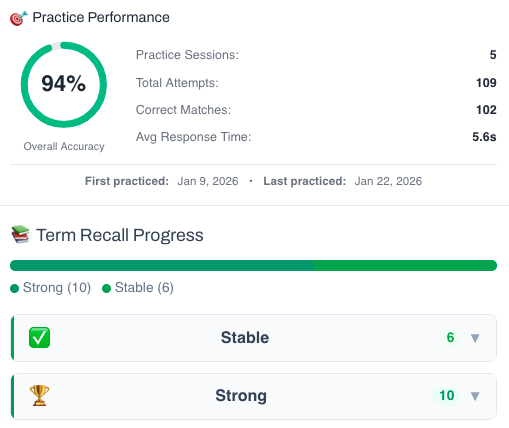
This isn’t a simple quiz — it’s a fully tracked learning system. You build knowledge through recognition, then recall, and your progress feeds directly into the Integrated Practice Bar (Writing tasks, AI Chat, and more).
- Practice sessions, accuracy, and response-time tracking
- Term strength levels (Learning → Stable → Strong)
- Personal progress history for each unit
This feature is available to YSP members.
Explore Membership Benefits