Countable Food: Fruits, Vegetables, and Everyday Foods
Core PathWay
1 Section 1. The Sweet Ones — Common Fruits
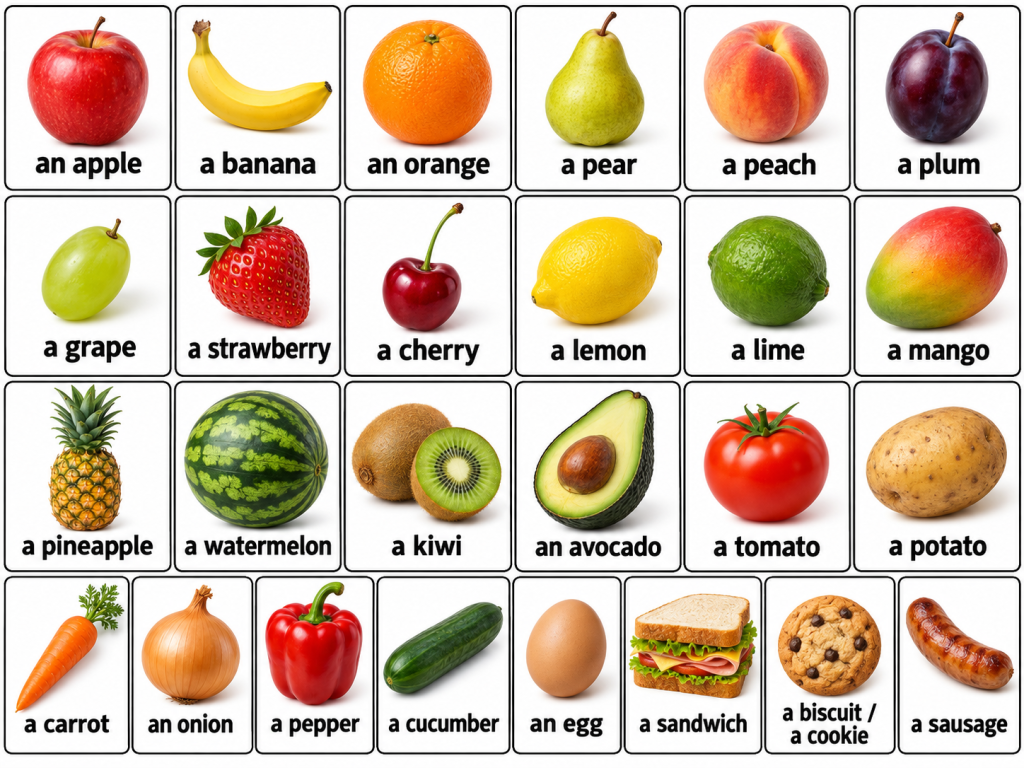
Want to talk confidently about food? It starts with these words. Let’s begin with fruit. Fruit is one of the most common food topics in everyday English. Most fruit names are countable. This means we use ‘a’ or ‘an’ before them. We say an apple, an orange, and an avocado because these words start with a vowel sound. We say a banana, a pear, a peach, a plum, and a mango because these start with a consonant sound. Notice the pattern: the article changes with the sound, not the spelling. A grape is small and round. We usually eat grapes in a bunch, but each one is still ‘a grape’. A strawberry is red and sweet. A cherry is also small and red, but it grows on a tree. A lemon is yellow and sour. A lime is green and also sour — it looks like a small lemon. A kiwi fruit is small, brown on the outside, and bright green inside.
2 Section 2. The Big Ones — Larger Fruits
Some fruits are much bigger. A pineapple is large, yellow inside, and has a rough, spiky skin. It grows in hot countries. A watermelon is very large and green on the outside. Inside, it is red and full of water — that is where the name comes from. These bigger fruits are still countable. We say ‘a pineapple’ and ‘a watermelon’ just like we say ‘an apple’. When we buy one, we often say: ‘I’d like a pineapple, please.’ When we talk about more than one, we add -s: ‘We need two watermelons for the party.’ Notice that an avocado is also quite large. It is green or dark purple on the outside, and it has a big stone in the middle. Avocados are popular in salads and on toast. Now you have a strong set of fruit vocabulary. In the next section, we move to vegetables.
3 Section 3. From the Ground — Common Vegetables
Vegetables are also mostly countable. A tomato is red and juicy. Many people think it is a vegetable, but it is actually a fruit — however, we use it like a vegetable in cooking. A potato is brown and starchy. We boil it, bake it, or fry it. It is one of the most common foods in the world. A carrot is orange and long. It is sweet and crunchy when raw. An onion is round and white or brown. It has a strong smell and taste. We use it in many cooked dishes. A pepper can be red, green, or yellow. It is crunchy and slightly sweet. A cucumber is long and green. We often eat it raw in salads. Notice that an onion and an avocado both use ‘an’ because they start with a vowel sound. All of these vegetables are countable, so we can say ‘one carrot’, ‘two peppers’, ‘three cucumbers’.
4 Section 4. At the Market — Buying Fruit and Vegetables
Now let’s think about how we use these words when we shop. At a market or in a shop, we often ask for a specific number. For example: ‘Can I have three apples and two pears, please?’ or ‘I’d like a mango and a pineapple.’ We can also use ‘some’ when we don’t say a number: ‘I need some tomatoes and some carrots.’ When a shopkeeper asks what you want, you might say: ‘I’m looking for a cucumber and a couple of peppers.’ Notice that ‘a couple of’ means two, or sometimes just a small number. It is a common phrase in spoken English. If something is not available, the shopkeeper might say: ‘Sorry, we don’t have any limes today, but we have plenty of lemons.’ This kind of language is very natural and useful for real shopping situations.
5 Section 5. Snacks and Meal Foods — Beyond Fruit and Vegetables
Not all countable foods are fruit or vegetables. Some are prepared or cooked foods. An egg is oval and white or brown on the outside. Inside, there is a yellow yolk. We boil, fry, or scramble eggs. A sandwich is two pieces of bread with a filling inside. People eat sandwiches for lunch very often. A biscuit is a small, flat, dry, and usually sweet food. We eat biscuits with tea or coffee. A sausage is a long, round food made from meat. We grill or fry sausages. They are popular at barbecues and for breakfast. A cake is a sweet baked food. We often eat cake at birthdays and celebrations. All of these are countable. We say ‘an egg’, ‘a sandwich’, ‘a biscuit’, ‘a sausage’, ‘a cake’. When we want more than one, we add -s: ‘two eggs’, ‘three sandwiches’, ‘four sausages’. Notice that ‘sandwich’ becomes ‘sandwiches’ — words ending in -ch take -es in the plural.
6 Section 6. Putting It All Together — Articles and Plurals
Let’s review the key pattern. Every food on this page is countable. This means two things. First, we use ‘a’ or ‘an’ with the singular form. Use ‘an’ before a vowel sound: an apple, an orange, an onion, an egg, an avocado. Use ‘a’ before a consonant sound: a banana, a cherry, a plum, a grape, a strawberry, a peach, a lemon, a lime, a mango, a kiwi fruit, a pineapple, a watermelon, a tomato, a potato, a carrot, a pepper, a cucumber, a sandwich, a biscuit, a sausage, a cake. Second, we add -s or -es to make the plural. Most words just take -s. Words ending in -ch or -o sometimes take -es: ‘tomatoes’, ‘potatoes’, ‘sandwiches’. Pay attention to these small changes — they matter in both writing and speaking. You now have all 26 food words. Use them with confidence.
7 Section 7. Now Hear It in Use
You’ve met all the words. Now hear them working in a real conversation. Listen to how two people use this food vocabulary naturally while they plan a meal together. Pay attention to how they use articles and plurals.
💬 Dialogue 1: Planning a Picnic
Two friends, Sam and Priya, are in a kitchen planning what food to bring to a picnic. They are checking what they already have and making a shopping list.
📝 Comprehension Check: Picnic Planning
Answer the questions based on what you heard in the audio.
Which speaker already has a large fruit item on the kitchen counter?
Which speaker says they have a long green salad vegetable at home?
Which speaker wants to use a citrus fruit to keep the food fresh?
Which speaker suggests making a large number of sandwiches instead of one each?
Which speaker says they need to buy eggs because they have none left?
Which speaker thinks they should buy more of a crunchy orange vegetable for dipping?
Which summary best describes what the speakers say?
Sam: “Right, so we need to make a list. I’ve already got a watermelon in the fridge and a pineapple on the counter. That’s a good start, isn’t it?”
Priya: “Great. What about sandwiches? We should make a few — maybe a chicken one and a cheese one for me.”
Sam: “Good idea. I’ll need to buy some bread then. And we’re definitely out of eggs — I wanted to boil a couple for the salad. Oh, and I was thinking of adding a sausage or two as well. People always love those at picnics.”
Priya: “Yes, a sausage is always a good idea! Should we bring a few or just two each? And I can make a quick salad — I’ve got a cucumber in the fridge, so that’s one thing we don’t need to buy.”
Sam: “Perfect. A cucumber will be great in the salad. What about something sweet? I was thinking of picking up a punnet of strawberries. A strawberry or two on the side looks really nice as well.”
Priya: “Oh, I love strawberries! Let’s get a big punnet. And should we bring a lemon? I could squeeze one over the fruit salad — it keeps everything fresh.”
Sam: “Good thinking. A lemon is definitely going on the list. What about vegetables? I’ve got a carrot left in the fridge — just one, though. We might need a few more for dipping.”
Priya: “I think one carrot isn’t enough. Let’s buy three or four more. And we could cut them into sticks for dipping. Should we bring a biscuit selection too? Some people might want something crunchy.”
Sam: “Definitely — a biscuit or two is always welcome at a picnic. I’ll grab a packet at the shop. Okay, so let me check the list so far: a watermelon, a pineapple, eggs, sausages, a cucumber, strawberries, a lemon, carrots, and biscuits. Does that sound right?”
Priya: “That sounds great! Oh, but we forgot the bread for the sandwiches. And actually, should we bring a sandwich each or make a big batch? I think a big batch is easier.”
Sam: “A big batch is definitely easier — let’s make eight or ten sandwiches. I’ll also grab an extra lemon just in case. Right, I think we’ve got a really good list now. Anything else you can think of?”
Priya: “I think that’s everything! A watermelon, a pineapple, sandwiches, eggs, sausages, a cucumber, strawberries, lemons, carrots, and biscuits. That’s going to be a great picnic!”
Member-Exclusive Practice Bar
Access a wide range of integrated practice for this unit — from Vocabulary and Grammar activities to AI-curated Writing tasks and Thematic Chat practice.
This feature is available to YSP members.
Explore Membership BenefitsMember-Exclusive Vocabulary Review & Acquisition System
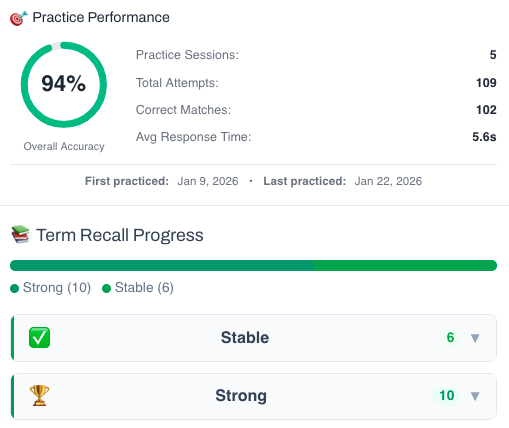
This isn’t a simple quiz — it’s a fully tracked learning system. You build knowledge through recognition, then recall, and your progress feeds directly into the Integrated Practice Bar (Writing tasks, AI Chat, and more).
- Practice sessions, accuracy, and response-time tracking
- Term strength levels (Learning → Stable → Strong)
- Personal progress history for each unit
This feature is available to YSP members.
Explore Membership Benefits