Comparing Things: Using Comparative Adjectives
Core PathWay
1 Why We Compare Things
Every day we compare things. We say ‘This coffee is better than yesterday’s coffee’ or ‘The new office is bigger than the old one.’ At work, we compare prices, we compare options, and we compare results. In social life, we compare restaurants, holidays, and films. This is normal! Comparative adjectives help us make choices and explain our preferences.
English has simple rules for making comparatives. Most adjectives follow a pattern based on how long the word is. A few adjectives are different — they don’t follow the rules. These are called irregular comparatives. The good news? There are only three important irregular ones: good, bad, and far.
When we compare two things, we use the word than. Look at these examples:
• ‘This phone is better than my old phone.’ (irregular: good → better)
• ‘Summer days are longer than winter days.’ (1 syllable: long → longer)
• ‘My new job is busier than my old job.’ (2 syllables ending in -y: busy → busier)
• ‘This sofa is more modern than that one.’ (2 syllables: modern → more modern)
• ‘Physics is more difficult than maths for me.’ (3 syllables: difficult → more difficult)
Notice the word than in every sentence? We use it to show what we are comparing. In the next section, we look at the rules in detail.
2 The Rules for Making Comparatives
Now let’s look at the complete rule set. Don’t worry — the patterns are simple once you see them!
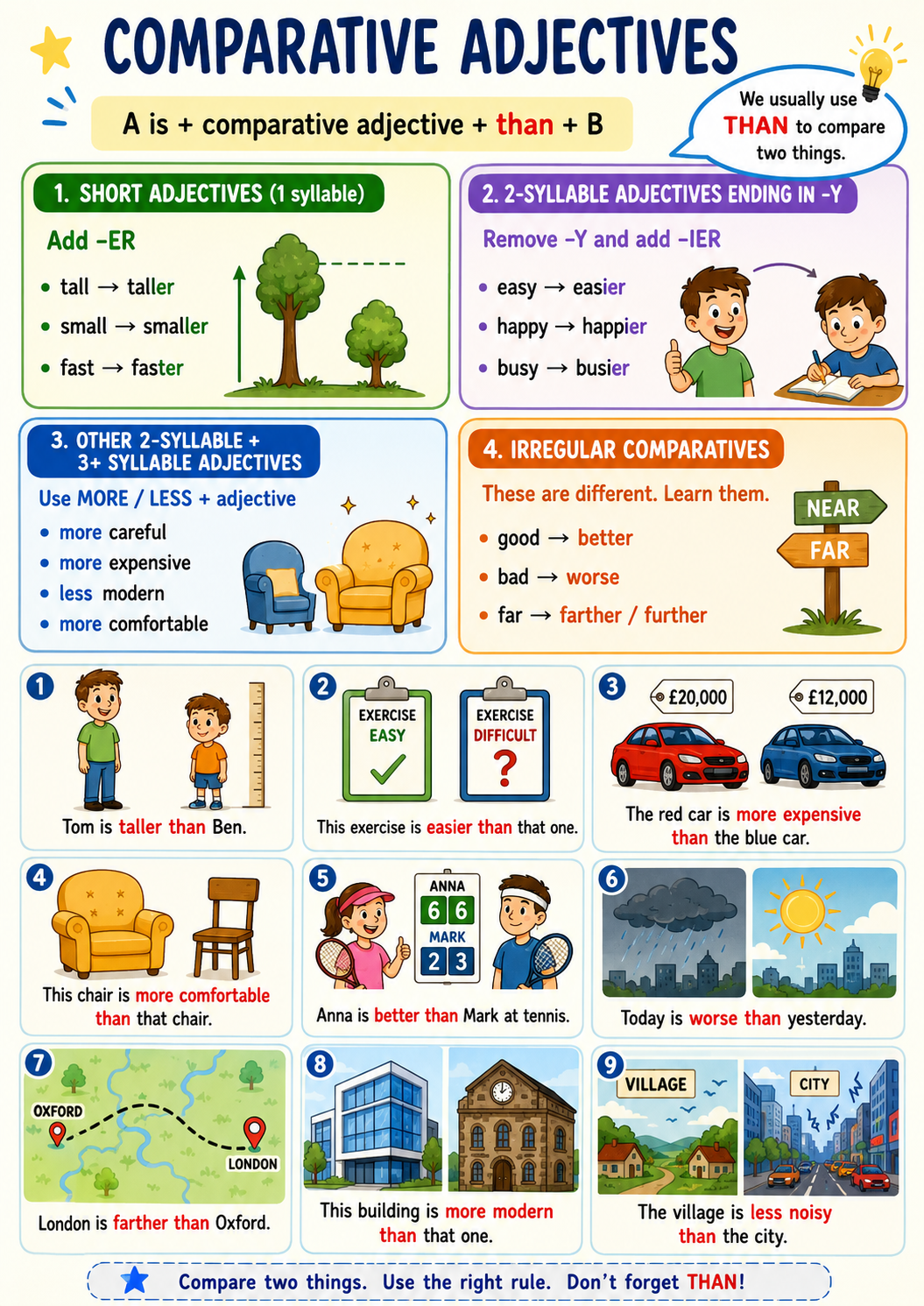
Most adjectives follow rules based on how many syllables (sound parts) they have. One-syllable words like big and small take -er. Three-syllable words like expensive take more. Two-syllable words? It depends! If the adjective ends in -y, change the -y to -ier. Other two-syllable adjectives can use -er OR more — but more is usually more common and sounds more natural.
Focus
- Irregular comparatives: good → better, bad → worse, far → further/farther
- One-syllable adjectives: add -er (double final consonant if needed)
- Two-syllable adjectives ending in -y: change -y to -ier
- Other two-syllable adjectives: use ‘more’ (or -er for some words)
- Three+ syllable adjectives: always use ‘more’
- Participle adjectives (-ed/-ing): always use ‘more’
Rules
- IRREGULAR (learn these!): good → better | bad → worse | far → further (or farther)
- ONE SYLLABLE: add -er. If the adjective ends consonant-vowel-consonant, double the final consonant: big → bigger, hot → hotter, sad → sadder. Regular: old → older, young → younger, new → newer, long → longer, short → shorter, fast → faster, slow → slower, cheap → cheaper, cold → colder
- TWO SYLLABLES ending in -y: change -y to -ier: happy → happier, busy → busier, early → earlier, easy → easier
- OTHER TWO-SYLLABLE adjectives: use ‘more’ (most common) OR add -er (less common): modern → more modern, polite → more polite, simple → more simple (or simpler), narrow → more narrow (or narrower)
- THREE OR MORE SYLLABLES: always use ‘more’: difficult → more difficult, expensive → more expensive, important → more important, beautiful → more beautiful, interesting → more interesting
- PARTICIPLE ADJECTIVES (-ed/-ing forms): always use ‘more’: bored → more bored, boring → more boring, excited → more excited, exciting → more exciting, worried → more worried, worrying → more worrying
Examples
- My new flat is bigger than my old flat. (one syllable: big → bigger)
- This exercise is easier than the last one. (two syllables, ends in -y: easy → easier)
- The city centre is more expensive than the suburbs. (three syllables: expensive → more expensive)
- Today’s meeting was more boring than yesterday’s meeting. (participle: boring → more boring)
- The weather is worse today than it was yesterday. (irregular: bad → worse)
Common mistake
3 Choosing a Holiday
Sam, Jordan, and Alex sat in a café looking at holiday options on Jordan’s laptop.
‘What about Greece?’ Sam asked. ‘The weather is hotter than here, and the food is better than in most places.’
Jordan shook his head. ‘Greece is beautiful, but it’s more expensive than Portugal. Look — the flights to Lisbon are cheaper.’
‘True,’ Alex said, ‘but Greece is more interesting for history. I want to see old buildings, not just beaches.’
‘Portugal has old buildings too!’ Jordan laughed. ‘And Lisbon is more modern than Athens in some areas. The public transport is better.’
Sam looked at the screen. ‘The hotel in Greece looks nicer. It’s bigger and it’s closer to the beach.’
‘But the Portugal hotel is newer,’ Jordan said. ‘And the reviews say the staff are friendlier.’
Alex smiled. ‘This is more difficult than I thought! Both places sound good. Maybe we should choose the place with earlier flights? I don’t want to get up at 5 a.m.’
‘The Lisbon flight is at 9 a.m.,’ Jordan said. ‘The Athens flight is at 6 a.m. So Portugal wins!’
‘OK, I agree,’ Sam said. ‘Portugal is cheaper, the flight time is better, and it’s different from our last holiday. Let’s book it!’
They clicked ‘confirm’ and started planning their trip. Sometimes the easier choice is the right choice.
Key Terms
4 Your Turn: Write About a Holiday
Now practise using comparative adjectives to describe your own experience.
5 What You’ve Learned
You now know how to form and use comparative adjectives! Let’s recap the key patterns:
Irregular forms — Just three to remember: good → better, bad → worse, far → further (or farther).
One-syllable adjectives — Add -er: old → older, big → bigger (double the consonant), fast → faster.
Two-syllable adjectives ending in -y — Change -y to -ier: happy → happier, busy → busier, early → earlier.
Other two-syllable adjectives — Usually use more: modern → more modern, polite → more polite. (Some can take -er, but more is safer!)
Three or more syllables — Always use more: expensive → more expensive, difficult → more difficult, important → more important.
Participle adjectives (-ed/-ing) — Always use more: bored → more bored, exciting → more exciting.
And don’t forget than! We use it to show what we’re comparing: ‘This book is more interesting than that one.’
Comparatives are everywhere in English. Now you can use them to talk about your preferences, make decisions, and explain why you like one thing more than another. Well done!
Member-Exclusive Practice Bar
Access a wide range of integrated practice for this unit — from Vocabulary and Grammar activities to AI-curated Writing tasks and Thematic Chat practice.
This feature is available to YSP members.
Explore Membership Benefits🎧 Module 1398 | Comparatives | Audio Review
Member-Exclusive Vocabulary Review & Acquisition System
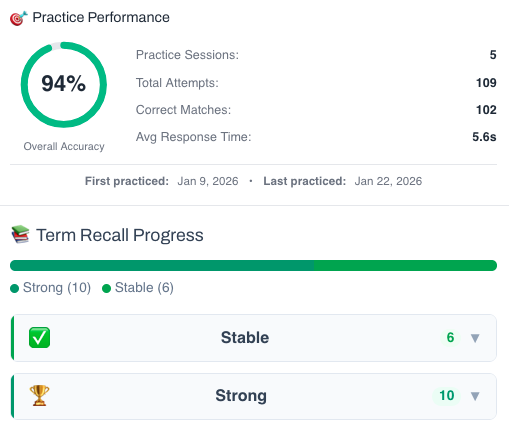
This isn’t a simple quiz — it’s a fully tracked learning system. You build knowledge through recognition, then recall, and your progress feeds directly into the Integrated Practice Bar (Writing tasks, AI Chat, and more).
- Practice sessions, accuracy, and response-time tracking
- Term strength levels (Learning → Stable → Strong)
- Personal progress history for each unit
This feature is available to YSP members.
Explore Membership Benefits🎮 Practice Games
Member-Exclusive Sentence Builder
Reconstruct scrambled sentences to practice word order and develop your grammar intuition.
This feature is available to YSP members.
Explore Membership Benefits