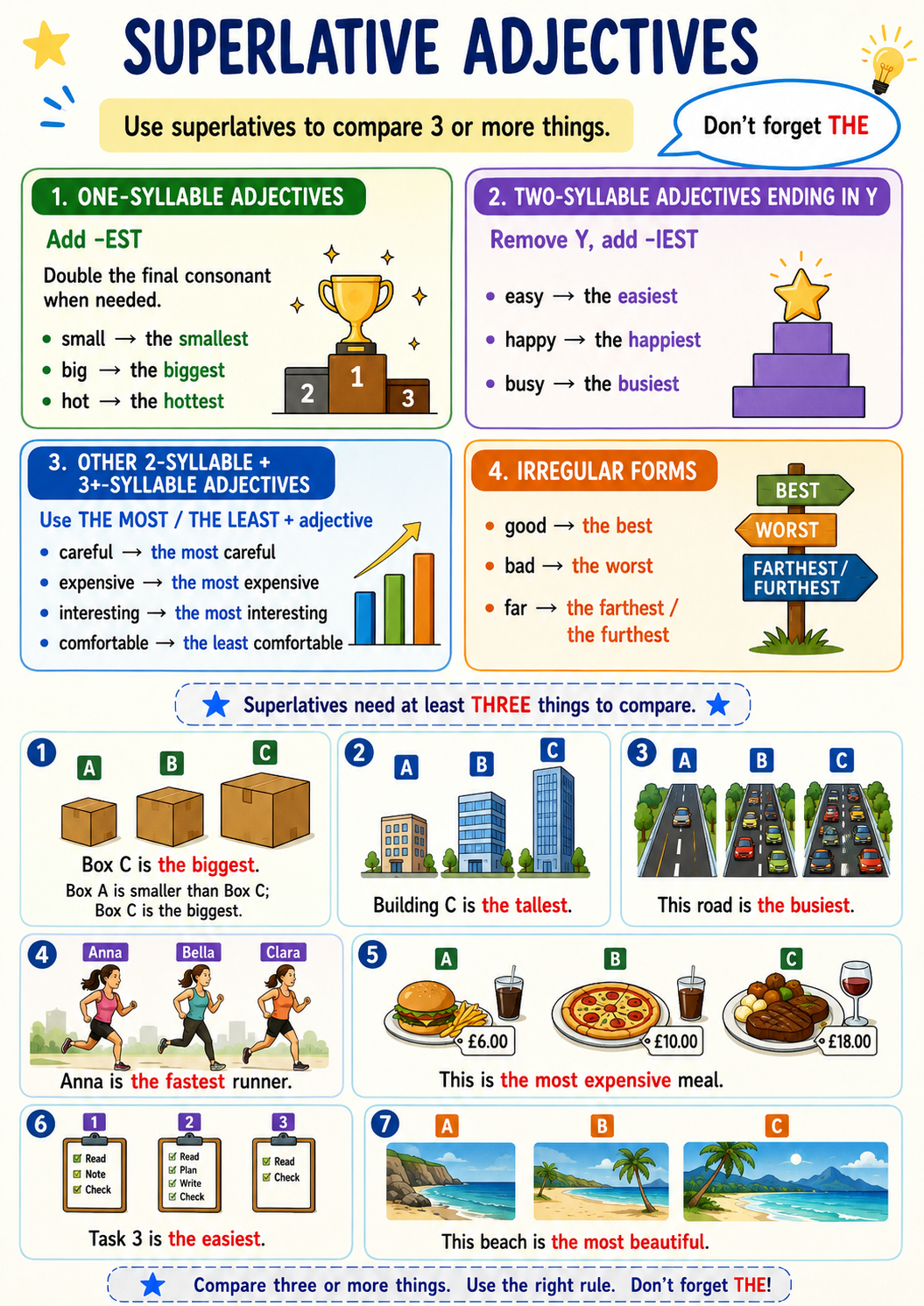
Introduction to Superlatives
Core PathWay
1 What Are Superlatives?
Every day we talk about extremes. We say ‘This is the best coffee in the city’ or ‘That was the worst film I have ever seen.’ At work, we look for the cheapest option or the fastest solution. In our social life, we talk about the oldest building in town, the newest restaurant, or the most expensive hotel. This is normal! Superlative adjectives help us describe number one — the top thing, the extreme.
English has simple rules for making superlatives. Most adjectives follow a pattern based on how long the word is. A few adjectives are different — they don’t follow the rules. These are called irregular superlatives. The good news? There are only three important irregular ones: good, bad, and far.
When we use superlatives, we ALWAYS use the word the. Why? Because a superlative means ONE thing — the single biggest, the single smallest, the one and only best. And the in English points to one specific thing. So they match perfectly! We say ‘the tallest building’ (one building), ‘the happiest day’ (one day), ‘the most difficult exam’ (one exam). We NEVER say ‘than’ with superlatives. Look at these examples:
• ‘This phone is the best in the shop.’ (irregular: good → the best)
• ‘Summer has the longest days of the year.’ (1 syllable: long → the longest)
• ‘Monday is the busiest day at work.’ (2 syllables ending in -y: busy → the busiest)
• ‘This sofa is the most modern in the store.’ (2 syllables: modern → the most modern)
• ‘Physics is the most difficult subject for me.’ (3 syllables: difficult → the most difficult)
Notice the in every sentence? We use it because we are talking about THE ONE — the single thing at the top. In the next section, we look at the rules in detail.
2 How to Form Superlatives
The pattern you use depends on how many syllables the adjective has. A syllable is a sound unit in a word. ‘Big’ has one syllable. ‘Happy’ has two syllables (hap-py). ‘Beautiful’ has three syllables (beau-ti-ful). Let’s look at each pattern.
Focus
- Irregular superlatives: good → the best, bad → the worst, far → the farthest/furthest
- One-syllable adjectives: add -est (the biggest, the smallest, the coldest, the hottest)
- Two-syllable adjectives ending in -y: change y to i and add -est (the busiest, the earliest, the happiest)
- Other two-syllable adjectives: most can use either pattern (the most modern OR the modernest — but ‘most modern’ is more common; the politest OR the most polite)
- Three or more syllable adjectives: use ‘the most’ (the most difficult, the most expensive, the most beautiful)
- Participle adjectives (-ed/-ing): always use ‘the most’ (the most worried, the most exciting, the most surprised)
Rules
- IRREGULAR FORMS: These three adjectives have special superlative forms. You must learn them: good → the best | bad → the worst | far → the farthest OR the furthest. Examples: ‘This is the best restaurant in town.’ ‘That was the worst day of my life.’ ‘Neptune is the farthest planet from the sun.’
- ONE SYLLABLE: Add -est to the adjective. If the adjective ends in one vowel + one consonant, double the final consonant. Examples: big → the biggest | small → the smallest | old → the oldest | young → the youngest | new → the newest | hot → the hottest (double t) | cold → the coldest | long → the longest | short → the shortest | fast → the fastest | slow → the slowest | cheap → the cheapest | full → the fullest | empty → the emptiest
- TWO SYLLABLES ENDING IN -Y: Change -y to -i and add -est. Examples: happy → the happiest | easy → the easiest | busy → the busiest | early → the earliest | tasty → the tastiest | friendly → the friendliest | Note: ‘the friendliest’ can also be ‘the most friendly’ — both are correct
- OTHER TWO-SYLLABLE ADJECTIVES: Most use ‘the most’ but some can use either pattern. Common ones: modern → the most modern | polite → the politest OR the most polite | quiet → the quietest OR the most quiet | simple → the simplest OR the most simple | narrow → the narrowest OR the most narrow | For safety, use ‘the most’ with two-syllable adjectives unless you know the word well
- THREE OR MORE SYLLABLES: Always use ‘the most’. Examples: difficult → the most difficult | expensive → the most expensive | beautiful → the most beautiful | important → the most important | interesting → the most interesting | comfortable → the most comfortable | different → the most different
- PARTICIPLE ADJECTIVES (-ED/-ING): Always use ‘the most’. These are adjectives that come from verbs. Examples: worried → the most worried | excited → the most excited | surprised → the most surprised | boring → the most boring | interesting → the most interesting | relaxing → the most relaxing
Examples
- This is the best coffee I know. (irregular: good → the best)
- January is the coldest month in my country. (1 syllable: cold → the coldest)
- Friday is the busiest day at the office. (2 syllables, -y: busy → the busiest)
- This chair is the most comfortable in the house. (3 syllables: comfortable → the most comfortable)
- That was the most boring meeting ever. (participle -ing: boring → the most boring)
Common mistake
3 Superlatives + Present Perfect: Talking About Life Experiences
Here’s a powerful way to use superlatives: combine them with present perfect to talk about your entire life experience. When you say ‘This is the best holiday I have ever had’, you are comparing this holiday to ALL the holidays in your whole life. You are saying it is number one, the top, the best. This pattern is very common in English, and it’s a great way to express strong feelings about experiences.
Focus
- Pattern: This/That is the [superlative] + [thing] + I have ever + [past participle]
- Use this to compare one experience to ALL similar experiences in your life
- The superlative shows it is number one — the top of everything you have experienced
- Common question form: What is the [superlative] + [thing] + you have ever + [past participle]?
Rules
- The pattern combines a superlative adjective with present perfect (have/has + past participle). The word ‘ever’ means ‘in all of your life’. So ‘the best film I have ever seen’ means ‘the best film in all my life — compared to every film I have seen’.
- Common structure: This/That/It is + the [superlative] + [noun] + I/you/he/she/we/they + have/has + ever + [past participle]. Example: ‘This is the most beautiful beach I have ever visited.’
- Question form: What is + the [superlative] + [noun] + you have ever + [past participle]? Example: ‘What is the worst meal you have ever eaten?’
- You can use any superlative in this pattern: the best, the worst, the biggest, the smallest, the most expensive, the cheapest, the most difficult, the easiest, the tastiest, the most interesting, etc.
Examples
- This is the best holiday I have ever had.
- That was the worst film I have ever seen.
- She is the friendliest person I have ever met.
- This is the most expensive restaurant I have ever been to.
- That was the easiest exam I have ever done.
- This is the hottest day I have ever experienced.
- What is the best book you have ever read?
- What is the most difficult thing you have ever learned?
- What is the tastiest food you have ever tried?
- What is the farthest place you have ever travelled to?
Common mistake
4 A Postcard from Paradise
Hi Sam!
I’m writing to you from Thailand and I have to tell you — this is the best holiday I have ever had! We are staying in a small hotel on the beach. It’s not the newest or the most modern hotel, but it’s perfect. The room is clean and the view is amazing.
The beach here is the most beautiful place I have ever seen. The water is warm and clear. Yesterday we went to a local restaurant and I ate the tastiest fish dish ever. The owner was the friendliest person — she told us all about the area and gave us free fruit!
We also visited a national park. It was the hottest day of the trip (35 degrees!) but we saw incredible wildlife. Our guide said we were lucky because we saw some of the oldest trees in Thailand — over 500 years old!
The only problem? The journey here was the longest flight I have ever taken — 14 hours! But it was worth it.
Tomorrow we are going to a market that sells the cheapest souvenirs in the region. I’ll buy something for you!
This trip has been amazing. I think Thailand might be the most different country I have ever visited — the culture, the food, the people — everything is special.
Miss you!
Alex
5 Your Turn: Write About Your Best Holiday
Now it’s your turn to practise! Think about a holiday you are on now, or imagine your dream holiday.
6 What You’ve Learned
Well done! You now know how to form and use superlative adjectives in English. You learned that superlatives describe extremes — the best, the worst, the biggest, the number one. You discovered the simple patterns: add -est to short adjectives, use ‘the most’ with long adjectives, and remember the three irregular forms (good → the best, bad → the worst, far → the farthest).
You also learned why we ALWAYS use the before superlatives — because a superlative points to ONE thing, and the points to one specific thing. They match perfectly!
Finally, you practised a powerful combination: superlatives + present perfect. This pattern lets you talk about your entire life experience and say what is number one. ‘This is the most beautiful beach I have ever seen’ compares this beach to EVERY beach in your whole life.
Superlatives are everywhere in English — in conversations, in reviews, in descriptions. Now you can use them confidently to express your opinions and describe the extremes in your world!
Member-Exclusive Practice Bar
Access a wide range of integrated practice for this unit — from Vocabulary and Grammar activities to AI-curated Writing tasks and Thematic Chat practice.
This feature is available to YSP members.
Explore Membership Benefits🎧 Module 1399 | Superlatives | Audio Review
Member-Exclusive Vocabulary Review & Acquisition System
This isn’t a simple quiz — it’s a fully tracked learning system. You build knowledge through recognition, then recall, and your progress feeds directly into the Integrated Practice Bar (Writing tasks, AI Chat, and more).
- Practice sessions, accuracy, and response-time tracking
- Term strength levels (Learning → Stable → Strong)
- Personal progress history for each unit
This feature is available to YSP members.
Explore Membership Benefits🎮 Practice Games
Member-Exclusive Sentence Builder
Reconstruct scrambled sentences to practice word order and develop your grammar intuition.
This feature is available to YSP members.
Explore Membership Benefits