Modifying Comparatives: Big and Small Differences
Core PathWay1 Big Differences and Small Differences
You already know how to make comparisons. You can say ‘Australia is bigger than England.’ But sometimes you want to show HOW MUCH bigger. Is it a little bit bigger? Or is it much bigger?
Look at these examples:
Simple comparison: Australia is bigger than England.
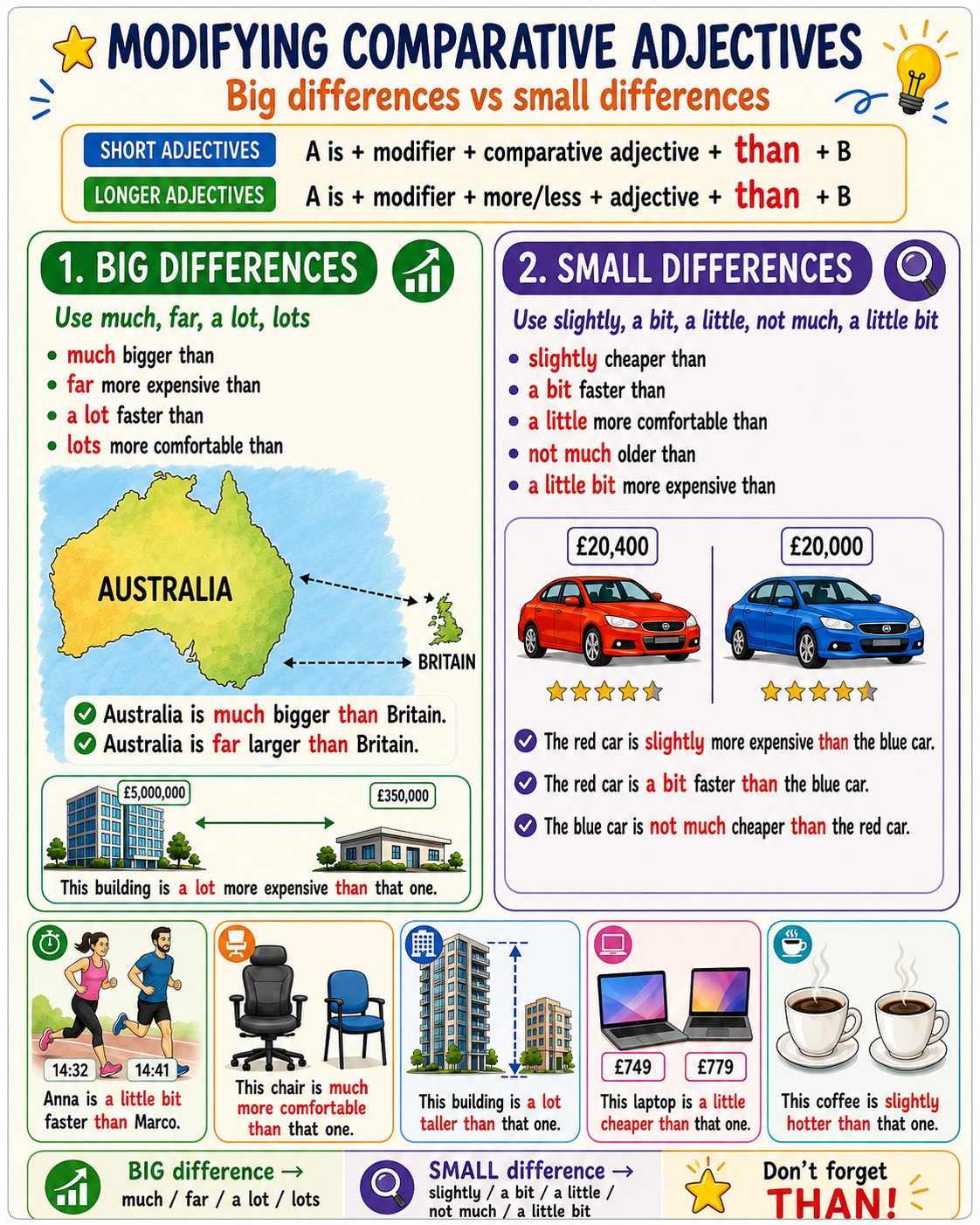
BIG difference: Australia is much bigger than England. / Australia is a lot bigger than England.
Simple comparison: This phone is more expensive than that one.
SMALL difference: This phone is slightly more expensive than that one. / This phone is a bit more expensive than that one.
See the difference? The words before the comparative adjective show the SIZE of the difference. This makes your English more exact and more natural.
2 Talking About Big Differences
When the difference between two things is big, you can use special words before the comparative adjective. These words make the difference clear.
The most common words are: much, a lot, lots, and far. They all mean the same thing — the difference is big.
Focus
- Use much, a lot, lots, or far BEFORE the comparative adjective
- These words show a BIG difference between two things
- You can ask ‘How much + comparative…?’ to ask about the size of difference
Rules
- Pattern: much/a lot/lots/far + comparative adjective + than
- Example: London is much bigger than Oxford.
- Question form: How much bigger is London than Oxford?
Examples
- This car is much faster than my old car.
- The new office is a lot more modern than the old one.
- How much more expensive is the new phone?
Common mistake
3 Talking About Small Differences
Sometimes the difference between two things is small. You want to say ‘yes, there is a difference, but it is not big.’ For this, use different words: slightly, a little, or a bit.
Focus
- Use slightly, a little, or a bit BEFORE the comparative adjective
- These words show a SMALL difference between two things
- This makes your comparison more polite and careful
Rules
- Pattern: slightly/a little/a bit + comparative adjective + than
- Example: This coffee is slightly hotter than that one.
- ‘A bit’ is more informal than ‘slightly’
Examples
- My new job is a little better than my old job.
- The train is slightly faster than the bus.
- This room is a bit warmer than the other room.
Common mistake
You can also say:
4 Guy and David Compare Countries
Guy is from Australia. David is from England. They work together in an office in London. Today they are arguing about which country is better.
“Australia is much bigger than England,” Guy said. “The distances are completely different. You can drive for hours in Australia and still be in the same state. That’s great!”
David nodded. “That’s true. England is far smaller, but I think it’s a lot easier to travel around. Our towns and cities are much closer together, so journeys are far quicker.”
“Yes, but Australia is much less crowded,” Guy replied. “The countryside is far more open, and some places are incredibly remote.”
“Exactly!” said David. “That makes England far easier to explore. You can see several different cities in a few days.”
Guy smiled. “OK, it’s not all about size. Our weather is much better than Britain’s.”
“Really?” David said. “I think you mean far hotter in summer. I prefer cooler summers.”
“What about the beaches?” Guy asked. “Australian beaches are a lot bigger and, in my opinion, far more beautiful.”
David laughed. “OK, the beaches may be a bit better. But England is much older historically. We’ve got castles, old villages and historic buildings everywhere.”
“True,” Guy said. “But Australian cities are generally much more modern, and our houses are often a lot bigger too. British houses tend to be far smaller.”
“So which country is better?” David asked.
Guy laughed. “Easy! Australia is much bigger, far warmer, much less crowded and has far better beaches.”
David shook his head. “And England is a lot smaller, much older and far easier to travel around. So obviously England is better!”
“Not a chance!” said Guy.
Key Terms
5 Your Turn: Write Comparisons
Now practise what you learned. Write about two airports: before and after redevelopment.

Compare the two airports. Write about the changes in the runways, terminal buildings, gates, apron areas, and taxiways.
Use comparative forms with modifiers like: much bigger, a lot larger, slightly longer, a bit wider.
Write about 60 words.