
The Novelist: Narrative Tenses
🎧 Emma's Novel – Chapter 3
📖 The Novel That Wouldn’t Come – Part Three: The Prize (B1)
Grammar Investigation
Answer each question to reveal the grammar explanation:
Then he announced the winner.
In the sentence ‘Then he announced the winner’, why do we use Past Simple?
Emma remembered the day she had finally finished her manuscript.
Why do we use Past Perfect in ‘Emma remembered the day she had finished her manuscript’ instead of Past Simple ‘she finished’?
She had been working on the last chapter for three weeks.
Why does the story say ‘She had been working on the chapter for three weeks’ instead of ‘She had worked on the chapter for three weeks’?
Now she was standing in a hotel ballroom, waiting for an announcement that would change everything.
In the sentence ‘Now she was standing in a hotel ballroom’, what does the Past Continuous show?
Now she was standing in a hotel ballroom, waiting for an announcement that would change everything.
In ‘waiting for an announcement that would change everything’, what does ‘would change’ express?
📚 Grammar Reference
PAST SIMPLE
Structure: regular verbs: base + -ed; irregular verbs: unique past forms
Pattern: subject + past simple verb (+ object/complement)
What it expresses: Completed actions at specific times in the past; main events in narrative sequences
When to use: For finished actions with clear time reference; for sequential events in stories; for main narrative events
Why this form: Past simple is the backbone of storytelling, moving the narrative forward chronologically
Examples in story: 22
PAST PERFECT SIMPLE
Structure: had + past participle
Pattern: subject + had + past participle (+ object/complement)
What it expresses: Actions completed before another past action or time; earlier events in past narratives
When to use: To show which of two past actions happened first; to establish background events before main narrative; with time expressions showing sequence
Why this form: Creates clear chronological layers in storytelling, showing what was already complete at the past moment being discussed
Examples in story: 18
PAST PERFECT CONTINUOUS
Structure: had been + present participle (-ing)
Pattern: subject + had been + verb-ing (+ duration/context)
What it expresses: Ongoing actions or states over a period before a past reference point; emphasis on duration and continuity of past activities
When to use: To emphasize how long something continued before a past moment; for repeated actions over a period; for temporary situations in the past before another past event
Why this form: Shows the continuous nature and duration of effort, struggle, or activity leading up to a past moment; emphasizes the process rather than just completion
Examples in story: 12
PAST CONTINUOUS
Structure: was/were + present participle (-ing)
Pattern: subject + was/were + verb-ing (+ time/context)
What it expresses: Actions in progress at a specific moment in the past; background actions; temporary situations; descriptions of scenes
When to use: To set the scene in narratives; for actions interrupted by another action; for parallel actions happening at the same time; for temporary states
Why this form: Creates vivid descriptions and atmosphere; shows what was in progress when main events occurred; provides background context
Examples in story: 14
USED TO
Structure: used to + base verb
Pattern: subject + used to + base verb
What it expresses: Past habits or states that are no longer true; repeated actions in the past that have stopped
When to use: To contrast past and present situations; for habits that existed over a period but have ended; for past states
Why this form: Not applicable in this forward-moving success narrative focused on specific completed events rather than past habits
Examples in story: 0
WOULD
Structure: would + base verb
Pattern: subject + would + base verb (in past context)
What it expresses: Future from a past perspective; anticipated results in past contexts; hypothetical outcomes considered in the past
When to use: To express what someone thought/expected would happen in the future (from a past viewpoint); for consequences imagined at a past moment
Why this form: Shows Emma’s thoughts about future outcomes while she was in the past situation; expresses anticipation and speculation from a past perspective
Examples in story: 20
Use the VAS to build solid recognition and recall of the terms below.
✔ Every correct Match = +1 point
✔ Every correct Recall = +2 points
🎓 Reach 5 points with good accuracy and the term is automatically promoted to your Personal Dictionary.
Incorrect answers lower accuracy, meaning more correct Matches or Recalls may be needed to reach promotion.
Member-Exclusive Vocabulary Review & Acquisition System
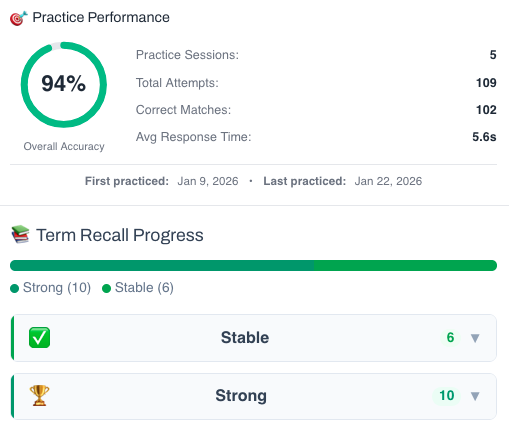
This isn’t a simple quiz — it’s a fully tracked learning system. You build knowledge through recognition, then recall, and your progress feeds directly into the Integrated Practice Bar (Writing tasks, AI Chat, and more).
- Practice sessions, accuracy, and response-time tracking
- Term strength levels (Learning → Stable → Strong)
- Personal progress history for each unit
This feature is available to YSP members.
Explore Membership Benefits