The Interview Stage: Screening, Selecting, and Assessing Candidates
Core PathWay
1 Section 1. From Inbox to Interview: Screening Applications
Ready to build your vocabulary for the recruitment interview process? Here is where we start — with the very first step: reviewing applications.
When a job is advertised, many people apply. The HR team cannot interview everyone. So they begin to screen applications. This is called CV screening. It means they read each CV and check if the candidate meets the basic requirements for the role.
After screening, the team creates a longlist. This is a larger group of candidates who all meet the minimum requirements. Think of it as the ‘yes, possibly’ pile.
Then the team looks more carefully. They screen out candidates who are not strong enough. This means those people are removed from the process at an early stage. At the same time, they screen in the strongest candidates — these people move forward.
The result is a shortlist. This is a smaller, final group of candidates who will be invited to interview. To shortlist someone means to put them on this list.
Not everyone on the longlist gets good news. The team must reject a candidate if they are not suitable. A rejection is the formal message telling someone they were not successful. Sometimes the team uses softer language: they decline an application. This means they choose not to continue with that person — it sounds a little more polite than ‘reject’.
2 Section 2. First Contact and Interview Formats
Once a shortlist is ready, the interview process begins. But interviews come in different shapes and sizes.
Often, the first step is a phone screen. This is a short phone call — usually 10 to 20 minutes — where a recruiter checks basic facts about the candidate. Is the salary expectation realistic? Can the candidate start on the right date? It is a quick way to check basic fit before spending time on a full interview.
If the phone screen goes well, the candidate is invited to a first-round interview. This is the initial interview stage. In many companies, there are several rounds, and this is just the beginning.
Some interviews involve more than one interviewer. A panel interview is when two or more people interview the candidate at the same time. Each member of the group is called a panellist, and together they form the interview panel.
Not all interviews follow the same structure. A structured interview is one where every candidate is asked exactly the same questions, in the same order. This makes it easier to compare candidates fairly. An unstructured interview is more like a conversation — it does not follow a fixed set of questions. It feels more natural, but it is harder to compare candidates afterwards.
Sometimes a colleague needs to observe but not lead the interview. We say they sit in on the interview. For example: ‘Our new HR assistant will sit in on the interviews this week to learn the process.’
3 Section 3. What Interviewers Ask — and How Candidates Answer
The questions an interviewer asks are very important. There are two main types.
A behavioural interview question asks the candidate to describe a real situation from their past. For example: ‘Tell me about a time when you had to deal with a difficult colleague.’ The idea is that past behaviour shows future behaviour.
A situational interview question is different. It asks the candidate to imagine a future situation. For example: ‘What would you do if a project deadline changed at the last minute?’ This tests how the candidate thinks and plans.
To answer these questions well, many candidates use the STAR method. STAR stands for Situation, Task, Action, Result. First, you describe the situation. Then you explain your task. Next, you say what action you took. Finally, you give the result. Using the STAR format helps candidates give clear, complete answers.
Some companies go further and use an assessment centre. This is not a place — it is an event. Candidates complete a series of exercises, tasks, and tests, often observed by several assessors at the same time. It is a thorough way to see how candidates perform under different conditions.
Companies may also use a psychometric test. This is a standardised test that measures a candidate’s aptitude, personality, or cognitive ability. In other words, it checks how a person thinks, how they work, and what kind of personality they have.
When a process really tests someone’s abilities fully, we can say it puts them through their paces. For example: ‘The assessment centre really put all the candidates through their paces.’
4 Section 4. After the Interview: Checking, Deciding, and Closing
The interview is not the end of the process. Several important steps come after.
First, the interviewing team needs to discuss what they observed. They debrief — this means they meet to compare notes and share their opinions about each candidate. This conversation is also called a debrief. It is important to do this soon after the interview, while the details are fresh.
If the process has multiple stages, the strongest candidates move to a final-round interview. This is the last interview before a decision is made. Senior staff often take part at this stage.
Before making a job offer, companies usually carry out checks. A reference check means contacting people from the candidate’s past — usually former employers — to verify their history and performance. We also say the company takes up references. To vet a candidate means to carry out careful checks on their background and suitability. Vetting can include reference checks, but it may also include other background checks.
During the process, it is important to follow up with candidates regularly. This means making contact after an interview to give an update — for example, to say when a decision will be made. Candidates appreciate this. It shows respect for their time.
And of course, the team must follow up at the end too — to tell successful candidates they have an offer, and to send a polite rejection to those who were not selected. Some companies prefer to say they are declining the application rather than rejecting it. The meaning is the same, but the tone is softer.
That is the full journey — from the first CV screening to the final decision. Now you have the language to describe every step.
Member-Exclusive Practice Bar
Access a wide range of integrated practice for this unit — from Vocabulary and Grammar activities to AI-curated Writing tasks and Thematic Chat practice.
This feature is available to YSP members.
Explore Membership BenefitsMember-Exclusive Vocabulary Review & Acquisition System
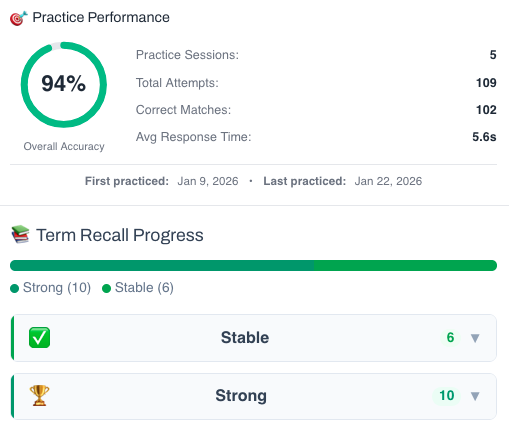
This isn’t a simple quiz — it’s a fully tracked learning system. You build knowledge through recognition, then recall, and your progress feeds directly into the Integrated Practice Bar (Writing tasks, AI Chat, and more).
- Practice sessions, accuracy, and response-time tracking
- Term strength levels (Learning → Stable → Strong)
- Personal progress history for each unit
This feature is available to YSP members.
Explore Membership Benefits