Crisis at the Runway: Managing an Aircraft Incident
Core PathWay
1 A Routine Day Interrupted
Regional airports handle dozens of movements daily, and most days pass without incident. Airport service managers coordinate operations, ensuring runways remain clear, emergency services stay on standby, and all systems function smoothly. However, even the quietest shift can change in seconds.
Dialogue: Morning briefing at Millfield Regional Airport
*Sarah Chen, Airport Services Manager, and Tom Bradley, Operations Supervisor, review the day’s schedule in the control tower.*
Sarah: Morning, Tom. What’s the picture looking like today?
Tom: Pretty straightforward, Sarah. We’ve got twelve scheduled movements between now and 1800 hours. Weather’s holding steady—light winds, good visibility. The fire service completed their drill yesterday, so we’re fully operational.
Sarah: Excellent. Any maintenance work I should know about?
Tom: Runway inspection finished at 0600. All clear. The emergency access routes were checked too. We’re good to go.
Sarah: Perfect. Let’s hope it stays this quiet.
*Two hours later, at 11:47, a Cessna 172 approaching from the north touches down but fails to stop properly. The aircraft skids off the eastern edge of the runway, coming to rest on the grass verge. The pilot immediately radios the tower.*
Pilot (via radio): Tower, this is Golf-Alpha-Bravo-Charlie-Delta. I’ve… I’ve run off the runway. We’re on the grass, eastern side. Aircraft is stationary.
Tom: Golf-Alpha-Bravo-Charlie-Delta, tower copies. Are you able to evacuate the aircraft? Any injuries?
Pilot: Negative on injuries. Two souls on board, both unharmed. We can exit safely.
Sarah *(immediately taking command)*: Tom, activate the crash alarm. I’m going to declare a full emergency and scramble the emergency services. We need to close the runway immediately and ground all movements until we’ve secured the scene.
Now what happens?
Key Terms
2 Immediate Response: The First Critical Minutes
When an incident occurs, the airport services manager must follow strict protocols to ensure safety and coordinate multiple teams simultaneously. The first actions taken in the minutes following an incident can prevent further damage and save lives.
Sarah’s immediate priorities are clear. Having already declared a full emergency and instructed Tom to activate the crash alarm, she now needs to notify the authorities—the local police and aviation safety regulators—and ensure specialist teams reach the scene. She picks up the direct line to alert the fire service, knowing they’ll need to assess for fuel leak before anyone approaches the aircraft. Simultaneously, she instructs another team member to dispatch the ambulance, even though the pilot reported no injuries; paramedics must examine everyone involved as standard procedure.
Within three minutes, emergency vehicles surround the incident site. The fire service arrives first, approaching cautiously to check for injuries and confirm there’s no fuel spillage that could ignite. Once they secure the scene—establishing a safety perimeter and confirming no fire risk—Sarah authorizes the medical team to approach. The two occupants, shaken but unharmed, are escorted to the ambulance for assessment.
Meanwhile, Sarah must establish the command center in the operations room, where she can coordinate all responding units and maintain contact with air traffic control. The runway remains closed, and all scheduled arrivals have been diverted to a neighboring airport 40 kilometers away. The incident area must be contained—no unauthorized personnel can enter until investigators complete their initial examination. Sarah knows that the next phase will involve inspecting for damage to both the aircraft and the runway surface, then planning how to recover the aircraft and resume normal operations as quickly as safety permits.
Key Terms
3 Aftermath and Recovery: Getting Back to Normal
By 13:15, the immediate emergency phase has concluded. The fire service has confirmed no fuel leak, the paramedics have cleared both occupants as uninjured, and the police have taken initial statements from the pilot. Now Sarah must focus on recovering the aircraft and reopening the runway safely.
The first step is to inspect for damage thoroughly. Sarah coordinates with the airport’s engineering team, who examine the runway surface where the aircraft left the tarmac. Fortunately, the grass verge is soft from recent rain, and the Cessna has caused minimal ground damage—some tire tracks and displaced turf, but no structural issues. The aircraft itself, however, has damaged its landing gear and will require specialist recovery.
Sarah contacts a certified aircraft recovery company, who arrive with a specialized low-loader vehicle at 14:30. The process to tow the aircraft to a secure hangar takes approximately 45 minutes. Throughout this operation, Sarah ensures the contained area remains secure, with only authorized recovery personnel permitted access. The fire service maintains a presence until the aircraft, with its fuel tanks, is safely removed from the grass.
Once the aircraft has been recovered, Sarah’s team conducts a final runway inspection. The engineering supervisor confirms that the runway surface is undamaged and safe for operations. At 15:45—exactly four hours after the incident began—Sarah authorizes air traffic control to resume normal operations. The runway reopens, and the first diverted flight lands at 16:02.
However, Sarah’s work is far from finished. Regulations require her to file an incident report with the Civil Aviation Authority within 24 hours. This document must detail every action taken, the timeline of events, the condition of all personnel and equipment, and the duration of the disruption. The report serves multiple purposes: regulatory compliance, insurance documentation, and organizational learning. Sarah knows that thorough, accurate reporting is as crucial as the emergency response itself.
Key Terms
4 Your Task: Writing the Incident Report
Now apply what you’ve learned by writing the official incident report.
5 Review: Crisis Response at Airports
You’ve now explored the complete cycle of airport crisis management, from the moment an incident occurs through to filing the official documentation. This lesson has equipped you with the specialized terminology that aviation professionals use when handling emergencies—language that must be precise, unambiguous, and universally understood across teams.
The key phases you’ve studied reflect real-world protocols: immediate response (declaring emergencies, activating alarms, closing runways), coordination (scrambling services, establishing command centers, securing scenes), assessment (checking for injuries, inspecting damage, assessing risks), and recovery (towing aircraft, resuming operations, filing reports). Each phase demands specific vocabulary because clarity can literally save lives.
Notice how the language you’ve learned combines action verbs with precise objects: we don’t simply “call for help”—we scramble the emergency services. We don’t just “move the plane”—we recover the aircraft or tow the aircraft depending on the method. We don’t merely “write a document”—we file an incident report according to regulatory requirements. This precision reflects the aviation industry’s commitment to safety through clear communication.
As you continue developing your crisis management skills, remember that the vocabulary itself is a safety tool. When an airport manager says “I’m declaring a full emergency,” every trained professional knows exactly what resources to deploy, what protocols to follow, and what their role entails. The incident report you practiced writing serves as both a legal record and a learning document that helps organizations improve their emergency response procedures. Mastering this specialized language means you can participate effectively in high-stakes situations where every second—and every word—matters.
Use the VAS to build solid recognition and recall of the terms below.
✔ Every correct Match = +1 point
✔ Every correct Recall = +2 points
🎓 Reach 5 points with good accuracy and the term is automatically promoted to your Personal Dictionary.
Incorrect answers lower accuracy, meaning more correct Matches or Recalls may be needed to reach promotion.
Member-Exclusive Vocabulary Review & Acquisition System
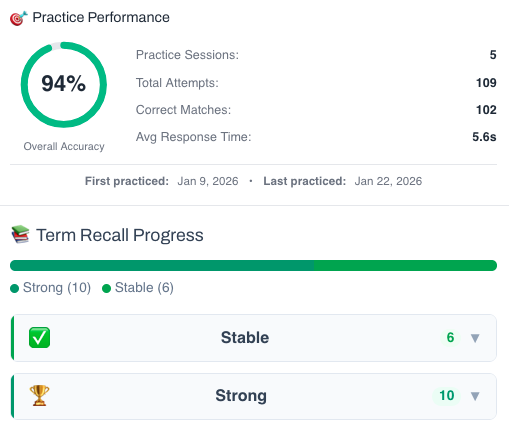
This isn’t a simple quiz — it’s a fully tracked learning system. You build knowledge through recognition, then recall, and your progress feeds directly into the Integrated Practice Bar (Writing tasks, AI Chat, and more).
- Practice sessions, accuracy, and response-time tracking
- Term strength levels (Learning → Stable → Strong)
- Personal progress history for each unit
This feature is available to YSP members.
Explore Membership BenefitsMember-Exclusive Practice Bar
Access a wide range of integrated practice for this unit — from Vocabulary and Grammar activities to AI-curated Writing tasks and Thematic Chat practice.
This feature is available to YSP members.
Explore Membership BenefitsMember-Exclusive Sentence Builder
Reconstruct scrambled sentences to practice word order and develop your grammar intuition.
This feature is available to YSP members.
Explore Membership Benefits