Asking Questions About Actions Happening Now
Core PathWay
1 Why Do We Ask Questions?
Questions help us talk to people. When you want to know what someone is doing now, you ask a question. In English, we change the word order to make a question. This is very important!
Look at these two sentences:
You are stretching. (This is a statement. You tell information.)
Are you stretching? (This is a question. You ask for information.)
The words change places! The word ‘are’ moves to the front. This is called inversion. We use inversion to make questions in English.
Today you meet two friends, Marco and Lisa. They are preparing for a training session in the park. They ask each other questions: Are you ready? Are you wearing your new trainers? These questions help them talk and plan together. Questions make conversations natural and friendly.
Key Terms
2 How to Make Questions
Now you learn the rule. When you make a Present Continuous question, the word am, is, or are moves to the front. The subject comes after.
Look at the pattern:
Statement: Subject + am/is/are + verb-ing
Question: Am/Is/Are + subject + verb-ing?
This is inversion. The words change places. You use this pattern to ask about actions happening now or around now.
Focus
- The word am, is, or are moves to the FRONT of the question
- The subject comes AFTER am/is/are in questions
- Short answers use the full form: Yes, I am (NOT Yes, I'm)
- Use this structure to ask about actions happening now
Rules
- Question form: Am/Is/Are + subject + verb-ing?
- Short answer form: Yes, subject + am/is/are OR No, subject + am not/isn't/aren't
- Examples: I → Am I…? / You → Are you…? / He/She/It → Is he/she/it…? / We/They → Are we/they…?
Examples
- Are you stretching? Yes, I am. / No, I am not.
- Is he warming up? Yes, he is. / No, he is not.
- Are they joining us? Yes, they are. / No, they are not.
Common mistake
Key Terms
3 Marco and Lisa at the Park
Marco and Lisa are running partners. Today they meet at the park for their training session. They always ask each other questions before they start running.
Marco arrives first. He sees Lisa. ‘Are you wearing your new trainers?’ he asks.
‘Yes, I am,’ Lisa says. ‘They are very good. Are you ready to start?’
‘Not yet,’ Marco says. ‘Are you stretching?‘
‘Yes, I am,’ Lisa says. ‘My knee is feeling better now. Are we doing intervals today?’
‘Yes, we are,’ Marco says. ‘Ten fast, ten slow. Is your knee feeling okay?’
‘Yes, it is,’ Lisa says. ‘I am warming up now. Are you joining me?’
‘Yes, I am,’ Marco says. He starts stretching too.
After five minutes, they are both ready. ‘Are we starting now?’ Lisa asks.
‘Yes, we are,’ Marco says. ‘Let’s go!’
They start running together. The session begins.
Key Terms
4 Your Turn: Write a Dialogue
Now you practice. Write a short dialogue between two people preparing for an activity.
5 Remember These Rules
Good work! Now you know how to ask questions about actions happening now.
Remember the inversion rule: am, is, or are comes BEFORE the subject in questions. You are running becomes Are you running? The word ‘are’ moves to the front.
Remember short answers: use the full form of am, is, or are. Say Yes, I am (NOT Yes, I’m). Say No, she is not or No, she isn’t.
Use these signal words with Present Continuous: now, at the moment, today, this week. These words tell you the action is happening now or around now.
Practice with your friends. Ask questions: Are you studying English? Is your teacher helping you? Are we learning new words? Questions make conversations fun and natural. Use them every day!
Member-Exclusive Practice Bar
Access a wide range of integrated practice for this unit — from Vocabulary and Grammar activities to AI-curated Writing tasks and Thematic Chat practice.
This feature is available to YSP members.
Explore Membership BenefitsMember-Exclusive Vocabulary Review & Acquisition System
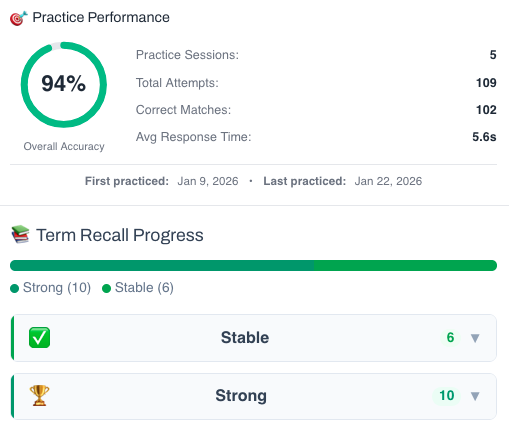
This isn’t a simple quiz — it’s a fully tracked learning system. You build knowledge through recognition, then recall, and your progress feeds directly into the Integrated Practice Bar (Writing tasks, AI Chat, and more).
- Practice sessions, accuracy, and response-time tracking
- Term strength levels (Learning → Stable → Strong)
- Personal progress history for each unit
This feature is available to YSP members.
Explore Membership Benefits🎮 Practice Games
Sentence Scrambler
Forming Present Continuous questions with be-subject inversion and providing short answers – Sentence Scramble
Member-Exclusive Sentence Builder
Reconstruct scrambled sentences to practice word order and develop your grammar intuition.
This feature is available to YSP members.
Explore Membership Benefits