Present Habits in Change: Using Present Perfect Continuous for Temporary Routines
Core PathWay
1 Your Usual Life vs. Recent Changes
Think about what you normally do. You probably have routines – things you do every day or every week. We use Present Simple to talk about these habits: ‘I usually walk to work,’ ‘She doesn’t eat meat.’ But life changes. Maybe this week is different.
When something temporarily changes your normal routine, we use Present Perfect Continuous. It shows that a habit is different now, but not forever. This grammar is very useful. It helps you explain why your life is not the same recently.
Look at these 10 examples. Each one shows a normal habit (Present Simple) and a recent change (Present Perfect Continuous).
1. I don’t usually use the air conditioner in my flat, but it’s been so hot lately that I’ve been using it every day.
2. He normally drives to work, but his car is in the shop, so he has been taking the bus this week.
3. We usually eat out on Fridays, but we have been cooking at home to save money.
4. She rarely drinks coffee, but she has been drinking two cups a day this month because of late nights.
5. They don’t normally exercise, but they have been going to the gym together since January.
6. I usually sleep eight hours, but I have been waking up at 5 a.m. for a new project.
7. He often reads before bed, but lately he has been watching TV shows instead.
8. We don’t usually spend much on clothes, but we have been shopping a lot for the wedding.
9. She normally has lunch at her desk, but this week she has been eating in the park.
10. I don’t usually work from home, but I have been working from home because of the construction.
2 Grammar Guide: Present Perfect Continuous for Temporary Changes
Now you understand the idea. Let’s look at the rules. Use Present Perfect Continuous when you want to talk about a habit or routine that has changed for a short time. It connects the past (when the change started) to the present (it is still happening). The change is not permanent – you expect to go back to your normal routine.
Focus
- Form: have/has + been + verb-ing
- We always show a contrast with our normal habit
- We use time expressions like 'lately', 'recently', 'this week/month'
- The action or situation started in the past and is still true now
Rules
- Use Present Simple to describe your usual habit: 'I usually cycle to work.'
- Use Present Perfect Continuous to describe a temporary change: 'But I have been walking this week.'
- Do not use stative verbs (like know, like, prefer) in the continuous form. Say 'I have preferred tea recently' not 'I have been preferring tea.'
- Do not use finished time expressions like 'last month' or 'yesterday' with Present Perfect Continuous.
Examples
- I normally watch the news, but I have been listening to podcasts recently.
- He often meets friends after work, but lately he has been going straight home.
- We don't usually order takeaway, but we have been ordering it three times this week.
Common mistake
3 A Change in Routine: Sam's Story
Sam is a graphic designer. He usually works in a busy studio with his team. But everything changed two weeks ago. His studio is being renovated, so he has been working from his small home office. He normally uses a large double monitor, but now he has been working on just his laptop. It has been quite difficult.
Usually, Sam has lunch with his colleagues, but recently he has been eating alone at his desk. He also usually goes for a walk after work. Lately, he has been skipping that – he just wants to finish work earlier. ‘I haven’t been sleeping well,’ he says. ‘The renovation will be finished next month, and I can go back to normal.’
Sam’s story shows how Present Perfect Continuous helps us talk about temporary changes in our daily habits.
4 Write About Your Recent Changes
Now it’s your turn. Think about a recent temporary change in your life. Write a short paragraph describing what you normally do (Present Simple) and what you have been doing differently recently (Present Perfect Continuous).
5 Key Points to Remember
Great work! Here is a quick recap of what you learned.
– Present Simple = your normal habits and routines. Example: ‘I usually walk to work.’
– Present Perfect Continuous = a temporary change from your normal habit. Example: ‘But I have been driving to work this week because it has been raining.’
– The change started in the past and is still happening now.
– Do not use stative verbs (like, prefer, believe) in the continuous form.
– Use time expressions like ‘lately’, ‘recently’, ‘this week’, ‘this month’ to connect the change to the present.
– Remember: the change is temporary, not permanent.
Keep noticing these patterns when you speak or listen to English. It will help you sound more natural when you talk about your life!
Member-Exclusive Practice Bar
Access a wide range of integrated practice for this unit — from Vocabulary and Grammar activities to AI-curated Writing tasks and Thematic Chat practice.
This feature is available to YSP members.
Explore Membership BenefitsMember-Exclusive Vocabulary Review & Acquisition System
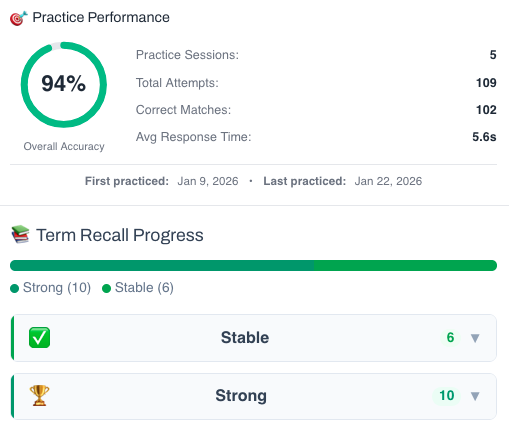
This isn’t a simple quiz — it’s a fully tracked learning system. You build knowledge through recognition, then recall, and your progress feeds directly into the Integrated Practice Bar (Writing tasks, AI Chat, and more).
- Practice sessions, accuracy, and response-time tracking
- Term strength levels (Learning → Stable → Strong)
- Personal progress history for each unit
This feature is available to YSP members.
Explore Membership Benefits🎮 Practice Games
Sentence Scrambler
Present Habits – With a foot in the past: Present Perfect Continuous – Sentence Scramble
Member-Exclusive Sentence Builder
Reconstruct scrambled sentences to practice word order and develop your grammar intuition.
This feature is available to YSP members.
Explore Membership Benefits