Present Simple in Formal and Academic Registers
Core PathWay
1 The Professional Power of Present Simple
When you write ‘I am working on the report’ in an email to a colleague, you sound perfectly natural. But when the same report states ‘The analysis reveals declining market share,’ you’ve shifted into a different linguistic register entirely. This isn’t about being more complex — it’s about being more precise.
In formal business and academic writing, Present Simple carries authority that continuous forms cannot match. ‘The data indicates a positive correlation‘ sounds definitive; ‘The data is indicating…’ sounds tentative, almost apologetic. Professional writers understand this instinctively: Present Simple demonstrates facts, constitutes definitions, and represents permanent truths. It’s the tense of certainty.
This register choice signifies more than grammatical preference — it signals your membership in a professional discourse community. When your quarterly report states ‘Revenue comprises three distinct streams’ rather than ‘Revenue is comprising…’, you’re not just avoiding an error. You’re demonstrating that you understand how serious business communication works. The framework remains identical to everyday Present Simple, but the function shifts entirely: from describing habits to establishing credible, objective statements that can withstand scrutiny in boardrooms and academic journals.
Key Terms
2 Grammar Overview: Present Simple in Formal Contexts
The form of Present Simple never changes whether you’re describing your morning coffee routine or presenting quarterly findings to the board. Subject + base verb (+ s/es for third person) remains constant. What transforms is the function: in formal registers, Present Simple becomes the primary tense for establishing facts, defining terms, and describing systems.
This shift matters because formal writing values precision and permanence over immediacy. Academic papers don’t speculate about what research ‘is showing’ — they state what it ‘shows.’ Business reports don’t describe what markets ‘are requiring’ — they define what they ‘require.’ The continuous form, so natural in conversation, sounds inappropriately tentative in professional documents.
Focus
- Definitions in academic writing: ‘Corporate governance encompasses the mechanisms through which companies operate.’
- Statements of fact in business reports: ‘The Asian market represents 34% of total revenue.’
- Describing processes and systems: ‘Our methodology comprises three distinct phases.’
Rules
- Use Present Simple for permanent truths and established facts, even when describing current research: ‘The study reveals’ not ‘is revealing’
- Use Present Simple for formal definitions and classifications: ‘This criterion constitutes’ not ‘is constituting’
- Use Present Simple when describing what data, graphs, or reports show: ‘Figure 3 demonstrates’ not ‘is demonstrating’
Examples
- The research suggests a causal relationship between investment and growth. (academic statement)
- This variable correlates strongly with consumer confidence. (data description)
- The trend encompasses both developed and emerging markets. (formal classification)
Common mistake
3 Business Report in Action
Q3 2024 Performance Analysis: Executive Summary
This report demonstrates sustained growth across all operational divisions during the third quarter of 2024. Revenue increases by 12.3% year-on-year, while the European market represents the strongest performer with 18% growth. The analysis reveals three primary drivers: enhanced digital infrastructure, strategic partnerships in emerging markets, and improved supply chain efficiency.
Our customer base now comprises 2.4 million active users, a figure that signifies successful retention strategies implemented in Q2. The data indicates particularly strong performance in the 25-34 demographic, which constitutes 41% of new acquisitions. This trend correlates directly with our increased social media presence and influencer partnerships.
The operational framework encompasses both legacy systems and newly integrated AI-driven analytics platforms. Early findings suggest that automation reduces processing time by 34%, though this variable requires further monitoring across different market segments. The preliminary hypothesis — that technological investment would yield immediate efficiency gains — proves accurate in seven of nine tested scenarios.
Looking forward, the methodology we have established for Q4 provides a robust foundation for scaling operations. Market conditions remain favourable, and our competitive position strengthens month-on-month. The key criterion for success continues to be customer satisfaction, which currently stands at 87%, exceeding industry benchmarks by 12 percentage points.
Key Terms
4 Essential Formal Reporting Verbs
Three verbs dominate formal business and academic writing: indicates, demonstrates, and reveals. Master these, and you’ll sound immediately more authoritative. Each carries subtle distinctions that matter in professional contexts.
These aren’t just fancy alternatives to ‘shows’ — they signal different relationships between evidence and conclusion. Understanding when to deploy each one separates competent professional writing from genuinely sophisticated communication.
indicates
- The quarterly figures indicate sustained growth in the Asian markets, though further analysis remains necessary.
- Recent consumer behaviour indicates a preference for sustainable products, particularly among younger demographics.
demonstrates
- The pilot programme demonstrates the viability of remote working arrangements across all operational divisions.
- This case study demonstrates how strategic partnerships can accelerate market penetration in competitive environments.
reveals
- The audit reveals systemic inefficiencies in procurement processes that have persisted for three fiscal years.
- Cross-market analysis reveals that pricing strategies effective in Europe fail to generate comparable results in North American markets.
Key Terms
5 Practice: Writing Formal Data Descriptions
Apply what you’ve learned by writing formal sentences that describe research findings or business data. Focus on using Present Simple with register-appropriate vocabulary.
6 Recap: Present Simple as Professional Voice
You’ve seen how Present Simple operates differently in formal registers. The grammatical form stays identical — subject + base verb — but the communicative function transforms entirely. Where informal English uses Present Simple for habits and routines (‘I check my email every morning’), formal writing deploys it for authority and permanence (‘The research demonstrates a causal link’).
The key insight: register isn’t about complexity; it’s about precision and objectivity. When you write ‘The analysis reveals’ instead of ‘The analysis is revealing,’ you’re not showing off — you’re following the conventions that make professional communication credible. The continuous form sounds tentative because it emphasises the temporary nature of an action. Formal writing needs the opposite: statements that stand as established facts.
Master the formal reporting verbs — demonstrates, indicates, reveals, suggests — and you control the subtle gradations between proof, inference, and discovery. These aren’t interchangeable synonyms for ‘shows’; each signals a different relationship between your evidence and your claims. This precision matters in contexts where your credibility depends on how you present information, not just what information you present.
Member-Exclusive Practice Bar
Access a wide range of integrated practice for this unit — from Vocabulary and Grammar activities to AI-curated Writing tasks and Thematic Chat practice.
This feature is available to YSP members.
Explore Membership BenefitsMember-Exclusive Vocabulary Review & Acquisition System
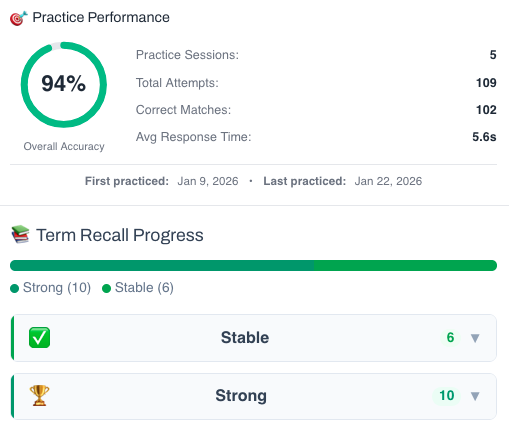
This isn’t a simple quiz — it’s a fully tracked learning system. You build knowledge through recognition, then recall, and your progress feeds directly into the Integrated Practice Bar (Writing tasks, AI Chat, and more).
- Practice sessions, accuracy, and response-time tracking
- Term strength levels (Learning → Stable → Strong)
- Personal progress history for each unit
This feature is available to YSP members.
Explore Membership Benefits🎮 Practice Games
Sentence Scrambler
Present Simple in Formal and Academic Registers – Sentence Scramble
Member-Exclusive Sentence Builder
Reconstruct scrambled sentences to practice word order and develop your grammar intuition.
This feature is available to YSP members.
Explore Membership Benefits